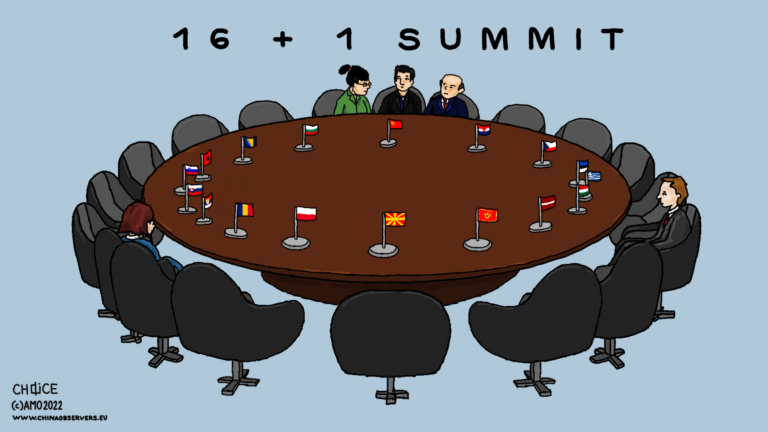
The EU has officially synchronized its language on China with NATO’s harder-edged position. In a significant shift, the EU Council has for the first time defined Beijing as both a “key enabler” of Russia’s aggression against Ukraine and “a critical long-term strategic challenge,” overshadowing its long-standing framing of China as a partner, competitor, and systemic rival.
This marks a convergence between the EU and NATO vocabulary, creating a new shared strategic discourse on China. The two Brussels-based organizations have historically framed China’s actions differently, based on their distinct mandates and internal balances. Yet, a consistent pattern emerges where, over the past decade, the EU has repeatedly echoed NATO’s language on China.
NATO’s Discourse Evolution on China
Until the mid-2010s, China figured in the NATO allies’ agendas primarily in the economic domain and was being handled either bilaterally or by the EU. Notably, there is no mention of China or the Indo-Pacific in the NATO Strategic Concepts of 1991, 1999, and 2010.
The wake-up call was North Korea’s missile and nuclear tests in 2016-2017. Pyongyang’s military progress raised concerns even among European NATO allies, and many believed that a dialogue with China could help stabilize the situation. China’s geopolitical weight could no longer be neglected at the North Atlantic Council table. Indeed, the first time China was mentioned in a NATO document, agreed by the Heads of State and Government, was in the London Summit Declaration in 2019. Amid the intensifying US-China trade war, NATO recognized, in a paragraph concerning national security risks posed by new technologies, that “China’s growing influence and international policies present both opportunities and challenges.”
The following period hardened NATO’s rhetoric. Ahead of the 2021 NATO Summit, Secretary General Jens Stoltenberg associated China with Russia as co-leading an “authoritarian pushback against the rules-based international order.” While stating that Beijing did not “share our values,” he still left room for dialogue and cooperation, noting that NATO did not “see China as an adversary.” This was also the first time NATO explicitly linked transatlantic security and the respect for freedom of navigation in the South China Sea. The 2021 Brussels Summit Communiqué neglected the “opportunities” and focused only on the “systemic challenges” China presented to “Alliance security.” Two elements stood out: the focus on values – “we are concerned by those coercive policies which stand in contrast to the fundamental values enshrined in the Washington Treaty” – and the first reference to Sino-Russian military cooperation.
The framing of China in the NATO 2022 Strategic Concept partly built on the 2021 Communiqué. The major shift concerned the terminology used to outline Beijing’s goals – to “project power” and “control key technological and industrial sectors.” The document also stated that China’s “malicious” operations harmed Alliance security and that its “deepening strategic partnership” with Moscow contrasted with NATO’s values and interests, as did their “mutually reinforcing” attempts to “undercut” the rules-based international order. The interpretation that emerged was that China was no longer simply a challenge but an active partner of NATO’s direct threat.
The NATO Washington Summit Declaration in 2024 marked a further evolution. It clearly labeled Beijing as a “decisive enabler of Russia’s war against Ukraine” through its “support for Russia’s defense industrial base,” which increases “the threat Russia poses to its neighbors and to Euro-Atlantic security.”
One further semantic marker is notable: since 2022, NATO has referred to China consistently as “the People’s Republic of China,” while the EU only uses “China.” Given that both organizations’ members formally adhere to the One-China Policy, this is a striking difference. It reflects not just a naming precision, more common in US policy environments than in Europe, but also an implicit reference that underlines the knowledge of dynamics in the Taiwan Strait.
The EU’s Parallel But Delayed Track
Since 1975, EU-China relations have been shaped by alternating phases of optimism, adjustment, and competition, with a persistent divide between economic and political tracks. The 2003 EU-China Comprehensive Strategic Partnership deepened and broadened cooperation in a wide range of areas. That same year, the EU’s first Security Strategy described China as a partner for building “a more effective multilateral order.”
The spirit of cooperation lasted in the following years. The 2013 EU-China 2020 Strategic Agenda for Cooperation promoted economic gains and cooperation and was followed by the 2016 Joint Communication on elements for a new EU strategy on China, which set out a five-year framework advancing European economic interests and universal values alongside “constructive management of differences.” The 2016 EU Global Strategy mentioned China very briefly and only regarding deepening the economic partnership and dialogue, and “seeking a level playing field.”
In the meantime, the distortive effects of the EU-China trade deficit, China’s state-backed overcapacity, its involvement in critical national assets, and assertive approach abroad began to surface more clearly. The EU-China Strategic Outlook of 2019 marked a turning point in tone and framing. It described China “simultaneously, in different policy areas” as a “cooperation and negotiating partner,” “economic competitor in the pursuit of technological leadership, and a systemic rival, promoting alternative models of governance.” The EU’s 2022 Strategic Compass repeated the triad, adding “growing concerns as regards reciprocity, economic competition, and resilience.” The Compass also highlighted the development of China’s military capabilities, in particular of its nuclear arsenal.
Progressively, the EU’s engagement model became harder to reconcile and sustain. Signs that a slow evolution was underway emerged when President von der Leyen talked about an “inflection point” and the need to rebalance the relationship during her meeting with Xi Jinping in 2025. Then, in early 2026, the European Parliament’s resolution on the Implementation of the Common Foreign and Security Policy referenced NATO’s 2024 language and expressed concern for China’s “accelerating militarization” and “aggressive behavior,” as well as for “its military and political partnerships with Russia, North Korea, and Iran.” More importantly, it acknowledged that the partner-competitor-rival approach “remains a useful analytical framework” but “is insufficient as a long-term strategic orientation,” calling on the Commission and the Council to redesign “a policy that is consistent, credible, and effective.”
The Drivers Behind the Convergence
The varying degrees of concern over China’s growing power among European countries prevented a strategic consensus toward Beijing and led to disjointed policies. Only from the late 2010s, mounting evidence regarding malicious Chinese hybrid activities, coupled with its ambitious military modernization program and growing influence in Europe’s neighborhood, pushed many NATO allies to highlight China in their national security policies. The growing security implications of China’s rise made it easier to reach consensus on hardening NATO’s language at an earlier stage.
By contrast, the EU’s shift was driven more by the economic challenges posed by Beijing. Only recently did the threat from China’s persistent use of economic leverage from trade imbalances and unfair competition, and its aspirations of technological superiority become so significant and explicit that once-opposing governments and interest groups pushed the EU to abandon its caution and harden its discourse. The growing relevance of the linkage between economics and defense and the persistence of Beijing’s support for Moscow consolidated the perception that China is not only aligning with Europe’s direct threat, but also indirectly undermining European well-being and governance.
This difference in timing produced an asymmetry between EU and NATO’s discourse with the EU consistently trailing NATO’s definitions on China. In 2021, NATO first highlighted China’s military build-up and its challenge to the rules-based order. The EU followed in 2022. In the same year, NATO hardened its language, culminating in the 2024 “enabler” label – a marker the EU only reached in 2026. The EU is finally adapting its rhetoric to a new security reality where Indo-Pacific and Euro-Atlantic security are visibly intertwined. Now, it is time for the strategic decisions that follow.
Written by

Michael Malinconi
MikemalinconiMichael Malinconi is Research Assistant Intern at Carnegie China. Previously, he worked at the Elcano Royal Institute and studied International Affairs at Johns Hopkins University School of Advanced International Studies (SAIS). His research interests include Taiwan's foreign policy and domestic politics, as well as US-China and EU-China relations.