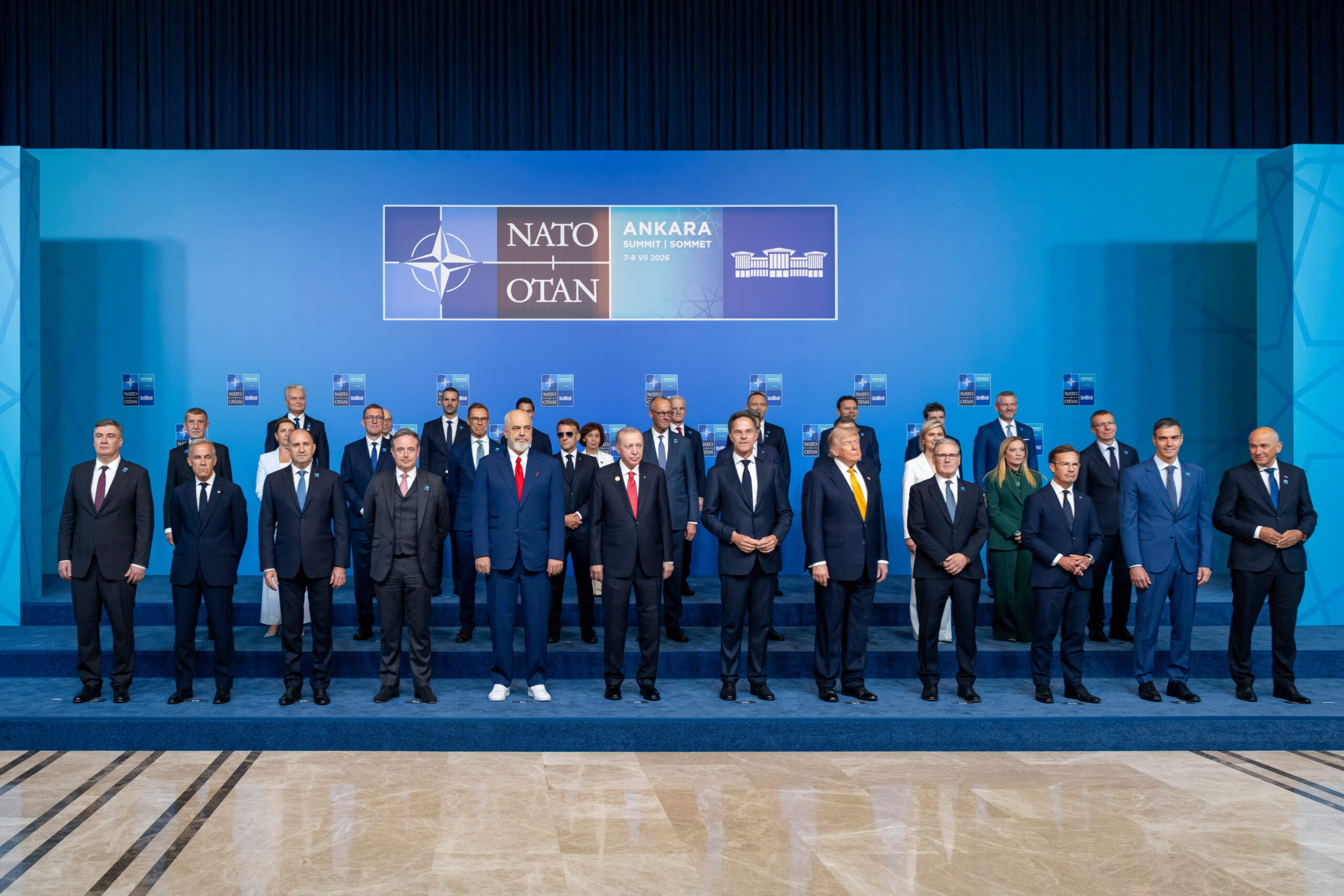
NATO leaders gathered in Ankara last week amid the biggest military buildup Europe has seen in decades. Russia was the threat everyone in the room could name. Yet China also loomed over the talks, even if it was not discussed openly.
For years, European governments treated Beijing mainly as a trading partner and an economic rival, but that view is shifting fast – behind closed doors, the EU is preparing to brand both Russia and China as its main threats, presenting Beijing as a key enabler of Moscow’s war in Ukraine. The summit in Ankara therefore unfolded at an unusual moment, as Europe is not only rearming against Russia – a threat it has recognized for several years – but also beginning to explicitly place China in the same category.
A Summit in an Age of Rearmament
NATO’s heads of state and government arrived in Ankara to display progress in reaching the target of spending five percent of GDP on defense and security by 2035, agreed upon at last year’s summit in The Hague. NATO’s Secretary General Mark Rutte used the occasion to call for a “transatlantic defense industrial revolution,” announcing tens of billions of dollars in new contracts, a Drone Edge program channeling more than $40 billion into counter-drone capabilities, and a multinational initiative to secure defense-related critical raw materials. The alliance also pledged roughly $80 billion in military assistance to Ukraine.
Beyond the sheer numbers and headlines, the summit mattered because it turned spending pledges into concrete procurement decisions, industrial initiatives, and capability development. It had the potential to be one of the most consequential NATO summits in a generation, and many in Europe would agree it was: a continent that spent years debating whether to rearm is now doing so in earnest, with the states along the eastern flank, especially in CEE, standing to gain the most. What made the Ankara summit distinctive, however, was the wider strategic backdrop against which it unfolded.
Brussels Prepares to Name Its Adversaries
That backdrop is a shift in how the EU defines danger. According to Contexte, the bloc is preparing to explicitly designate Russia and China as its main threats – a phrase present in the provisional “assessment of the EU’s strategic environment” approved on July 8 by the EU member states’ ambassadors and expected to be adopted by foreign ministers on July 14.
In the draft, Russia reportedly appears as “the most immediate and direct threat to European security,” while China is presented as “a key facilitator of Moscow’s aggression against Ukraine.” The draft also describes China as a “major long-term strategic challenge,” driven by an ambition to become the world’s leading power and willing to exploit geopolitical instability and asymmetric advantages – from critical raw materials to advanced technology – to expand its influence in Europe.
This framing is telling. For years the EU treated Beijing primarily through an economic lens, as a partner, competitor, and “systemic rival” at once. Naming China a security threat – and doing so largely through the prism of Russia – marks a clear hardening of tone. Explicitly recasting Beijing as a facilitator of the war on the EU’s doorstep transforms what was treated as an economic issue into a security one. NATO itself had already labeled China a “decisive enabler” of Russia’s war, and the EU’s assessment may push that logic further into the machinery of European policy.
The Axis Comes into View
This designation lands just as the real depth of Russian-Chinese military cooperation comes to light. A joint investigation by Der Spiegel, The Insider, and Le Monde has exposed a secretive Russian-Chinese Forum for Military Technology, whose gatherings in Yekaterinburg, Guangzhou, and St. Petersburg were reportedly united by a shared purpose: breaking American military superiority.
The leaked documents describe a division-of-labor partnership in which each side compensates for the other’s weaknesses. Russia contributes experience from its ongoing war of attrition, while China supplies the electronics, semiconductors, and machinery. What Moscow learns in Ukraine, Beijing could apply to Taiwan; what China develops, Russia can test at the front. The two are reported to be jointly building a next-generation air and missile defense system capable of intercepting hypersonic missiles, aiming for operational readiness around 2030, and Chinese specialists have proposed an “anti-Starlink alliance” to contain the satellite network that has proven indispensable to Ukraine. Der Spiegel’s joint investigation also mentions that European intelligence services indicate that Russian operators have trained on Chinese drones, and that officers of the People’s Liberation Army have visited the Ukrainian front as observers.
The investigation therefore reinforces the view that China’s “neutrality” vis-à-vis Ukraine is fictional, and it lends additional evidentiary support to the EU’s characterization of China as Russia’s key facilitator. However, what is perhaps even more important is that it indicates that the two theaters once seen as separate – Ukraine and Taiwan, or Europe and Asia – may be gradually blurring into one.
“Made in NATO” Meets “Buy European”
But even as Europe grows more assertive, the Ankara summit exposed a rift over who should profit from the rearmament boom. Rutte hailed more than $54 billion in new deals as proof of a “Made in NATO” future, including joint weapon production agreements between American and European firms, intended to appeal to President Trump and keep Washington invested in European security. However, this vision may collide in practice with the EU’s “Buy European” approach. The Union’s €150 billion Security Action for Europe (SAFE) scheme caps non-EU content at 35 percent of the estimated cost of the end-product’s components, and its €90 billion loan to Ukraine restricts purchases of non-EU equipment. Faced with those limits, US firms are lobbying against the provisions and shifting some production to the continent under license.
There may be no direct line between this procurement clash and the EU’s China policy, but the two may be quietly connected. “Buy European” is not only about weapons and NATO. It is also part of the EU’s answer to China, meant to shield the bloc’s industry from Chinese overcapacity and to lessen Europe’s reliance on outside powers. Therefore, the worry is that a strong “Made in NATO” push could pull in the opposite direction, steering Europe’s spending toward American firms. And should it weaken “Buy European” in the process, it could also undermine the broader logic of industrial sovereignty that drives Europe’s push to de-risk from China – an outcome many in the EU would find counterproductive.
A Continent Re-learning to Deter
If NATO’s summit in The Hague marked the turning point last year, this year’s gathering in Ankara was where the alliance – and especially Europe – doubled down and grew more openly assertive. This approach at NATO level, paired with remilitarization efforts and the EU’s growing willingness to name its adversaries, is converging into something Europe has not seen in decades: a strategic posture built explicitly around the prospect of confrontation.
The harder task now is coherence. The EU is attempting, all at once, to deter Russia, de-risk from China, and keep an unpredictable Washington within the fold – goals that do not always point in the same direction. And not every EU capital weighs these tensions equally. For example, in many member states, especially in CEE, the friction between “Buy European” and “Made in NATO” may matter far less, as long as they can defend themselves and see their adversaries deterred and clearly identified.
In the end, the silver lining is that Europe seems divided over method, not purpose. However European capitals choose to rearm – through Brussels, NATO, or alongside Washington – they now operate largely from the same premise: that security comes first, and that Russia is the main threat, increasingly enabled by China. These shared convictions, more than any single deal struck in Ankara, are what holds Europe together as it steps into a more politically realist decade.
Written by

Konrad Szatters
Konrad Szatters is a China Analyst at AMO, focusing on China’s political discourse and foreign policy. He also serves as a Lead Researcher for the Ukrainian Heritage Diplomacy in China at the University of Canterbury in New Zealand. Previously, he gained experience at the College of Europe in Natolin, the Polish Diplomatic Academy, and the Embassy of Poland in Beijing.