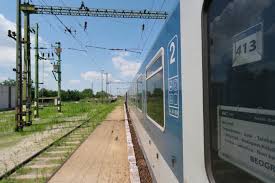
When freight operations began on the reconstructed Hungarian section of the Budapest–Belgrade railway in February 2026, the occasion was remarkably low-key. There was no grand inauguration, no senior government officials celebrating Hungarian–Chinese cooperation, and little of the political fanfare that had accompanied the project for more than a decade. Instead, the start of operations was announced by the head of Hungarian State Railways (MÁV) on social media.
Once celebrated as a flagship of China’s Belt and Road Initiative (BRI) in Europe, the railway had become an increasingly controversial investment ahead of Hungary’s April 2026 parliamentary elections. The subsequent change of government added a new dimension to the story: the incoming administration promised to investigate the project and disclose previously classified documents, but doing so has proved more complicated than anticipated. The railway thus raises broader questions about the economic rationale, political legacy, and long-term accountability of Chinese-financed infrastructure in Europe.
From Flagship Project to Political Liability?
For years, Viktor Orbán’s government presented the Budapest–Belgrade railway as a symbol of Hungary’s Eastern Opening policy and a major step toward transforming the country into a regional logistics hub. The project was intended not only to improve transport connections but also to demonstrate the benefits of Hungary’s close political and economic relationship with China.
Yet, by the time freight operations finally began on February 27, 2026, the political context had changed considerably. The investment had become extraordinarily expensive, its economic benefits remained uncertain, and years of delays had been compounded by technical problems, particularly with the train control system. The delays also affected the project’s financial closure: according to the Hungarian member of the construction consortium, the prolonged handover and acceptance process pushed the final settlement of the construction project from 2025 into 2026. Although freight services had started, passenger operations could not be launched before the parliamentary elections.
Against this background, the unusually subdued launch was politically significant. Although the government’s reasons were never explicitly stated, the approaching elections and growing controversy surrounding the project offer a plausible explanation. What had once served as a prominent symbol of the government’s international ambitions had become a potentially uncomfortable reminder of the costs and uncertainties associated with those ambitions.
A Decade of Connectivity Promises
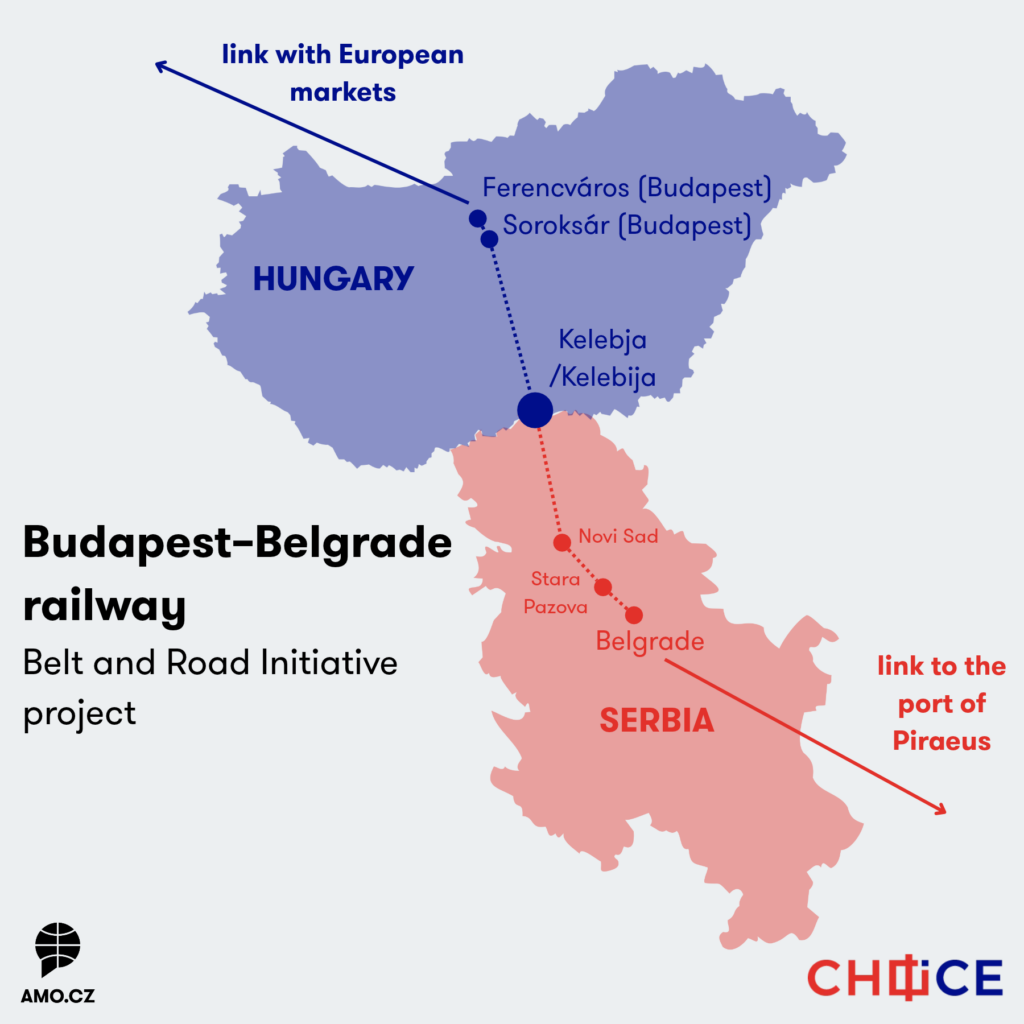
First proposed in 2013 within the China–CEE cooperation framework, the Budapest–Belgrade railway quickly became one of the most prominent European projects associated with the BRI. The approximately 350-kilometer railway was intended to modernize the connection between the Hungarian and Serbian capitals, reduce passenger travel times from around eight to four hours, and facilitate freight transport between Southeast and Central Europe.
Its broader strategic significance was linked to the Chinese-controlled port of Piraeus in Greece. The railway was envisaged as part of a transport corridor connecting the Mediterranean with European markets through North Macedonia, Serbia, and Hungary. For China, the project offered opportunities to diversify logistics routes, internationalize its construction companies, and demonstrate the competitiveness of Chinese railway technology in Europe.
The motivations of the participating countries were, however, different. Serbia had clear infrastructure development needs and fewer financing alternatives than an EU member state. Hungary, by contrast, already possessed an extensive railway network, and its most urgent modernization needs lay elsewhere. The Hungarian section, from Budapest to Kelebia on the Serbian border, was not necessarily the most obvious priority from the perspective of domestic passenger demand, as it does not directly serve major southern Hungarian economic centers such as Szeged and Pécs. For Hungary, the project’s appeal therefore rested less on immediate domestic transport needs than on the prospect of becoming a regional freight and logistics hub, alongside the political benefits of closer cooperation with China.
More than a decade after its announcement, however, the central question is no longer whether the railway can be completed, but whether the economic benefits originally promised can justify the substantial costs incurred along the way.
The Economics of Connectivity: Who Benefits?
Under the original financing arrangements, up to 85 percent of the construction contract was to be covered by a loan from China’s Export-Import Bank, with the remainder financed by Hungary. According to AidData, the loan agreement signed in April 2020 amounted to approximately $1.875 billion, reportedly carrying a 20-year maturity, a five-year grace period, and a fixed interest rate of 2.5 percent.
The construction contract was awarded to a Chinese–Hungarian consortium bringing together Chinese state-owned railway companies and RM International, associated with the interests of Lőrinc Mészáros, a businessman closely linked to former Prime Minister Orbán.
While China benefited from a major construction contract and an opportunity to showcase its railway technology within the EU, the economic rationale for Hungary is less straightforward. In theory, improved railway infrastructure could strengthen the country’s position as a regional logistics hub, increase freight capacity, and facilitate connections to international markets. Yet these potential benefits depend on actual transport demand, the development of complementary logistics infrastructure, and, crucially, the extent to which increased transit traffic generates economic value within Hungary rather than merely passing through its territory.
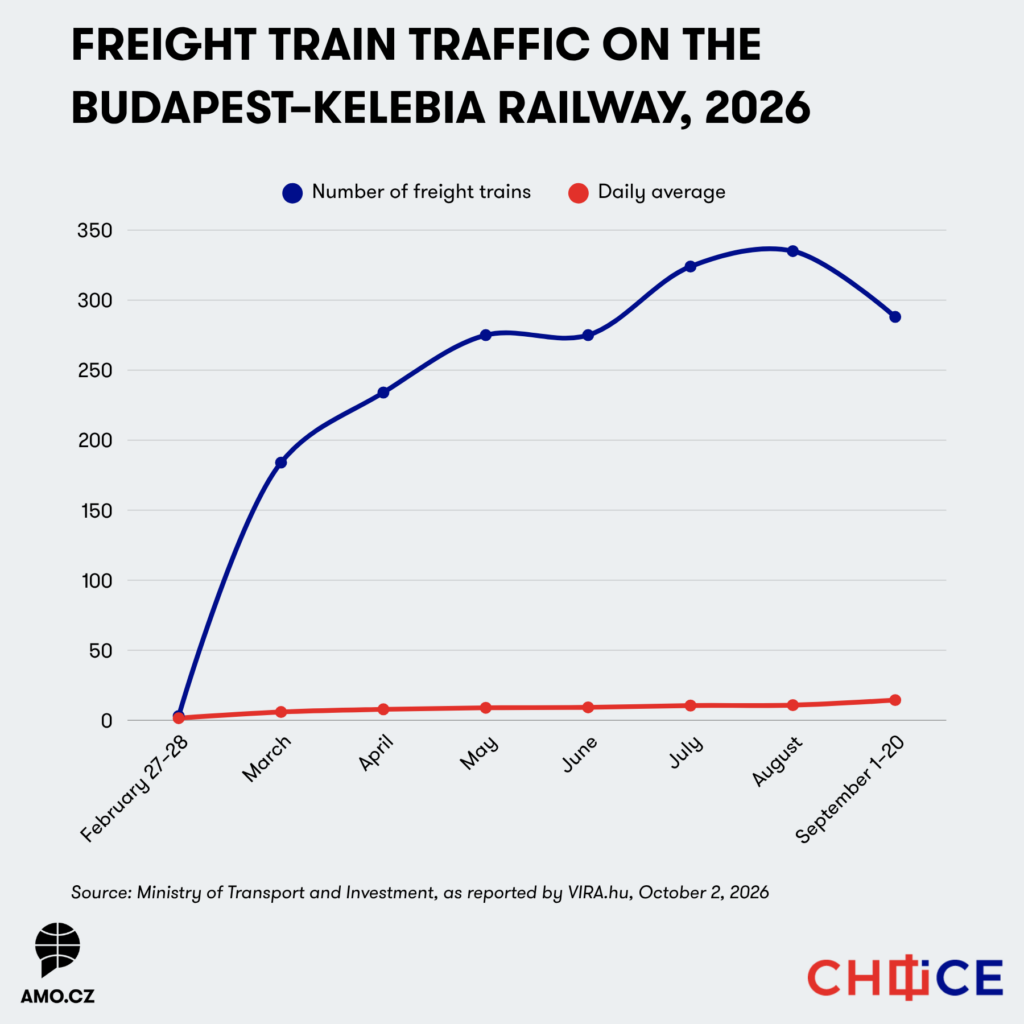
Freight traffic has gradually increased since operations began. While an average of approximately 6.3 freight trains per day used the reconstructed Hungarian section during its initial weeks, figures released by the Ministry of Transport and Investment show that traffic rose: during the first 20 days of September, the line carried an average of 14.4 freight trains per day. Although this indicates growing use of the railway, it remains too early to assess whether the additional traffic will generate economic benefits commensurate with the investment’s substantial costs.
Assessing the railway’s economic value requires looking beyond its direct financial returns. Even if revenues fail to cover the investment costs, improved connectivity may generate wider economic benefits. The question, however, is whether these benefits are substantial enough to justify the expenditure, particularly when compared with alternative infrastructure investments. This is especially relevant in Hungary, where much of the existing railway network is in urgent need of modernization. Investing such substantial resources in a single international corridor inevitably raises questions about priorities and opportunity costs.
A Change of Government, but Not Necessarily Greater Transparency
The April 2026 parliamentary elections introduced an entirely new political dimension to the project. The incoming Tisza government had made transparency and accountability central elements of its electoral program, including a pledge to disclose previously classified government decisions and agreements. Given the longstanding controversy surrounding its financing, procurement, and secrecy, the Budapest–Belgrade railway was an obvious candidate for scrutiny.
On June 5, 2026, the new government formally ordered a comprehensive review of the investment, covering the procurement process, financing arrangements, and key decisions made during its implementation. Transport and Investment Minister Dávid Vitézy also raised questions about the project’s escalating costs, including contractual arrangements under which Hungarian contractors were paid in US dollars. Alongside the review, the government initiated steps to make previously classified project documents publicly accessible, with the aim of enabling greater scrutiny of the decisions and financial commitments behind the investment.
On June 27, Vitézy announced that he had formally initiated the declassification process, following consultations with Gong Tao, China’s ambassador to Hungary. However, the process proved less straightforward than a domestic government decision might suggest. According to the minister, releasing certain documents required the consent of the Chinese side, as the project was governed by bilateral agreements between Hungary and China. This meant that, despite the change of government and its stated commitment to transparency, making the project’s financial and contractual arrangements public was not entirely within the Hungarian government’s control.
The roots of this problem go back to 2020, when the Orbán government introduced legislation restricting public access to key project documents for ten years. Originally justified by the need to protect Hungary’s foreign policy and economic interests, the secrecy surrounding the investment has now become an obstacle to the new government’s efforts to scrutinize its predecessor’s decisions. The case illustrates how confidentiality arrangements established under one administration can continue to shape the options available to its successor, even after a fundamental change in political priorities.
By mid-November 2026 there was still no publicly available comprehensive assessment of the project’s financial and economic implications, nor had the key contractual and financing documents been made accessible for independent scrutiny. While the government had initiated the declassification process, there was little public information about its progress or the Chinese side’s response. As a result, fundamental questions concerning the investment’s costs, contractual obligations, and expected economic returns remained unanswered.
The Railway’s Uncertain Legacy
The Budapest–Belgrade railway is not simply a story of Chinese infrastructure investment, nor can its success or failure be judged from its initial freight traffic figures. Following technical tests in October, domestic passenger services were initially expected to begin in November, with international connections between Budapest, Belgrade, and Vienna planned for December 2026. However, on November 13, Dávid Vitézy announced that further testing had revealed additional problems, primarily software-related, in the Chinese-built train control system. These require corrective work and renewed safety testing, delaying the launch of passenger services once again. With the planned December opening now postponed and no new date confirmed, the railway’s economic performance will take longer to assess against the promises made over the past decade.
The situation also presents a dilemma for China. Beijing has signaled its willingness to maintain pragmatic and constructive relations with Hungary’s new government, but the question of transparency may put this commitment to the test. Cooperating with the release of previously confidential agreements could help build trust with the new administration, while potentially exposing politically sensitive details of a flagship Chinese-financed project. Whether Beijing sees greater value in protecting the confidentiality of past arrangements or demonstrating openness toward its new Hungarian partner remains to be seen.
Whether the Budapest–Belgrade railway will ever generate economic benefits commensurate with its substantial costs remains highly uncertain. But its legacy will depend not only on how many trains use the line, but also on whether the public can finally assess what was agreed, at what cost, and with what benefits.
Written by

Ágnes Szunomár
Ágnes Szunomár is an Associate Professor at the Institute of Global Studies, Corvinus University of Budapest, and a Senior Research Fellow at the Institute of World Economics, HUN-REN Centre for Economic and Regional Studies, Hungary. She is also a CHOICE Fellow for Visegrád countries.