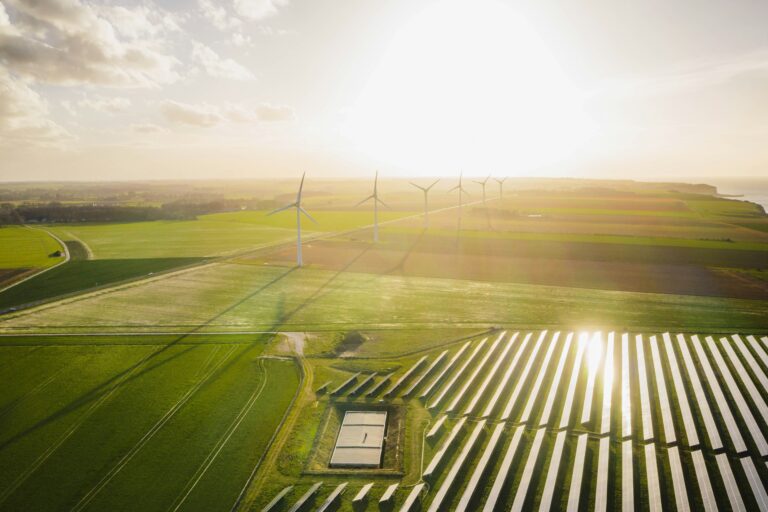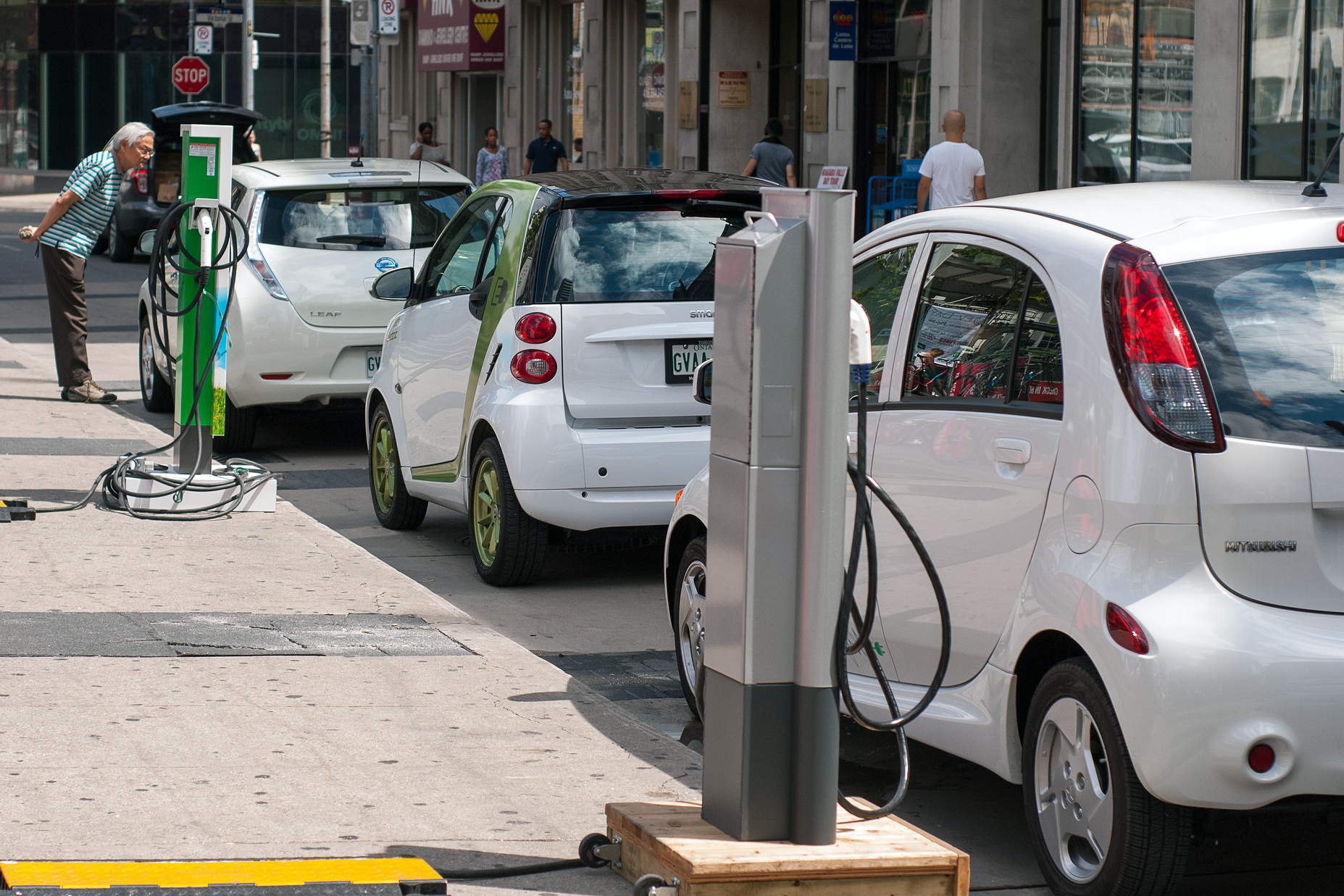
Europe’s electric vehicle (EV) transition increasingly runs through China. This is the paradox at the heart of the current debate on green industrial policy: the EU wants to decarbonize road transport, strengthen industrial sovereignty, and reduce strategic dependencies – yet the technologies, companies, and capital required for the rapid expansion of electric mobility are often Chinese. This tension is particularly visible in CEE, where Chinese EV and battery investments are not marginal additions to existing industry, but part of a broader restructuring of the region’s automotive model.
Europe’s Green Transition Runs Through China
The EU’s regulatory direction remains clear: Regulation (EU) 2023/851 introduced a 100 percent CO₂ emission reduction target for new cars and vans from 2035, effectively pushing the market toward zero-emission vehicles. At the same time, the EU has imposed countervailing duties on Chinese EVs, arguing that their value chain benefits from unfair subsidies. However, the result is not derisking as Chinese firms are increasingly localizing production inside Europe. For CEE, this creates a new phase of integration: not a rupture with China, but a form of industrial re-risking under green, technological, and geopolitical pressure.
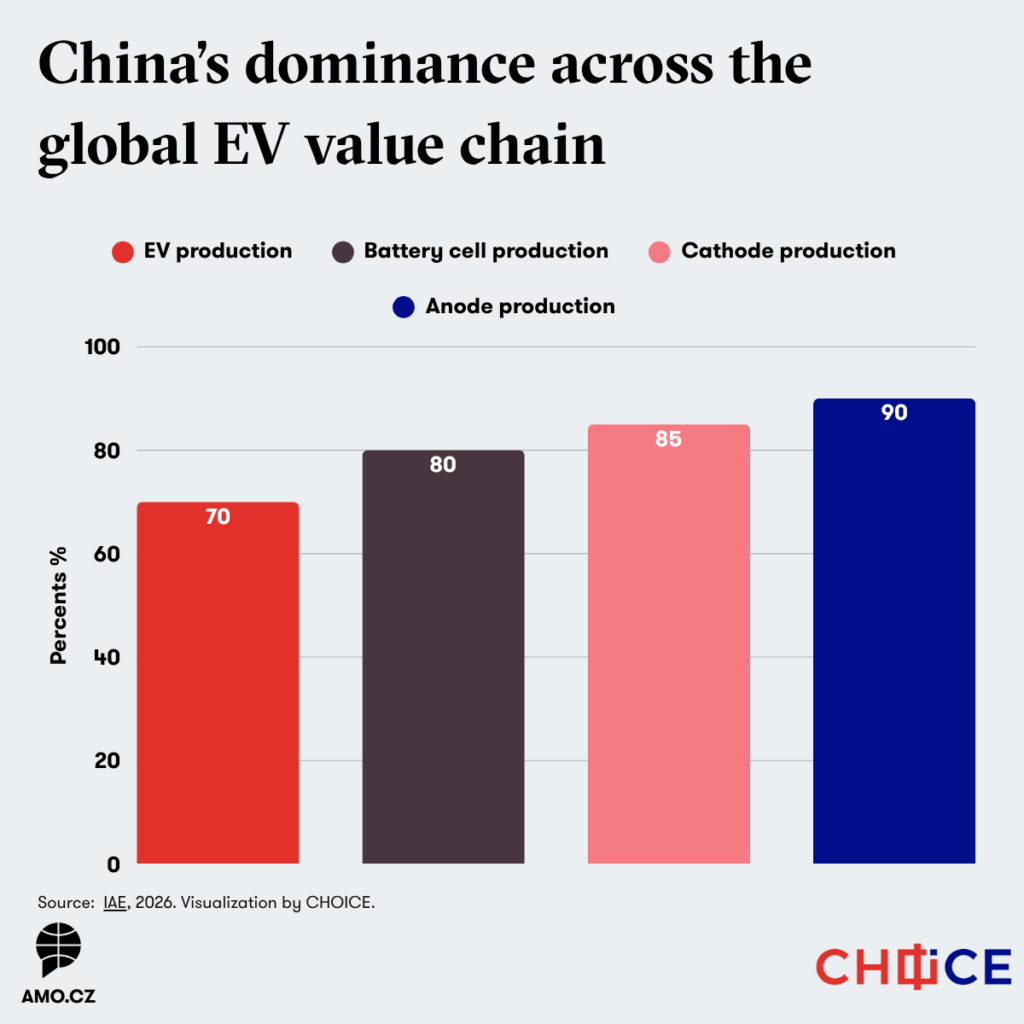
This shift reflects a broader transformation in the geography of the global automotive industry and, increasingly, of global energy markets as well. While China accounted for less than 5 percent of global EV sales a decade ago, it has since become the world’s largest EV market and the dominant player in battery manufacturing, refining capacity, and several critical segments of the EV supply chain. The rise of electromobility is already reshaping China’s energy demand: transport fuel consumption has begun to slow down and Chinese road transport oil demand has peaked around 2023. With EVs accounting for nearly half of new car sales in China, energy consumption is gradually shifting from oil toward electricity. Chinese firms such as CATL, BYD, EVE Energy, and Gotion are therefore no longer simply suppliers to European manufacturers but increasingly are shaping technological standards, production capacities, and competitive dynamics worldwide. For European policymakers, this creates a difficult balancing challenge: reducing strategic vulnerabilities without undermining the speed and affordability of the green transition itself.
China Conquers Europe Through the CEE
CEE has long been an automotive manufacturing platform. Since the 1990s, the region has attracted foreign direct investment (FDI) through relatively low labor costs, skilled workers, proximity to Western European markets, and integration into EU supply chains. The Visegrád countries became deeply embedded in automotive global value chains (GVCs), but mostly in manufacturing and assembly functions, while higher-value activities such as research and development (R&D), product design, and strategic decision-making remained elsewhere. The EV transition now disrupts this model. It threatens existing internal combustion engine-based suppliers, but also opens space for new battery, component, and EV production.
This is why Chinese EV-related FDI matters. It is not simply “foreign investment” in the conventional sense. It brings capital, technology, production capacity, and market access at a moment when CEE economies are trying to preserve their role in the European automotive industry. Hungary is the most visible example of this transformation. Building on decades of integration into German automotive value chains, the country has actively positioned itself as an emerging European EV hub through generous investment incentives, the 2030 National Battery Industry Strategy and a notably China-friendly investment policy. Today, Hungary hosts not only major German carmakers such as Audi, Mercedes-Benz, and BMW, but also some of the world’s largest battery producers. Chinese firms have become particularly prominent in that regard. CATL’s Debrecen project – expected to become one of Europe’s largest battery plants with a planned capacity of 100 GWh – and BYD’s new factory in Szeged, the company’s first European passenger car production site, symbolize China’s deepening industrial footprint in the region. Alongside these flagship projects, investments by companies such as EVE Energy, Sunwoda, and Semcorp are further strengthening Hungary’s role as a bridge between European carmakers and Asian battery technologies.
In neighboring Slovakia, another major automotive hub of CEE, the Chinese footprint is expanding rapidly as well. Volvo’s new EV plant in Kosice – itself majority-owned by China’s Geely Holding – is expected to become one of the country’s largest industrial investments and may also serve other Geely brands in the future, including Polestar. At the same time, Slovak battery producer InoBat has entered into a strategic partnership with China’s Gotion High-Tech to develop a gigafactory in Šurany, initially with a planned capacity of 20 GWh and the possibility of expansion to 40 GWh. Together, these projects suggest that Chinese companies are not merely exporting EVs to Europe but are increasingly embedding themselves in the region’s industrial ecosystem, making CEE one of the principal gateways for China’s automotive expansion into the European market.
While Chinese EV-related investment has also reached Poland – most notably through Ningbo Ronbay’s battery-material project – and, to a much lesser extent, Czechia, the scale and strategic importance of these investments remain considerably smaller than in Hungary and Slovakia. It is therefore in these two countries that the broader economic, social, and political implications of China’s growing industrial presence can currently be observed most clearly.
Economic Impacts Beyond GDP and Export
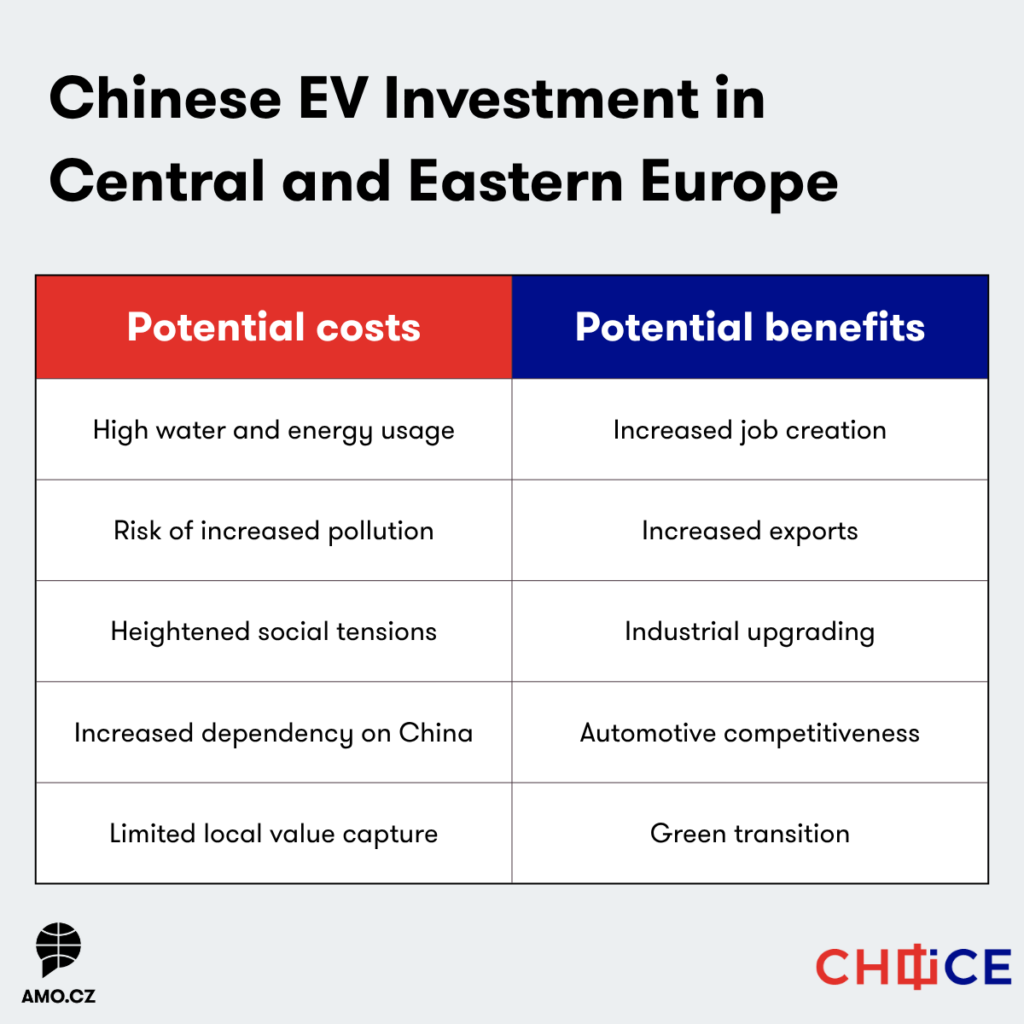
There are plenty of positive effects among the potential impacts of these projects. Chinese EV and battery investments help maintain CEE’s relevance in a sector undergoing technological transformation. They create jobs, increase industrial output, strengthen export capacity, and may attract further suppliers. In regions with weaker labor markets, such as parts of eastern Hungary or eastern Slovakia, these projects can become anchors of local economic development. They also help European carmakers secure nearby battery supply, which is essential if Europe wants to produce EVs at scale rather than import them from Asia.
Yet these benefits come with limits. The central question is not whether Chinese FDI creates growth, but what kind of growth it creates. Evidence from Hungary and the wider CEE region suggests that EV-related investments can expand production while reinforcing reliance on foreign capital, foreign technology, and foreign strategic decision-making. Participation in green industries may generate jobs and exports without necessarily producing domestic technological upgrading, policy autonomy, or significant local value capture.
The problem is familiar from earlier waves of automotive FDI in CEE. Foreign-owned firms dominate production, domestic suppliers often remain weakly integrated, and high-value functions stay outside the region. However, the risks may be even greater in the EV sector. Battery manufacturing is highly capital-intensive, technologically complex, and characterized by strong economies of scale and intellectual property concentration. Local economies provide land, infrastructure, labor, water, energy, and public subsidies, while the most valuable assets – such as battery chemistry, patents, software, production know-how, and strategic decision-making – remain largely in the hands of multinational firms, increasingly Chinese ones.
This creates a new form of asymmetric interdependence: CEE countries become indispensable production locations for Europe’s green transition, yet their bargaining power within these value chains remains limited. Without stronger local supplier development, domestic R&D capacities, and technology transfer mechanisms, the region risks reproducing the dependent market economy model in “greener colors” rather than moving beyond it.
Social Impacts Beyond Job Creation
The social impacts are equally ambivalent. On the one hand, EV investments promise employment and industrial renewal. On the other, they can create new tensions around labor, housing, local services, and environmental risk. Battery production requires large amounts of energy and water, and local residents often worry about air, soil, and water pollution, waste management, industrial accidents, and the transparency of permitting procedures. These concerns are not abstract. In Hungary, battery plants and related suppliers have already generated protests in places such as Göd (Samsung SDI) and Debrecen (CATL and Semcorp), where residents have questioned whether national industrial ambitions are being pursued at considerable local expense.
Labor is another sensitive area. Large plants require thousands of workers, but local labor markets are often too small or already tight. This increases reliance on foreign guest workers, which can alleviate labor shortages but may also generate tensions around housing, public services, and social integration if not managed carefully. Allegations concerning working conditions at construction sites linked to the BYD project illustrate how quickly industrial success stories can turn into social and political controversies. Even when such cases involve subcontractors rather than lead investors directly, they affect the legitimacy of the wider investment model.
Environmental incidents can have similar consequences. The recent controversy surrounding wastewater pollution linked to Semcorp’s operations near Debrecen has reinforced local concerns about regulatory oversight and environmental monitoring – illustrating that the long-term social acceptance of battery investments will depend not only on the number of jobs created, but increasingly on transparency, environmental governance, and corporate accountability.
As a result, Chinese EV battery investments are both the remedy and the poison. They can support EU climate goals and help preserve the European automotive industry, but they can also create environmental burdens, social tensions, and distributive injustices. That is, the benefits are often national or transnational – export growth, industrial competitiveness and decarbonization – while the costs are frequently local: noise, traffic, land-use change, pressure on water resources, pollution risks, social tensions, and anxiety about long-term environmental impacts.
What is Next: Stricter Rules, More Localization?
The next phase will likely be more regulated. At the EU level, the new EU Battery Regulation introduces requirements on sustainability, safety, labeling, due diligence, waste management, and the battery passport. The Net-Zero Industry Act aims to strengthen European clean-tech manufacturing capacity, with a target that the EU’s strategic net-zero manufacturing capacity should approach or reach at least 40 percent of annual deployment needs by 2030. The Clean Industrial Deal, launched in 2025, also seeks to connect decarbonization with competitiveness, lower energy costs, quality jobs, and industrial resilience.
Most importantly for Chinese investors, the European Commission’s 2025 automotive action plan explicitly states that European content requirements for battery cells and components in EVs sold in the EU will be addressed in the upcoming legislative files, including the Industrial Accelerator Act and the Circular Economy Act. This does not necessarily mean the exclusion of Chinese firms. But it does mean that “Made in Europe” will increasingly have to mean more than final assembly in Europe. Localization, traceability, carbon footprint, recycling, labor standards, and domestic value added will matter more.
Hungary may also be entering a different domestic regulatory phase. The new Hungarian government plans to create a stronger environmental authority for the EV battery sector, with tougher standards and penalties linked to company turnover rather than fixed fines. If implemented, this would mark a shift from a highly permissive investment-attraction model toward a more conditional one. That shift would not necessarily undermine Chinese investment: it could make it more sustainable and locally acceptable. But it would change the terms of embeddedness.
Challenges Ahead for CEE
For CEE governments, the policy challenge is therefore not to reject Chinese EV investment, but to govern it better. Three priorities stand out. First, investment incentives should be tied to measurable local benefits: supplier development, training, R&D activity, technology cooperation, and environmental performance. Second, permitting and monitoring must become more transparent, especially in communities directly affected by battery plants. Third, the region should avoid a subsidy race in which countries compete for the same projects while weakening their own regulatory leverage.
Chinese EV investment is neither a silver bullet nor a threat that can be dismissed in simple geopolitical terms. It is a test case for Europe’s green industrial transformation. If CEE remains merely a low-cost production platform, the EV transition may reproduce the old dependencies in a greener form. If, however, governments use the new regulatory moment to demand deeper local embeddedness, stronger environmental standards, and more domestic value creation – Chinese FDI could become part of a more balanced industrial upgrading strategy.
The real question therefore is no longer whether Chinese capital will shape Europe’s electric future – it already does. The question is under what rules, for whose benefits, and at whose cost.
Written by

Ágnes Szunomár
Ágnes Szunomár is an Associate Professor at the Institute of Global Studies, Corvinus University of Budapest, and a Senior Research Fellow at the Institute of World Economics, HUN-REN Centre for Economic and Regional Studies, Hungary. She is also a CHOICE Fellow for Visegrád countries.