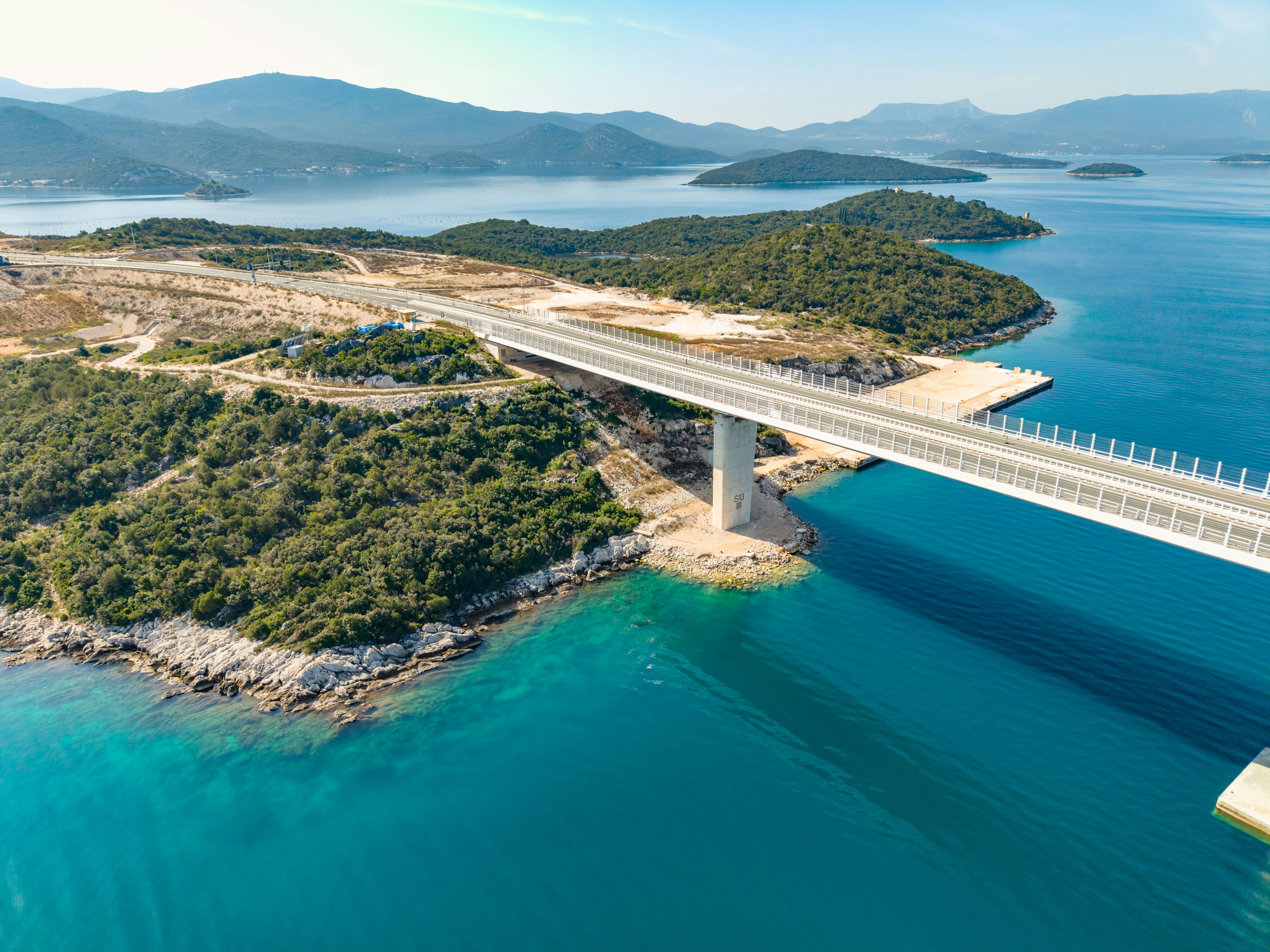
Cracks in the protective concrete layer of the Pelješac Bridge, together with a €60 million contractual claims filed by its Chinese contractor, have once again placed one of Croatia’s most important infrastructure projects at the center of public attention, four years after its opening.
Yet the episode points less to political capture or direct political influence than to the long-term patterns of China’s economic presence in Croatia. Over the past decade, Chinese companies have succeeded in strengthening their position in the Croatian market, particularly in the field of major infrastructure projects, without clear evidence that this economic engagement has translated into measurable influence over Croatian foreign or domestic policy. Whether such a development should be regarded as reassuring depends largely on whether the relevant risks are assessed through the lens of political influence, economic dependence, strategic infrastructure, or long-term market presence of Chinese actors.
European Money, Chinese Knowledge
The European Commission covered 85 percent of eligible costs with €357 million from cohesion funds, and in 2019 the state road company Hrvatske Ceste awarded construction to a consortium led by China Road and Bridge Corporation (CRBC) for roughly €275 million. That bid undercut Austria’s Strabag and an Italian-Turkish consortium by a wide margin – both competitors appealed and both lost. The procedure ran under EU public procurement rules, which is exactly why the outcome proved so hard to contest. Whatever CBRC’s expected margin, the project strategic value lay in the precedent it set: a Chinese state-owned enterprise delivering a major project financed by the EU budget on the territory of a member state.
Since then, that precedent has been translated into a growing order book. CRBC is driving the 2.5 kilometer Kozjak tunnel above Split, with its first phase costing €74.6 million. It won the €67.3 million contract for Zagreb’s southern entrance in 2025, and it is building the Brestovac-Godinjak expressway near Požega under a contract worth €159.8 million. None of these projects comes with Chinese financing. Croatian and European funds pay for Chinese execution.
European Money, Chinese Construction
Norinco International, acting through a Croatian subsidiary that holds the majority stake in the local company Energija Projekt, invested around €200 million in the 39 turbines of the Senj wind farm. At 156 MW, it remains both the largest wind farm in the country and the largest Chinese greenfield investment in Croatia, and Zagreb presented the project as a contribution to the green transition.
The corporate parent behind that green transition is China’s principal state-owned military supply conglomerate. The US Department of Defense lists Norinco Group among Chinese military companies operating in America. Its international arm has since moved from owner to contractor. Together with the Shandong Electric Power Engineering Consulting Institute, it is building the 99 MWp Korlat solar plant for the state utility Hrvatska Elektroprivreda (HEP). Korlat is Croatia’s largest solar facility, but unlike Senj it will remain Croatian state-owned. HEP is the project owner and borrower, with financing from the European Bank for Reconstruction and Development and the European Investment Bank. The plant has been in trial operation since February 2026. European institutional money paired with Chinese construction is the combination recently traced across the Western Balkans, where Chinese lending has receded while Chinese contractors have stayed. Croatia shows the same model operating inside the Union, in the power system of a member state.
The Senj investment was completed before Croatia established a comprehensive national screening regime, and the construction contracts discussed above were procurement awards rather than foreign investments. The Foreign Investment Screening Act entered into force in November 2025. Adopted under an urgent procedure, it also fulfilled an OECD accession criterion. This law applies to qualifying pre-existing investments, which must be screened within three years of its entry into force. A first implementing rule governing application contents was adopted in June 2026, but the system remains largely untested.
China-Croatia Economic Relations
For China and its global economic policy, Croatia is one of the main destinations for Chinese companies expanding abroad and highlights growing opportunities for bilateral investment and commercial cooperation. This suggests that the expansion of Chinese companies in Croatia was not merely the unintended result of competitive public tenders but also coincided with a broader Chinese effort to encourage its firms to establish a stronger presence in the Croatian and broader European market (Going Global Strategy). Croatia, however, is not an isolated case. According to MERICS and Rhodium Group, Chinese foreign direct investment (FDI) in Europe rose by 67 percent in 2025 to €16.8 billion, its highest level since 2018.
Measured against those showpieces, the aggregate figures for the relationship look surprisingly thin. China was Croatia’s largest source of imports outside the EU in 2024, yet it accounted for only about three percent of total imports, according to the state statistics office. Chinese official data put cumulative direct investment in Croatia at $250 million by the end of 2023, only a fraction of Croatia’s overall inward investment. Croatia has no known current project linked sovereign loan from a Chinese policy bank, and nothing in the relationship resembles Montenegro’s Export-Import Bank loan for the first Bar-Boljare motorway section. The exposure is primarily contractual rather than financial.
The Rijeka Port Authority annulled the concession tender for the Zagreb Deep Sea container terminal at the end of 2020 after a consortium of Ningbo Zhoushan Port, Tianjin Port, and CRBC had emerged as the leading bidder. The rerun went to APM Terminals and Enna Logic, and Rijeka Gateway opened in October 2025. As one expert pointed out, Maersk would not be in Rijeka had the Chinese bidders not been excluded. No Croatian official publicly framed the annulment as China policy either.
Croatia signed a Belt and Road cooperation Memorandum of Understanding in 2017 and hosted the China-CEEC summit in Dubrovnik in 2019, but the format has held no leaders’ summit since 2021. In 2024, Croatia abstained on definitive duties for Chinese battery electric vehicles, sitting with 11 other member states in the middle column rather than joining Hungary’s opposition or Poland’s support.
Questions and Problems
One of the arising questions concerns what exactly a decade of these projects has built – and the answer comes in three parts. Chinese state-owned contractors are now embedded in Croatian road and tunnel construction and in the renewable-energy buildout of the state utility, after repeatedly submitting competitive bids against European rivals. Disputes arising from those contracts are being handled through dispute boards and arbitration clauses rather than through politics. Ownership exposure is narrower but more sensitive, the Senj wind farm is ultimately controlled by Chinese Norinco International, whereas Korlat and the transport projects remain Croatian-owned.
The EU’s recent regulation requires every member state to operate a mandatory screening mechanism covering a common minimum scope of sensitive sectors beginning January 17, 2028. Croatia’s earlier national law is already in force but remains largely untested. Neither instrument establishes a general security-screening mechanism for ordinary public procurement, although the Croatian law extends to concessions and public-private partnerships involving foreign investors. The remaining procurement gaps are those already flagged across the Western Balkans, from beneficial-ownership transparency and disclosure of state support to a robust method for assessing abnormally low bids.
Calling Croatia a case of Chinese political capture would therefore be analytically insufficient. What emerges is more ordinary and more instructive: an EU member state that repeatedly accepts the cheapest qualified offer without first deciding what it thought about the state actor standing behind the bidder. The first stress test has arrived as a warranty repair and a parallel contractual dispute over a bridge.
Written by

Ante Batistic
Ante Batistić is a senior expert associate at the Dr. Franjo Tuđman Defense and Security University in Zagreb and a doctoral candidate in media and communication at the University North in Koprivnica. A historian by training, with a master's degree in diplomacy and international relations, he researches Intelligence history, national and global security, security and intelligence systems, and the role of ICT in the transformation of the US intelligence community.