After the Loans, the Contracts Remain: China’s New Balkan Model
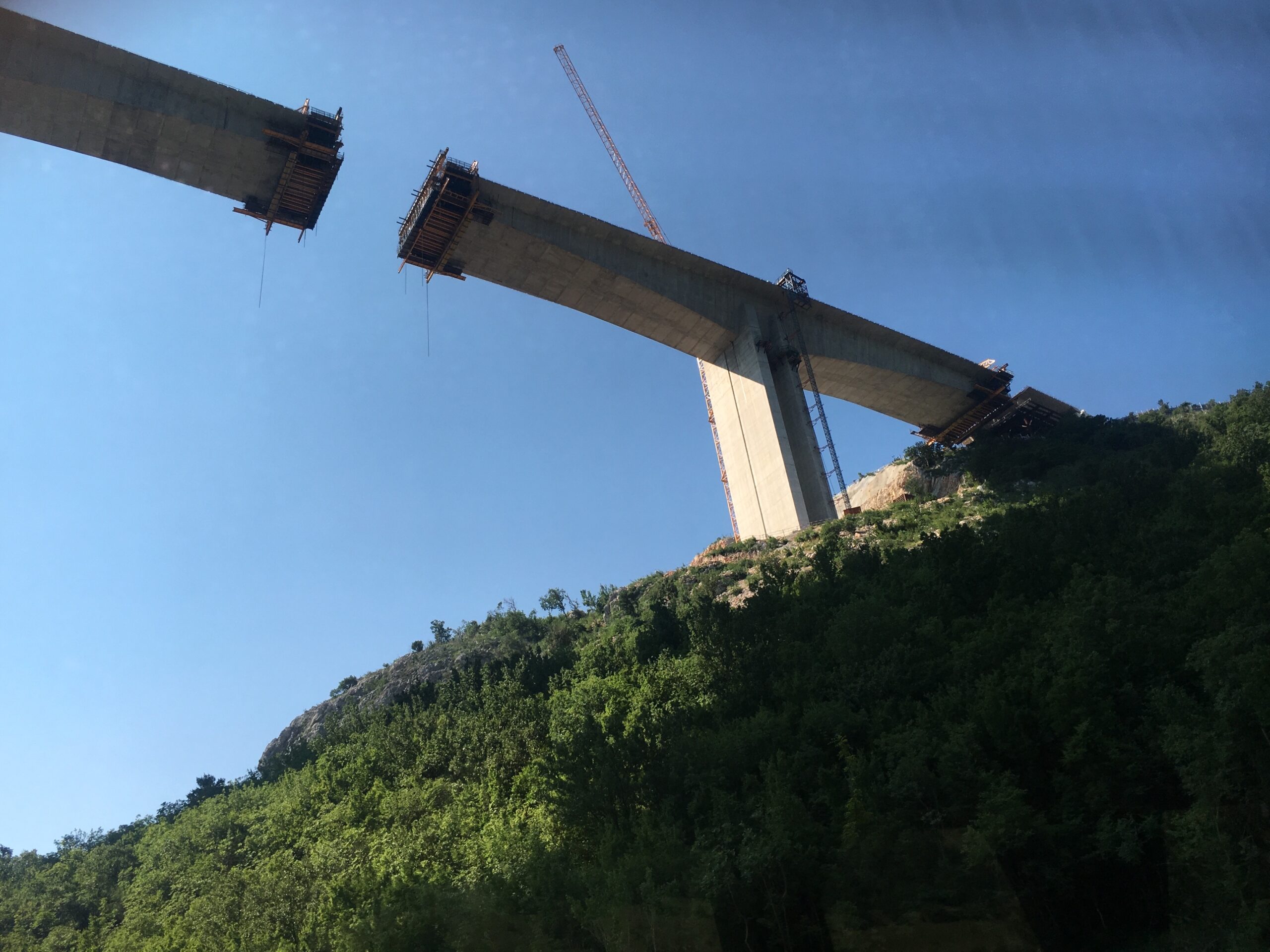
In late June, preparatory work began on Montenegro’s second Bar–Boljare highway section. European institutions provide the financing, but a Chinese consortium builds the road once again. That combination captures a wider shift across the Western Balkans – Chinese loans have receded, while Chinese contractors have stayed and adapted.
From Creditor to Contractor
For much of the previous decade, China’s offer to the Western Balkans came as a package.
The Export-Import Bank of China provided a loan, a regional government accepted the debt, and a Chinese state-owned enterprise received the construction contract, often through bilateral agreements rather than open procurement. This model supported major highway, railway, bridge, and energy projects in Serbia, Montenegro, North Macedonia, and Bosnia and Herzegovina, and it tied Chinese finance to Chinese implementation. Serbia received the region’s largest portfolio and became the main platform for Chinese construction companies.
Large new Chinese loans have now all but disappeared from the regional infrastructure pipeline. China’s overseas development lending remains far below its 2015–2017 peak, regional governments have grown more cautious about expensive sovereign liabilities, and the EU, the European Bank for Reconstruction and Development (EBRD), the European Investment Bank (EIB), and domestic budgets have expanded their role in regional infrastructure instead.
Yet the retreat of Chinese lending has not produced a comparable retreat of Chinese companies. Research conducted for this article identified 22 projects awarded to Chinese implementing companies between July 2021 and July 2026 without disclosed Chinese loan financing: 16 in Serbia, three in Bosnia and Herzegovina, two in Montenegro, and one in Albania. The research found no strict qualifying case in Kosovo or North Macedonia during the period, although Chinese contractors continued work on older EBRD-financed projects in North Macedonia.
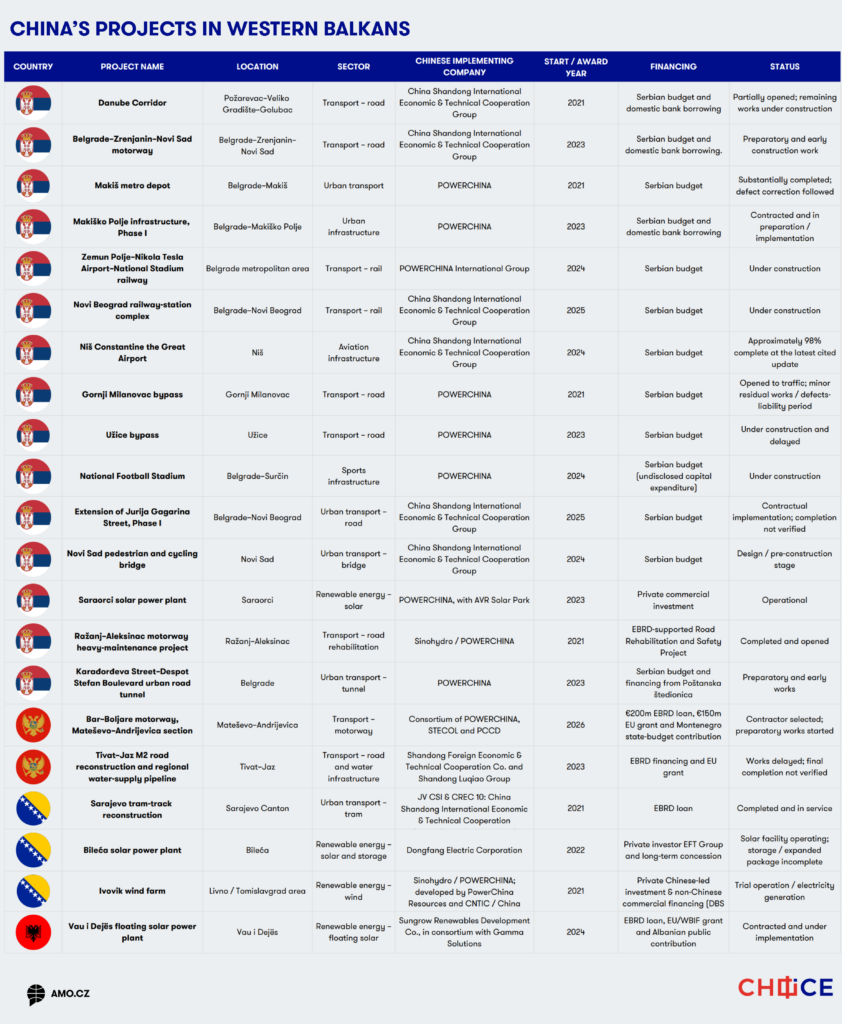
Fourteen of the 22 projects rely mainly on public budgets or domestic bank borrowing. Five use EBRD loans, EU grants, or related European financing, while three rely on private investment, concessions, or project finance. The list spans roads, railways, urban transport, airports, renewable energy facilities, and Expo 2027 infrastructure – showing that Chinese companies, predominantly state-owned enterprises, can now secure work without Beijing financing the host government.d
For Nenad Stekić, assistant professor at the Faculty of Security at the University of Belgrade, this transition reflects a shift in China’s approach rather than a retreat:
“The changing model of Chinese engagement in Serbia is primarily the result of the evolution of China’s development strategy rather than a withdrawal from the market. Beijing has become considerably more selective in approving sovereign loans due to pressures on China’s domestic financial system, the limited profitability of certain Belt and Road Initiative projects, and its efforts to reduce exposure to political and credit risks abroad.”
The decline of direct lending, in other words, should not be confused with declining economic ambition. The means of maintaining China’s position are changing, but the incentive to preserve access to regional infrastructure markets remains.
Montenegro’s Second Highway Test
Montenegro offers the clearest illustration. In 2014, the country borrowed $944 million from the Export-Import Bank of China for the first, 41-kilometer section of the Bar–Boljare highway, which China Road and Bridge Corporation (CRBC) built. When principal repayments began in 2021, the dollar-denominated loan created serious fiscal and foreign exchange concerns, and Montenegro arranged hedging deals with Western banks to reduce currency exposure and lower the effective interest rate. Montenegro managed the immediate crisis, and the first section of the highway opened in 2022, though the experience became the region’s most recognizable example of the risks attached to large Chinese infrastructure loans.
The second section has an almost reversed financing structure. A €200 million EBRD loan, a €150 million EU grant, and Montenegro’s budget back the approximately 22-kilometer Mateševo–Andrijevica section, and the tender followed EBRD procedures. A consortium of POWERCHINA, STECOL, and POWERCHINA Chengdu Engineering Corporation won with an offer of approximately €694 million before value-added tax.
For Mladen Grgić, teaching associate at the University of Montenegro’s Faculty of Political Science and former adviser to the Montenegrin president Jakov Milatović, the decision not to seek another Chinese loan reflects both the availability of alternatives and Montenegro’s political trajectory:
“Montenegro is not seeking financing from China because funding is available from Western and European banks, which offer various arrangements for additional infrastructure development in the country. Therefore, there is no need for Chinese loans. Such loans are also politically costly, as the broader narrative surrounding them is problematic for Montenegro, which is fully aligned with the EU’s Common Foreign and Security Policy and is on the verge of joining the EU. The country does not want to take unnecessary risks.”
The field itself revealed the construction strength of China. China Communications Construction Company submitted another qualified financial offer, and the only non-Chinese qualified bidder was the Cengiz-Azvirt consortium, while a second Chinese consortium reached the process but failed to qualify for the financial stage. European money therefore supported a tender in which Chinese companies dominated the final field.
Monteput CEO Milan Ljiljanić said the contractor was selected through an international tender conducted under EBRD rules and noted that the winning bid was the most competitive one submitted while meeting all technical requirements. The EU’s ambassador to Montenegro, Johann Sattler, framed the stakes at the signing: “This is not simply a gift – it is both a gesture of support and a statement of expectation,” he said. “When we invest European money, it means we also expect European quality.”
The consortium signed the contract in February, and preparatory work began in June. It has 14 months for design and 46 months for construction, and the project must follow Montenegrin law, EBRD procurement rules, and European technical and environmental standards.
European Money, Chinese Builders
Using EBRD or EU money does not imply that a European company should win. EBRD procurement is open to companies from any country and is based on non-discrimination, fairness, and transparency. European institutional financing exists to deliver infrastructure under defined rules and standards, not to reserve contracts for European firms. A Chinese company should not lose a tender because of its nationality and awarding it the contract can represent the normal operation of open procurement if it satisfies technical requirements and offers the best evaluated bid.
European institutions mobilize public money to connect the Western Balkans with the EU, support enlargement, and improve resilience. But when Chinese state-owned companies capture the resulting construction revenue, experience, and local influence, Europe finances infrastructure while part of the long-term commercial benefit flows to its principal systemic competitor.
The Western Balkans did not create this dilemma. Croatia’s Pelješac Bridge provided the most visible precedent inside the EU. EU cohesion funds covered 85 percent of the project, and CRBC won the construction contract through a competitive tender. Chinese state-owned companies met EU tender requirements, undercut European competitors, delivered a flagship project, and converted the result into a powerful commercial reference.
Grgić sees Montenegro’s second highway section as evidence that this precedent is no longer an isolated case:
“The fact that Chinese companies are winning public tenders in Montenegro, as has also happened in Croatia, demonstrates that they are well established in the market and face limited competition from European companies. The EU has created a framework in which European companies are often smaller, fragmented, and more expensive. Meanwhile, Chinese companies, which previously relied on a ‘loan-for-investment’ model, have become competitive even under the procurement standards of European financial institutions such as the European Bank for Reconstruction and Development.”
The pattern now appears across the Western Balkans on a smaller scale. An EBRD-financed Chinese consortium reconstructed Sarajevo’s tram tracks, though the Sarajevo Canton government has kept much of that contract confidential, citing EBRD procedural requirements the bank itself declined to confirm. Chinese firms won the EBRD-supported Tivat–Jaz road contract in Montenegro. A Chinese-Spanish consortium, comprising Sungrow and Gamma Solutions, is implementing Albania’s Vau i Dejës floating solar project with EBRD and Albanian financing. The Sarajevo project is complete, while the other two remain under implementation.
The relevant policy question is not how to prevent Chinese participation. It is whether procurement rules fully account for the advantages large state-owned contractors enjoy, including state support, economies of scale, tolerance for lower short-term margins, and the strategic value of entering new markets. Western Balkan tenders need transparent ownership information, disclosure of state support, realistic assessment of abnormally low bids, and stronger monitoring of subcontracting, labor, environmental, and lifecycle costs.
European firms also need to decide whether the region matters enough to compete. Governments cannot award contracts to companies that do not bid, and if European contractors avoid complex Western Balkan projects, Chinese companies will not need political favoritism to expand.
Serbia and the Politics of Access
Serbia is the center of gravity of the new model. The research identified 16 qualifying projects in the country, almost three-quarters of the regional total. Most rely on the Serbian budget or domestic borrowing rather than disclosed Chinese loans.
The method of awarding these projects varies. Some Chinese companies have won internationally financed or competitive contracts, while others received work through direct commercial agreements under Serbia’s intergovernmental framework with China. Official project records identify direct contracting for the Zemun Polje–Nikola Tesla Airport–National Stadium railway, even though Serbia’s budget finances the project.
This mixture of competitive tenders and government-to-government arrangements is central to China’s ability to maintain its position. As Stekić explains:
“Rather than exporting capital through intergovernmental loans, China is placing greater emphasis on the internationalization of Chinese companies, which are increasingly operating as market actors and competing for projects financed through European funds or other commercial sources. In Serbia, this shift is additionally encouraged by the growing number of infrastructure projects subject to open competition rules. As a result, Chinese companies are increasingly securing their presence through public tenders rather than package arrangements backed by Chinese financing.”
Expo 2027 takes this approach into a more consequential and less transparent space. POWERCHINA is constructing the exhibition complex in Surčin and is involved in related infrastructure, including the National Stadium, and Serbia is funding the works through the budget and broader public borrowing rather than a dedicated Chinese project loan. The 2026 budget allocated 47.5 billion dinars to Expo preparations, and Serbia has also issued long-term government bonds to support Expo-related infrastructure projects.
Financing the project through government bonds does not make the cost disappear. It changes the creditor and spreads the obligation across Serbia’s public finances. The state raises the money, and a Chinese state-owned contractor still receives a major share of the construction work.
The special law adopted for Expo-related construction creates a separate concern. It exempts key projects in the Surčin complex from the ordinary Law on Public Procurement, and Transparency Serbia has argued that the arrangement removes legal protection for bidders and creates a significant risk of higher costs than genuine competition would produce. Serbia therefore shows why financing source and procurement quality need separate assessment: a project can be free of Chinese loan exposure while remaining opaque, anti-competitive, or politically negotiated.
Yet Chinese companies do not win every contest. Azerbaijan’s Azvirt took over parts of Serbia’s “Smile of Vojvodina” expressway after an earlier framework agreement with a Chinese state contractor broke down over construction pace and financing commitments. That earlier arrangement had involved prospective The Export-Import Bank of China financing, which is why it falls outside the criteria for this research. The change nevertheless shows that Chinese commercial access is substantial rather than absolute.
China no longer needs to act as the Western Balkans’ lender of first resort to preserve its infrastructure position. Its companies can follow European money, compete under EBRD rules, work through concessions and private finance, or rely on direct agreements with governments such as Serbia’s. This is a more mature and potentially more durable form of engagement.
Stekić describes this as an adjustment in instruments rather than objectives:
“This demonstrates that China’s strategy is adapting to new regulatory and financial circumstances. The objective remains the same: to preserve a long-term economic presence, but the instruments used to achieve it are significantly different.”
The appropriate response is not exclusion based on nationality. It is genuine competition, full disclosure of financing and state support, stronger scrutiny of abnormally low offers, enforceable labor and environmental standards, and transparent contract awards. Otherwise, the Western Balkans may leave the era of Chinese loans only to enter an era in which European institutions and regional taxpayers finance infrastructure that Chinese state-owned companies increasingly build.
Written by

Stefan Vladisavljev
vladisavljev_sStefan Vladisavljev is CHOICE Visiting Fellow. He is also the Program Coordinator of the Serbia-based non-governmental organization Foundation BFPE for a Responsible Society. He analyzes Chinese presence in Central and Eastern Europe with a special focus on Serbia and the Western Balkans.