CHOICE Newsletter: What Lies Ahead for Lithuania-China Relations?
Dear reader,
The summer break is over, but Europe’s China dilemmas have not become any easier in our absence. The coming weeks will bring renewed debate over how far the EU is prepared to go in protecting its economic interests – and how much unity remains once Beijing responds. With trade negotiations continuing ahead of a potentially decisive October, the autumn may reveal whether Europe’s increasingly assertive language can be translated into policy.
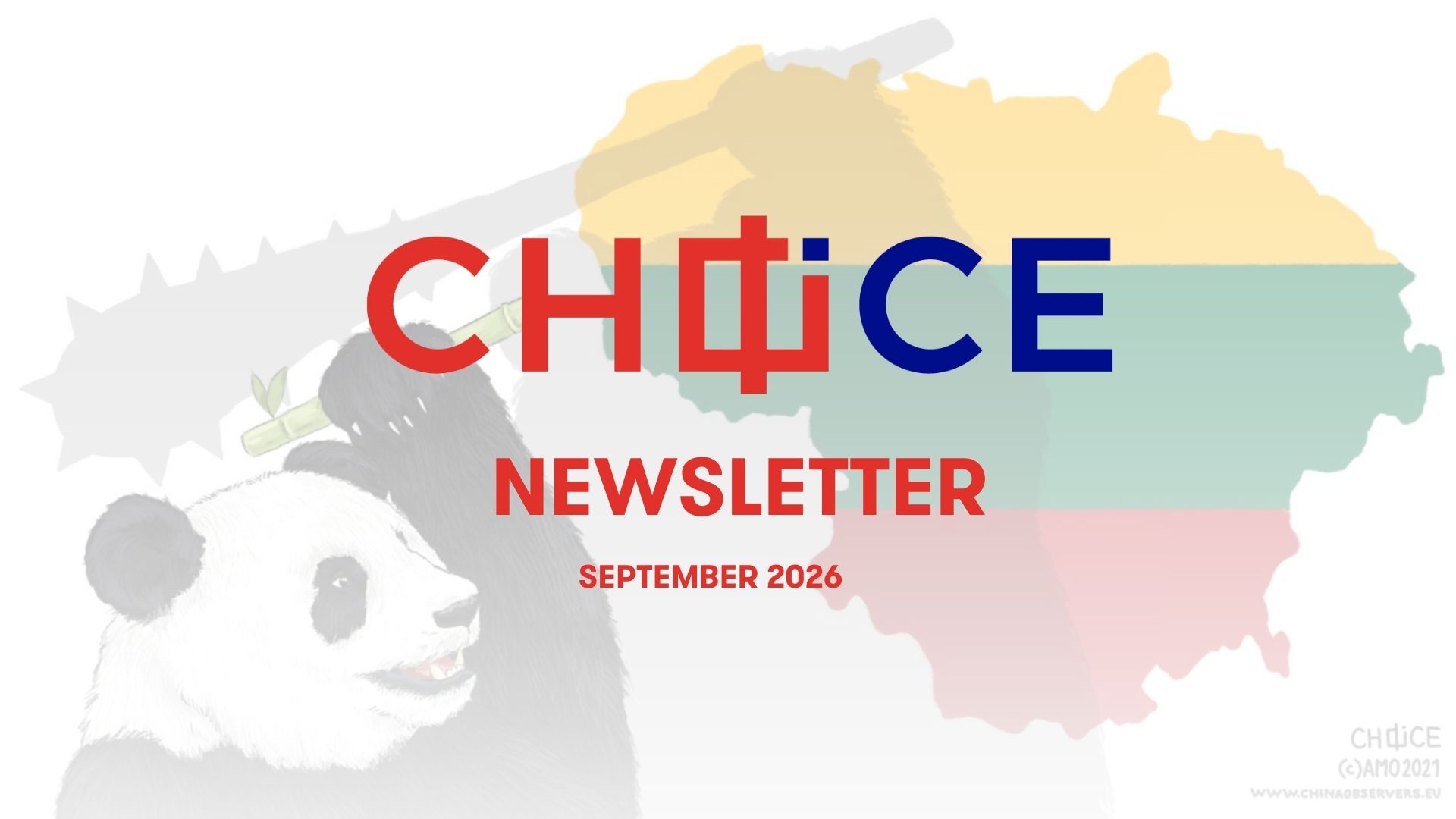
This issue also takes us to Lithuania, a country whose relationship with China has rarely followed a predictable path. Recent political changes have reopened questions that appeared settled only a few years ago, while Lithuania’s upcoming EU Council presidency gives its choices significance far beyond Vilnius. Rather than offering a single reading of where the country is heading, we invited two Lithuanian experts to examine the issue from different angles. Together, their contributions show why Lithuania is once again a country worth watching closely.
Welcome back – and enjoy the read.
Ivana Karásková, CHOICE Founder and Team Lead (based in Prague)
CHOICE Quick Takes
In 2026, Lithuania has drawn particular attention from CEE China observers for very good reasons. The government has departed from the confrontational China policy that made Vilnius a flashpoint in 2021, when it allowed Taiwan to open a “Taiwanese Representative Office” and prompted retaliatory measures from Beijing. The current shift raises a number of questions, and makes the future of Vilnius’s ties with Taipei uncertain. To understand what lies ahead, we asked two Lithuanian experts to share their perspectives.
Paulína Ovečková, CHOICE Analyst (based in Prague)
Toward a More Flexible Approach?

Raigirdas Boruta, Associate Expert at Geopolitics and Security Studies Centre (GSSC)
After 2021, Lithuania’s relations with China and Taiwan were viewed largely through a zero-sum lens: closer engagement with Taipei coincided with a strained relationship with Beijing. In recent months, however, Vilnius appears to be pursuing a more flexible approach. The new government, sworn in on July 14, has explicitly committed to normalizing diplomatic relations with China, while officials maintain that ties with Taiwan should continue on a pragmatic, results-oriented basis centered on trade, investment, innovation, and technology. The resumption of negotiations on a Lithuania-Taiwan economic cooperation action plan also suggests that Vilnius intends to preserve substantive ties with Taipei despite its more proactive push to normalize relations with Beijing.
The emerging policy looks less like a reversal than an attempt to treat both relationships that became politically fused after 2021 on separate tracks – maintaining active cooperation with Taipei while seeking to normalize relations and lower tensions with Beijing. China, however, continues to link the two, insisting that progress toward normalization depends on Lithuania correcting its past Taiwan-related “mistakes.” At the same time, the US Congressional Taiwan Caucus has urged Lithuanian leaders to maintain their relationship with Taiwan, framing their appeal against the backdrop of Chinese coercion. Whether Lithuania can sustain this compartmentalization will therefore depend not only on Beijing’s willingness to accept it, but also on Vilnius’ ability to recalibrate without appearing to retreat under Chinese pressure in the eyes of Washington.
Lithuania’s EU Presidency and China

Elzė Pinelytė, Political Attaché at the EU Delegation to the Pacific in Fiji & Associate Expert at GSSC
When Lithuania assumes the EU Council presidency in January 2027, Beijing will likely treat it as a pressure point, entering through the new government’s interest in normalization. It can weigh each step toward restored relations against Vilnius’ restraint on the trade, export-control, and de-risking files that irritate China most – ones that Lithuania itself will steer through the Council. A softer posture is nevertheless unlikely: Lithuania has anchored itself to a principled economic-security line, co-signing the non-paper urging a tougher EU strategy on China.
The dilemma, then, is not that Vilnius will yield, but that it must sustain this hard line while pursuing normalization under unprecedented circumstances: no member state has ever held the EU Council presidency over China-related files without functioning diplomatic relations with Beijing. Vilnius cannot count on others to absorb the cost once China’s retaliation begins – the Ceuta crisis exposed European solidarity as brittle and conditional. That leaves Vilnius managing EU-China relations not only from a position of diminished national capacity, but also from one that depends on collective backing. That backing faces its first test in mid-October, after the EU Trade Commissioner Šefčovič’s planned Beijing trip, when the European Council either hardens its line or settles for token gestures and further talks. Either outcome will shape how much room Vilnius has to pursue normalization without conceding to Beijing or straining ties with China-friendly capitals.
CHOICE in Brussels
Tit-for-Tat, But Only on Paper: Beijing’s Answer to the EU’s 21st Sanctions Package

Konrad Szatters, CHOICE Analyst & Executive Editor (based in Brussels)
On July 23, the EU adopted its 21st sanctions package against Russia, adding 51 entities to its dual-use export restrictions – among them 14 companies from mainland China and Hong Kong seen as contributing to Russia’s war in Ukraine. Beijing’s Ministry of Commerce (MOFCOM) responded the next day, placing 14 European entities under dual-use export controls: Germany’s Rheinmetall, Poland’s Vigo Photonics, Czechia’s Tatra Trucks, and 11 others. MOFCOM also criticized the EU’s decision as “egregious.” Brussels’ initial reaction was measured: the European Commission said the EU would “seek clarification with their counterparts in China” and liaise together with the affected member states and companies.
At first glance, the exchange may read as symmetrical – 14 for 14 – but from a European perspective, it is not necessarily the case. First, reach: the EU’s restrictions bind EU exporters, including EU companies operating abroad, while China’s controls explicitly extend to Chinese-origin dual-use goods outside China, prohibiting overseas organizations and individuals from supplying listed entities with such goods. Second, pace: the EU spent weeks negotiating its sanctions package among member states, while Beijing responded within a day, with its restrictions reportedly taking immediate effect. Third, targeting: the EU listed entities linked to Russia’s military-industrial complex, including third-country firms contributing to the circumvention of export restrictions, while China selected strategic entities with direct relevance to Europe’s own defense-industrial and advanced-technology base – including Rheinmetall, one of Europe’s most important defense manufacturers, alongside specialized suppliers such as Poland’s Vigo Photonics. With some of the EU’s most significant tools – such as the Anti-Coercion Instrument – remaining inactive as tools of deterrence, the open question is to what extent member states whose national champions have been individually targeted will be able to reach consensus and force a collective answer at the European level – or at least quietly seek solutions of their own.
WiCH Highlights
Sari Arho Harvén, WiCH co-chair for Finland, wrote a commentary assessing China’s language on Ukraine and Belarus. Read it here!
Francesca Ghiretti, WiCH co-chair for Italy, examined how China misperceives itself in a new commentary. Read it here!
Alicia García-Herrero, WiCH co-chair for Spain, co-authored a paper on how countries can reduce their AI dependence on the US and China. Read it here!
CHOICE News
 Ivana Karásková commented on China ties of Czech MEP Ondřej Dostál for Novinky.cz (read it here), and her 2023 study on Chinese narratives in the Czech Republic was quoted by RSF (read it here).
Sense Hofstede wrote an article about EU-China trade conflict for Volkskrant in Dutch (read it here) and moderated the CEE-Nordic Dialogue on Chinese FIMI (read about it here). He was interviewed in Dutch by Nieuwsuur and NPO about Taiwanese military (watch the former here).
Paulína Ovečková wrote an article about European Green Parties’ China policy for the Green European Journal (read it here) and was quoted by Seznam Zprávy about China’s growing influence in the Arctic (read it here).
This is the web version of our newsletter. If you’d like to receive the CHOICE newsletter in advance, straight to your inbox, sign up here:
Written by

CHOICE
CHOICE is a multinational consortium of experts providing informed analysis on the rising influence of the People’s Republic of China within the countries of Central and Eastern Europe (CEE).