CEE-Nordic Dialogue on Chinese Information Manipulation and Interference

On June 9, 2026, the 4th iteration of the CEE-Nordic Dialogue on China was held online, co-organized by the Association for International Affairs (AMO)’s China Team behind China Observers in Central and Eastern Europe (CHOICE) and the Swedish National China Centre (NKK) at the Swedish Institute of International Affairs (UI). This time, the discussion turned to Chinese influence in the media and the prospect of China-Russia alignment.
Both organizations came to the table with fresh research. CHOICE experts had mapped a “playbook” of borrowed mouths and laundered messages, distilled from the Chinese foreign information manipulation and interference (FIMI) practices observed across Central and Eastern Europe (CEE). An NKK survey of Swedish media documented intensifying efforts by Beijing to influence the work of foreign journalists.
Active Chinese Efforts
The panel drew speakers working on Sweden, the Baltic states, and CEE – countries that sit on the front line of Russian interference while also facing active efforts from Beijing. Differences in the state of relations with China and linguistic barriers give each country its own story; the Russian-speaking communities of the Baltics are a partial exception. Yet a common playbook runs beneath the local variation. As one speaker cautioned, someone who concludes there is no Chinese messaging in their country is most likely looking in the wrong place.
Backlash and Retreat in Traditional Media
A survey of journalists suggests that traditional Swedish media were quite successful in countering Chinese influence efforts. In fact, Chinese actions triggered an increase in critical reporting. The unique situation of the wolf-warrior ambassador Gui Congyou (2017–2021) played a big part in the reception of Beijing’s efforts in the country.
Another example of backlash concerned Estonia, where China’s embassy tried to publish paid articles in traditional media. One such article denying human rights violations in Xinjiang led to a public scandal that made most outlets refuse future articles.
Publicly attributable placements of this kind have largely disappeared from CEE, where that approach was abandoned around 2019. In their place came message laundering: planting content indirectly so that it reads as homegrown. Some less rigorous broadcasters in the Visegrad Four (the Czech Republic, Hungary, Poland, and Slovakia) carried paid or promoted segments built on scripts supplied from China, with political content folded into lifestyle items on tourism, food, or culture. One telling example had Taiwan’s Yushan mountain presented as the highest peak “in the province of Taiwan.”
Alternative Media and Influencers
The Chinese embassy’s activities in Sweden have decreased since the departure of Ambassador Gui in 2021. Beijing’s strategy is changing. It now focuses more on alternative media and the right side of the political spectrum.
A similar lack of results with traditional media efforts in Estonia led to a shift there as well. Chinese outreach now consists of visiting schools and co-organizing events such as Chinese New Year celebrations with local governments. Many of these activities are directed at the country’s Russian-speaking minority. Local officials do not always see this as a problem, often because they cannot imagine themselves important enough to be a target.
China has been making greater use of influencers in Sweden, the Baltics, and CEE. The playbook is consistent: invite individuals to China on paid trips, help them produce content on safely apolitical themes, frequently food and travel, and inject subtle political messaging.
A confluence of Chinese and Russian channels began around 2017. During the COVID-19 pandemic, the migration of Chinese efforts to social media intensified. Following local governments’ closure of Russian channels after the full-scale invasion of Ukraine in February 2022, many related individuals and narratives moved to Chinese channels.
Limited Effect Presages Move to More Sensitive Areas
Chinese efforts face a tough crowd when they are publicly linked to Beijing. Czechia and Sweden rank among Europe’s most China-skeptic countries because of their recent experiences with Beijing. Added to this is the anti-communist sentiment that is widespread in the entire CEE region, including the Baltic countries, as a consequence of Soviet history.
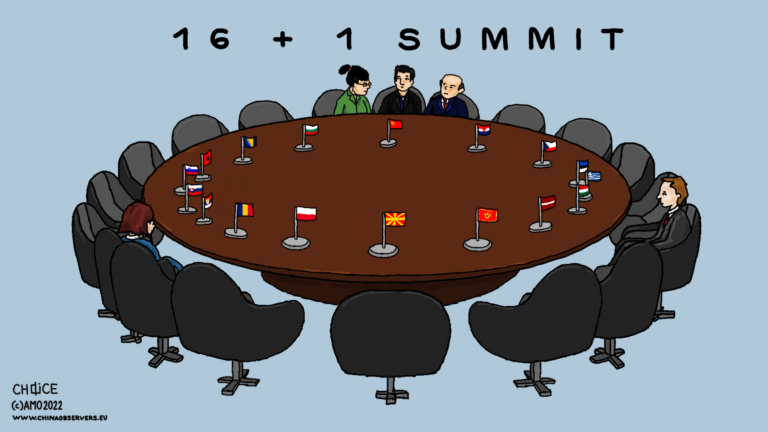
Coercion, indeed, tends to backfire: blunt attempts to buy influence at the height of the “16+1” format that Beijing created for summit meetings between China and CEE countries, and pressure on the Czech Senate’s leadership over a planned Taiwan visit, produced backlash rather than compliance. Chinese support for Russia’s war effort against Ukraine has further damaged Beijing’s image in the region. Yet the focus on Russia also means that China’s politics are not widely known among the public and not a priority for politicians.
This situation carries risks. The Chinese toolbox has significantly changed since 2019, learning from the Hong Kong protests and the COVID-19 pandemic. Beijing’s messaging is no longer limited to positive fluff about China. Negative messaging about the EU, national governments, and NATO has become core.
Now, Chinese efforts are moving from targeting the elites – journalists, fringe politicians, businesspeople, and so on – to targeting the broader population, especially young people. Blunt and easily attributable moves backfired, yet work with influencers is less counterproductive.
Future Worries
The convergence of Chinese and Russian efforts is real but mostly opportunistic. The starkest evidence came from a participant’s description of Bulgaria, where China Today and Russia Today reportedly shared not only a building but also an editor. The pattern is one of China exploiting infrastructure that already exists. A worry for the future is that, as Moscow’s economic situation deteriorates, more of its clients may find a better-funded patron in Beijing.
Transnational information suppression is not only about what Beijing actively pushes, but also what messages it seeks to suppress. Suppression is far harder to detect, since it results in something not happening. Beijing has been reported to go over targets’ heads – to an employer or a party chief – when it wants to stop e.g. politicians, since ignoring one’s own boss is harder than defying Beijing. Advances in AI do not only help content creation but also content deletion.
A particular blind spot is EU citizens of Chinese origin. Their information environment and ties to the PRC make them targets of Chinese propaganda efforts. Yet as the EU-funded RESONANT project and a recent minibook by the journalist Chu Yang illustrate through fieldwork, this environment is difficult to study. One proposed remedy is greater support for independent Chinese-language journalists already in Europe, who can report China from a different vantage point and teach others how to do the same.
As media consumption splinters into bubbles, influencers, not bound by a journalistic code, will only gain ground. A fragmented ecosystem is a harder target for FIMI researchers. The defense most often urged by the participants was media literacy – which should not only consist of teaching people critical reading of sources but also ‘critical avoidance’ to prevent wasting limited attention spans – paired with exposing Chinese operations, since Chinese actors remain remarkably sensitive to being named.
Set against the earlier dialogues, the 4th installment dwelt less on the geopolitical story than on the practical operation of FIMI and China-Russia alignment. Faced with the backlash that open efforts via traditional media provoked, Beijing has shifted to less visible methods. This development provides new challenges, which demand sustained attention to the front-line states in CEE and the Nordic region.
Written by

CHOICE
CHOICE is a multinational consortium of experts providing informed analysis on the rising influence of the People’s Republic of China within the countries of Central and Eastern Europe (CEE).