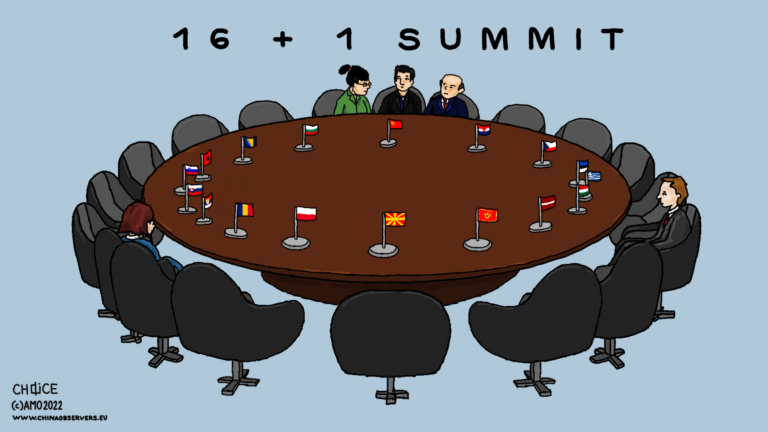
When Donald Trump visited Beijing in May 2026, Xi Jinping did not merely host one of the year’s most anticipated summits. He also assigned a new diplomatic label to US-China relations: a Constructive Bilateral Relationship of Strategic Stability (中美建设性战略稳定关系). To many observers, the phrase sounded like another piece of diplomatic jargon. Yet it reflects a distinctive feature of Chinese foreign policy. Over the past three decades, Beijing has developed an elaborate system of bilateral relationship classifications centered on graded ‘partnership’ (伙伴) formulas. Flexible in application yet highly hierarchical in structure, these labels signal varying levels of political trust, strategic importance, and diplomatic ambition.
Precisely because they encode such distinctions, the labels are far from being mere diplomatic slogans: they provide a valuable window into how China conceptualizes and organizes its external relations. Yet the distribution of partnership labels across CEE also highlights some of the limitations of these classifications as indicators of bilateral relations and political alignment.
Partnership Diplomacy
Most studies, including those by Xiang Haoyu, Yue Shengsong, Georg Strüver, and Thomas Wilkins, trace the emergence of China’s partnership diplomacy (伙伴外交) to the post-Cold War period, linking it to the ‘Reform and Opening’ policies and China’s growing engagement with the outside world. The accounts routinely view the establishment of a strategic partnership with Brazil in 1993 and a partnership of strategic coordination with Russia in 1996 as key milestones in its development.
Emerging from Beijing’s post-Mao commitment to an independent foreign policy, the partnership framework offered a flexible alternative to formal Western-style military and security alliances and a mechanism for managing an increasingly diverse network of bilateral relationships. Indeed, apart from its treaty alliance with North Korea, China maintains no formal alliances. Over time, this approach evolved into a complex hierarchy of partnership designations that signal varying levels of political trust, strategic coordination, and diplomatic importance.
During the 2000s, partnership diplomacy expanded rapidly in three important respects. First, the number of bilateral partnerships grew significantly across regions. Second, partnership designations proliferated, creating a more differentiated and sophisticated hierarchy of bilateral relationships. Third, partnerships became increasingly institutionalized through regular summit meetings, high-level political dialogues, and sector-specific cooperation frameworks – giving them a more durable and operational character.
By the end of the 2000s, partnership diplomacy had become a staple feature of China’s foreign policy. And Xi Jinping’s rise to power did not fundamentally alter the logic of the system. Instead, under his leadership, new descriptors within partnership categories emerged, such as ‘new era’ (新时代) or ‘all-weather’ (全天候), reflecting Xi’s political and ideological priorities. The more significant development was the integration of partnership diplomacy into Beijing’s wider conception of global order. This shift is reflected in the concept of a ‘global partnership network’ (全球伙伴关系网络), increasingly presented by Chinese officials and scholars alike as a cornerstone of China’s international relations. Through this framework, Beijing seeks to connect diverse bilateral relationships to a broader vision of international order, positioning partnerships as a central vehicle for advancing China’s global influence and its advocacy of a more multipolar world.
By 2026, China has established formal partnership relations with well over 100 countries and numerous regional and international organizations, making partnership diplomacy one of the most extensive components of its foreign policy toolkit.
Partnership Hierarchy
Although scholars generally agree that China’s partnership diplomacy constitutes a hierarchical system, there is no consensus regarding the precise number of tiers. In the absence of an official classification from Beijing, researchers have reconstructed the hierarchy from partnership designations, diplomatic practice, and patterns of relationship upgrading. Some aggregate China’s numerous partnership labels into four broad categories arranged in ascending order of political, economic and military coordination: partnership (伙伴关系), comprehensive partnership (全面伙伴关系), strategic partnership (战略伙伴关系), and comprehensive strategic partnership (全面战略伙伴关系). Others distinguish an intermediate tier of strategic cooperative partnerships (战略合作伙伴关系), between strategic partnerships and comprehensive strategic partnerships, producing a five-level hierarchy.
More recent analyses have proposed increasingly differentiated hierarchies. A 2025 study, for example, identifies seven partnership levels and places exceptional formulations such as China’s Comprehensive Strategic Partnership of Coordination for a New Era with Russia (中俄新时代全面战略协作伙伴关系) and several ‘all-weather’ partnerships above the standard comprehensive strategic partnership. Other breakdowns adopt a less rigid approach emphasizing the proliferation of customized partnership designations and treating many such formulations as relationship-specific adaptations rather than distinct hierarchical categories.
Despite these differences in classification, scholars broadly agree that China’s partnership diplomacy constitutes a stratified system in which partnership titles signal varying degrees of political trust, strategic importance, and institutionalized cooperation. Furthermore, the absence of an official classification is itself revealing: it provides Chinese diplomacy with considerable flexibility to create, upgrade, and customize partnership titles in response to changing political circumstances.
Ironclad Friendship
Alongside China’s partnership taxonomy, Chinese diplomatic discourse also uses additional formulations that sit outside the partnership classification system, most notably ‘ironclad friendship’ (铁杆友谊). The term has gained greater visibility in recent years, though it has earlier usage, and is applied sparsely – acting as a special designation reserved for a handful of deeply trusted partners, most notably Pakistan, Serbia, and Cambodia.
In Chinese official usage, the ‘ironclad friendship’ refers to relationships characterized by high political mutual trust, strong support on core interests, and a commitment to standing together in times of difficulty and external pressure. It operates as an additional layer of political messaging alongside partnership classifications, often presented as being even more resolute or time-tested than standard or comprehensive strategic partnerships.
Partnership Labels in CEE
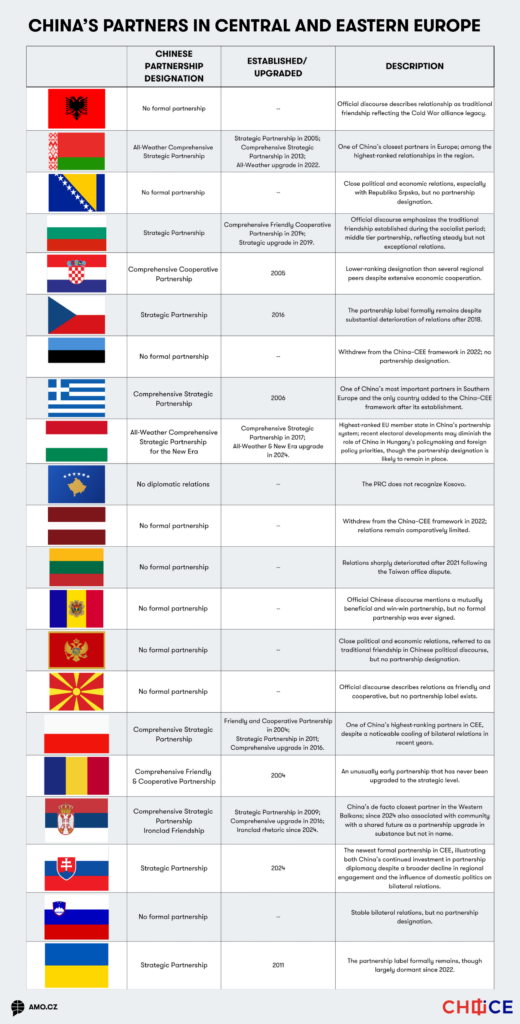
The table below summarizes China’s current partnership architecture across CEE. It provides a basis for assessing the distribution of partnership labels across the region and their analytical value for understanding broader bilateral relations.
What Do Partnership Labels in CEE Reveal?
Two conclusions emerge from the distribution of Chinese partnership labels across CEE. First, partnership labels are imperfect indicators of the actual state of bilateral relations. Second, partnership labels are also imperfect indicators of broader political alignment toward China.
The distribution of partnership labels across CEE demonstrates both the utility and the limitations of China’s partnership diplomacy as an analytical tool. On the one hand, partnership designations provide important clues regarding how Beijing evaluates the political importance of particular countries and the level of cooperation it seeks to institutionalize. On the other hand, the labels do not always accurately reflect the actual condition of bilateral relations. The Czech Republic and Ukraine, for example, formally retain strategic partnership designations despite the substantial deterioration of their relations with China in recent years. Conversely, countries such as Bosnia and Herzegovina and Montenegro maintain relatively close political and economic ties with Beijing despite lacking any formal partnership designation. Partnership labels therefore offer a useful snapshot of China’s diplomatic intentions and past relationship-building efforts, but they cannot be treated as a comprehensive measure of the contemporary state of bilateral relations.
Partnership labels are also of limited value as indicators of broader political alignment toward China. While they reveal how Beijing seeks to frame individual bilateral relationships, they capture only a portion of the factors shaping China policy across the region. Domestic politics, EU and NATO constraints, elite perceptions of China, economic interests, and changing geopolitical circumstances often exert a greater influence on policy outcomes than the formal partnership designation itself. As a result, countries occupying similar positions within China’s partnership hierarchy may pursue markedly different approaches toward Beijing. China’s partnership diplomacy therefore provides a valuable lens into Beijing’s diplomatic worldview, but not a definitive guide to the political dynamics of China-CEE relations.
Written by

Selena Orly
Selena Orly holds a PhD in China Studies and serves as Deputy Lead of the AMO China Team. Her research focuses on modern and contemporary Chinese intellectual history, the translation and amplification of Chinese women intellectuals’ voices through Reading the China Dream project, and China’s engagement with CEE, particularly the Western Balkans.