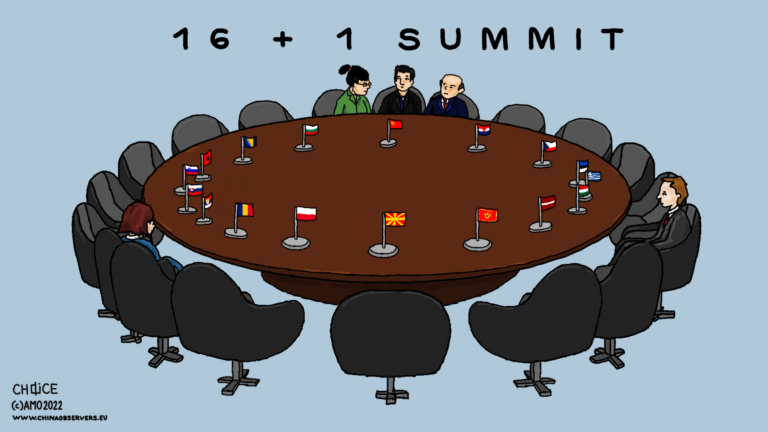
Donald Trump’s state visit to Beijing on May 13-15 – the first by a sitting US president since his last trip nine years ago – came at a moment of NATO’s eastern flank increased fragility. While Xi and Trump shook hands on the steps of the Great Hall of the People, American troops were packing in Germany – and, more surprisingly, in Poland too. At a time when American security umbrella over Europe is becoming less certain than at any point in the last decades, Poland and other Central and Eastern European (CEE) states increasingly view Beijing through the prism of its deepening partnership with Moscow.
A State Visit Aimed at Preventing Further Tensions
Trump’s visit was heavy on symbolism. Over three days, Xi received Trump with full state honors, the two leaders held an extended bilateral session, and both governments issued statements emphasizing stability and dialogue. The substance followed the truce reached at the Xi-Trump meeting in South Korea over six months ago: tariff cuts and soybean flows confirmation, talks of deepening trade and technology cooperation, and a shared interest in keeping the relationship from sliding into an open confrontation. No grand agreement was struck, but none was really attempted or planned.
This restraint is itself one of the key takeaways. Both sides approached the meeting with reasons to avoid escalation, and both mostly managed to achieve that. This is because the US and China, as the world’s two largest economies, are so deeply intertwined that neither can seriously hurt the other without paying a substantial price itself. Bound together by semiconductors and soybeans, rare earths and treasury bonds, Washington and Beijing have tied a Gordian knot that neither side dares to cut. This is the paradox of enemies who cannot afford to fight, and the meeting in Beijing was its latest manifestation.
Why Poland Cannot Look Away
The trouble for Poland and the broader CEE region is that this tension between the US and China has a price. Many of the American military decisions freeing up attention and resources for the potential contest with China in the Indo-Pacific may need to be paid by Europe, which – taking into account Russia’s war in Ukraine – is of concern predominantly for Poland, but for the broader CEE as NATO’s eastern frontier as well.
This was felt already in October last year, when the Pentagon chose not to replace troops stationed in Bulgaria, Hungary, Romania, and Slovakia. But the clearest sign came in May. The Pentagon confirmed the withdrawal of 5,000 American troops from Germany, and Trump suggested the cuts could “go a lot further.” That alone raised some alarms in Poland, but what followed made the situation even harder to absorb. In mid-May, the US Army abruptly cancelled the planned rotation of roughly 4,000 soldiers to Poland – the “Black Jack” Armored Brigade Combat Team from Fort Hood, Texas, with its Abrams tanks and Bradley fighting vehicles. The cancellation was not announced before the deployment began – it was announced after. Some soldiers and equipment had already arrived in Poland, and the personnel who had reached the country were told to “make haste” to return to Texas.
What made the episode so striking was that the surprise was not limited to Warsaw – or even to Europe. According to US officials, the decision surprised the “Black Jack” unit itself along with the defense officials and the Congress, which was not briefed and now demands an explanation. Even the American military leaders in Europe reportedly learned about the decision only through a Defense Department memo.
The situation was all-the-more surprising because Warsaw had long been presented by successive US administrations as one of America’s most reliable allies on NATO’s eastern flank – or a “model ally,” in the US Secretary of Defense Pete Hegseth’s own words. Poland consistently fulfilled alliance commitments, increased defense spending to nearly 5 percent of GDP, avoided direct political confrontation with US presidents – including Donald Trump – and remained one of the most pro-American societies in Europe. According to a recent poll, Poland and Romania are the only European countries where a majority of the public supports hosting American military bases, with the support in Poland remaining significantly higher.
But for Poland – and the broader CEE – the importance of this episode may lay less in the precise number of troops than in the question of predictability and US priorities. If a brigade can be recalled in the middle of a deployment to a “model ally” with minimal-to-none warning, then the assumption that the region rests under a fixed and unquestionable American security guarantee no longer holds in quite the same way it once did. And for a region like CEE, traditionally security-focused and hypervigilant about its eastern borders with Russia, such signals matter immensely.
But What About China?
Poland cannot afford and is not willing to see China as an enemy. The economic interdependence is simply too deep for such a position to be workable. For example, the rail corridor running through Poland and Belarus was reported to carry close to 90 percent of China-EU rail freight, and the Chinese goods made up roughly 15.5 percent of all Polish imports in 2025, with similar levels across other CEE countries.
Nonetheless, Poland does not see China as a neutral partner either, and the reason for that is Russia. Beijing has officially stayed out of Russia’s war in Ukraine, but it has become the quiet beam keeping the Russian war economy standing. None of this is a secret. Ukrainian intelligence reported in 2025 that most of the electronic parts inside Russia’s Geran-2 drones are now Chinese, and the clearest statement of the underlying logic came directly from the Chinese side itself. Last July in Brussels, Chinese Foreign Minister Wang Yi reportedly told the EU’s High Representative, Kaja Kallas, that China cannot afford for Russia to lose in Ukraine, because a Russian defeat would let Washington turn its attention to China. For Poland – a country whose security concerns largely begin and end with Russia – that single sentence calls for a shift in the approach toward China.
And this is also where the larger US-China relations paradox ricochets. Poland finds itself in a smaller version of their bind: unable to comfortably side with China that underwrites the Russian war on its doorsteps, but also unable to afford breaking with a partner this relevant. Poland did not choose this position and is not really a player in the contest either – it is simply a place where the ricochets land.
Europe’s Absence from the Agenda
This state of affairs is more broadly reflected in what Xi and Trump actually said about CEE and Europe as a whole – almost nothing. The statements from both sides centered on Taiwan, trade, and the Strait of Hormuz. Ukraine was reportedly discussed only in passing. Europe as an actor, and European security as a subject, were largely absent. The most important meeting of the year between the two powers shaping the global order treated the continent essentially as a bystander.
One could argue that this was simply a consequence of the bilateral nature of the Xi-Trump meeting. But given the scale, intensity, and geopolitical significance of Russia’s war against Ukraine, the marginal presence of Europe as a whole was nevertheless striking. It suggests that the Russian threat looming over Europe no longer sees the same degree of global attention it once did. This is not necessarily a catastrophe, but a reality that Poland, CEE, and the broader EU, must internalize and act accordingly – rather than wait for it to pass.
In practice, however, this is likely to be an issue managed quietly. Warsaw will keep playing down the US cutting numbers of its troops in Europe, much as it has already chosen to do. The line toward Beijing will remain what it largely is now – cautious hedging, neither rupture nor embrace. This is because what guides Poland’s stance vis-à-vis both the US and China is a single conviction: that Russia is, and will remain, the threat and priority that outranks all others. Everything else – how Poland approaches Washington’s decisions and how warily it treats Beijing – is ultimately calibrated to that.
Written by

Konrad Szatters
Konrad Szatters is a China Analyst at AMO, focusing on China’s political discourse and foreign policy. He also serves as a Lead Researcher for the Ukrainian Heritage Diplomacy in China at the University of Canterbury in New Zealand. Previously, he gained experience at the College of Europe in Natolin, the Polish Diplomatic Academy, and the Embassy of Poland in Beijing.