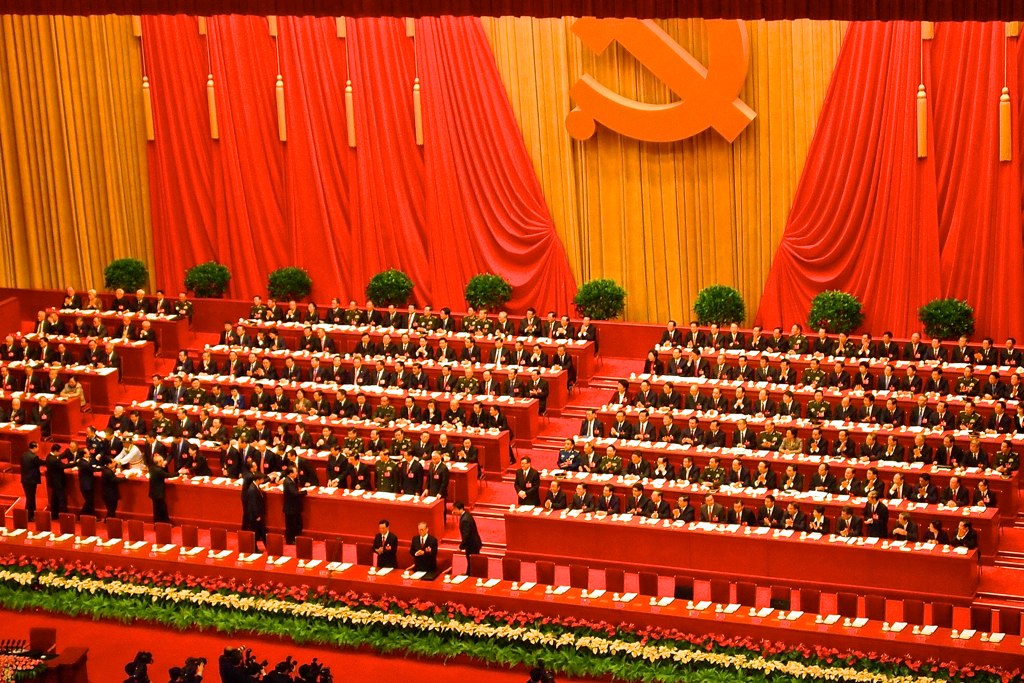
China’s Communist Party (CCP), with over 100 million members, stands as the world’s single largest political organization, governing the globe’s second-largest economy. A stark contrast to Europe’s old communist parties, which in countries such as Germany, Hungary, Slovakia and Luxembourg cannot even gather one percent of votes in national elections. European “comrades” have largely lost their vitality and relevance in European political life – with (by our count) more than half of the EU’s communist parties not holding a single seat in their national assemblies, and others surviving only through coalitions with broader left-wing movements as is the case in Spain, Portugal, France, and Bulgaria. Yet despite their marginal status, these political relics continue to receive invitations and red-carpet treatment from Beijing.
Why does China invest diplomatic capital and efforts in these seemingly politically insignificant old comrades? In the European Parliament, European communists and other members of The Left have repeatedly taken stands against the EU’s assertive policies toward China and adopted a pro-Beijing tone. It could then be that this “old-comrade diplomacy” serves an effort to incorporate Beijing’s vision of the global order into European left-wing parties’ discourse and positions, thus attempting to legitimize it through ideologically sympathetic channels.
The Body in Charge of Party-to-Party Diplomacy
Analysis of online publications of the International Department of the Communist Party of China (ID-CPC) and of individual European communist parties reveals that half of the active communist parties in EU countries have visited Beijing in the past five years. In addition to these, the Greek Communist Party met with Chinese officials during their visit to Greece, Germany’s communist party held video conferences with Beijing’s International Department in 2020, and in Luxembourg, the Chinese ambassador regularly attended communist party demonstrations and festive gatherings.
ID-CPC, the structure behind this outreach effort, has been led since 2022 by Liu Jianchao, an Oxford-educated diplomat who has transformed China’s party-to-party diplomacy. Unlike his predecessor Song Tao, who rarely ventured beyond Asia, Liu has embarked on an ambitious global tour, visiting 18 countries in his first year, with 11 outside Asia including Great Britain, Italy, France, and Germany. The ID-CPC operates as China’s parallel diplomatic track, maintaining contact with over 400 parties across 160 countries.
The CCP’s “friend to all” approach to foreign policy transcends ideological boundaries, however, when it comes to communist parties, the ID-CPC’s statements and communication emphasize shared ideological foundations and roots in Marxism-Leninism and use a deliberately fraternal language. This “common ideology” shared with “comrade and friend” parties is highlighted as the foundation for all efforts to “strengthen exchanges and cooperation” as well as to “enhance understanding of China” and “jointly contribute to world peace and stability.”
Such language creates a sense of ideological solidarity able to transcend tensions of traditional diplomacy and in turn creates a convenient alternative channel for Beijing in case official diplomatic ties are put under strain. Such is the case in the Czech Republic, whose diplomatic relations with China have reached a freezing point over the last few years, but whose Communist Party (which scored 3.6 percent in the country’s last general elections in 2021) is ever so warm to Beijing. In February this year, Liu Jianchao welcomed the Czech Communist Party’s Chairwoman Kateřina Konečná, declaring: “the CCP regards the Communist Party of Bohemia and Moravia as a comrade and friend, appreciates its long-term support for the development of Czech-China and Europe-China relations.”
During their visits to China, delegations invited by the ID-CPC are often invited to witness China’s economic development firsthand and participate in symposiums on “Chinese-style modernization.” Such was the case for Italian Communist Party member Francesco Maringiò, who described his 2023 visit as “a unique privilege” which strengthened “internationalist ties.”
Echoing Beijing’s Narratives: in Parliament and Beyond
While individually weak, these parties gain collective influence through their representation in the European Parliament (EP). Communist parties with EP seats belong to The Left group, which consistently votes against European measures it perceives as anti-Chinese, including resolutions to deepen cooperation with Taiwan, or relating to the EU’s wider policy strategy of “de-risking” its economic relations with China. Furthermore, through the interventions of some communist MEPs in EP debates, Beijing’s narratives, key concepts, and terminology make their way into European public space. A striking example is Portuguese communist MEP João Oliveira whose Party visited China two years earlier; in an address to the EP in July 2025 areas of the EU-China summit, he called for the “strengthening of relations with China”. Oliveira’s speech – featured in a news report of state-owned news agency Xinhua – emphasized the “principle of non-interference” and “respect for the one-China principle, without hesitation or distortion” and pointed the finger at “the policy of escalation and confrontation of the US” – all favorite recurring notions and terminologies of China’s foreign policy.
Through these parties, Beijing also attempts to iron out contentious points with Europe, such as concerns over human rights violations. The Cyprus’ Communist Party (AKEL), a major opposition party back home, maintains robust ties with Beijing and defends Chinese positions on sore points of EU-China relations, praising for instance” China’s development in Xinjiang province.”
Online and in the media, these parties can potentially be instrumental in Beijing’s objectives of “telling China story right” whether they serve as content creators or narrative amplifiers. Hungary’s Communist Workers’ Party (Munkaspart) – whose leader Gyula Thürmer appeared in Chinese state media praising the CCP as “a testament to the power of socialist ideas” back in 2021 – publishes daily pro-Beijing micro-articles on its official website. Further, last year, the French Communist Party and its newspaper L’Humanité, represented by its director during a visit in Beijing, committed to “enhancing understanding of China” and “reporting the real China to European people”. While the newspaper’s recent publications do not suggest an alignment with Chinese narratives, such an exchange exemplifies the opportunity that a communist media can represent for Beijing in order to challenge its portrayal in the European media landscape.
From Chinese state-media’s own perspective, foreign communist party leaders make perfect interviewees to cater to their own audiences. In a 2022 interview for China Dialogue, Nikos Ioannou, a member of the Secretariat and Political Bureau of the Central Committee of AKEL, expressed gratitude for Chinese investments in Cyprus. One year before him, French communist leader Fabien Roussel was interviewed by the Chinese news agency Xinhua and likewise praised China’s development under communist leadership and lauded Chinese help to developing countries.
Aligning Anti-Capitalist World Views with Beijing’s Geopolitical Interests
The main result of this comrade-diplomacy so far seems to be aligning China’s geopolitical interests with European communists’ anti-imperialist world views, with the potential to permeate to the larger leftist political spectrum. These parties’ inherent opposition to NATO, American imperialism, and neoliberal capitalism provides fertile ground for Chinese narratives about an alternative world order.
In perfect line with one of Beijing’s key foreign policy objectives, European communists often present China as a peacemaker in contrast with a “belligerent US.” In a statement opposing European rearmament, Spain’s Communist Party exemplifies this alignment, commenting that “while the United States opts for military escalation, other powers like China have firmly appealed to peace, diplomacy and dialogue as indispensable ways to avoid disaster.” In a similar vein, Belgium’s Workers’ Party (PTB) leader Peter Mertens wrote an opinion piece for Le Monde Diplomatique, in which he portrays a hostile and jealous Washington preparing “the next conflict (…) against China.” Such a rhetoric aligns perfectly with Beijing’s narratives, self-presenting as an actor for global peace and reacting merely defensively to a belligerent and aggressive US.
Although European communist parties engage with Beijing according to similar patterns, they do not all align when it comes China. One notable exception is the Swedish Communist Party. Back in 2021, the party published an article reacting and refusing the invitation to sign a statement authored by the Chinese Communist Party (CCP). In this statement, it designates China as “one of the strongest capitalist and imperialist powers,” and declares that it “refused to be a tool of Chinese foreign policy.”
An Unsuspected Gateway for Wider Political Influence in Europe
China’s active relationship with Europe’s marginal communist parties is one of the many prongs of a sophisticated influence operation that transcends traditional diplomatic channels. By leveraging shared ideological foundations, Beijing creates a gateway for diffusing its worldview into certain European left-wing political spheres. As China continues asserting its global influence, these “old comrades” provide valuable allies in the battle for hearts and minds across European political landscapes. Their marginality, rather than being a weakness, grants them greater agency in such relationships due to reduced scrutiny and accountability pressures. In China’s patient, long-term approach to global influence, every comrade counts – no matter how small their domestic political footprint.
Written by

Emma Belmonte
Emma Belmonte is China Projects Analyst at AMO, specializing in Beijing’s influence on European political discourse, Chinese security and law enforcement activities in Europe, and Taiwan-Europe cooperation initiatives. Emma has been working as a reporter specialized on Chinese speaking regions and has written multiple feature articles and conducted on the ground reporting in both Taiwan and China. She reported on topics ranging from China’s presence in the DR Congo, life in Taiwan’s Matsu Islands amidst cross-strait tensions, and the contrasting realities behind China’s manufacturing industry. Her work has been published in various media outlets including GEO magazine, Figaro Magazine, Asialyst and the Green European Journal. She holds a Master’s degree in Modern Chinese Studies from the University of Oxford and a Bachelor’s degree in Philosophy from the Ecole Normale Supérieure de Lyon.