How China Keeps Its Foothold in Montenegro
Montenegro’s Western alignment has not prevented China from building lasting relationships across its political divides. Recent infrastructure decisions and party exchanges reveal how that access can survive changes of government. For a NATO member pursuing EU accession, the challenge is to keep cooperation accountable as those relationships multiply.
In January this year, Montenegro selected a Chinese consortium for the next section of the Bar–Boljare highway. In June, Prime Minister Milojko Spajić met Chinese Premier Li Qiang in Dalian, where China announced approximately €13 million in grant assistance, with implementation arrangements still to be agreed. These developments extend a relationship that began under a different governing establishment and now reaches well beyond infrastructure.
Chinese Contractors Under European Rules
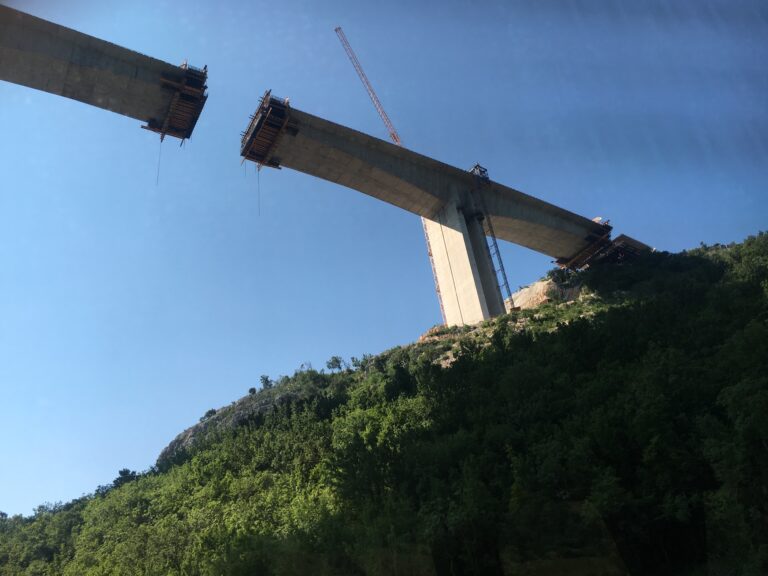
The Bar-Boljare highway established the most visible connection. In 2014, China Exim Bank provided a loan of approximately $944 million to finance 85 percent of the first section’s construction contract with China Road and Bridge Corporation. The section opened in 2022. The project generated controversy over fiscal sustainability, transparency, tax exemptions, and currency risk. But describing it simply as a ‘debt trap’ obscures Montenegrin agency. Domestic leaders chose the project and gained political credit from the promise of new infrastructure. As research on recipient-country agency emphasizes, Chinese finance interacts with local political and economic interests.
The highway also created recurring contact among lenders, contractors, ministries, state companies, and local subcontractors. Those relationships survived the Democratic Party of Socialists’ loss of power in 2020. Successor governments criticized the original financing and used arrangements with Western banks to manage currency exposure. This adjustment shows that continuity in cooperation can coexist with efforts to reduce dependence. The next section of the highway, on the other hand, shows how Chinese participation adapts. Monteput, the state highway company, selected the POWERCHINA-STECOL-PCCD consortium for the Mateševo-Andrijevica section with a bid of approximately €694 million. The European Bank for Reconstruction and Development (EBRD) provides a loan of up to €200 million, and an EU grant of up to €150 million supports the construction.
Monteput says the tender followed EBRD standards, and the consortium submitted the lowest of three financial bids opened. Chinese participation alone therefore does not establish procurement wrongdoing. In May, Monteput also selected a consortium including Shandong for part of the Budva bypass, at approximately €196 million. The pattern extends beyond one highway and one contractor, showing that European funding can improve oversight while Chinese firms continue to build local relationships.
A Partner Across Party Lines
China’s political contacts show similar continuity. In 2014, a Chinese Communist Party (CCP) delegation met the then-governing Democratic Party of Socialists, emphasizing dialogue at both party and state levels. This year, the relationship has expanded to other political camps. According to an official Chinese account of a meeting in June, Prime Minister Spajić, who also serves as the president of the Europe Now Movement, expressed readiness to deepen interparty cooperation with the CCP. In return, the Chinese side proposed exchanges involving party governance, youth and women’s organizations, research centers, and media. Also in June, a Democratic People’s Party delegation visited China at the CCP’s invitation. The party argued that closer Chinese relations and EU integration should coexist.
All these parties have different political histories and priorities, and their contacts with Beijing do not prove a common geopolitical allegiance. The significance lies in the diversity of relationships: China’s access has become less dependent on one political gatekeeper. This is cross-elite embedding – overlapping ties across competing parties, institutions, and generations. A governing party can present engagement as development policy, while another political camp emphasizes sovereignty or bilateral friendship. The language changes, but opportunities for continued contact remain.
Reaching Beyond Today’s Decision-makers
China’s network in Montenegro reaches official institutions as well as political leaders. During a November 2025 visit, China’s special representative met senior government and parliamentary officials, the president of Tivat’s municipal assembly, and representatives of the Port of Bar management. Such contacts matter because ministries, state companies, and municipalities translate political agreements into projects and administrative decisions. Relationships distributed across these bodies can continue when a minister or government changes.
The realm of education also helps in that regard. The University of Montenegro’s Confucius Institute was opened in 2015 through a partnership with Changsha University of Science and Technology. Its activities include language teaching, scholarships, and summer programs. The University of Donja Gorica’s Confucius Classroom, approved in 2019, focuses partly on tourism and professional exchange. These are educational activities, and their Chinese origin alone does not make them an act of interference. But their relevance to China’s network in the country is that they provide opportunities to build contacts among students, academics, administrators, and professionals. Some relationships may remain useful as participants move into new roles.
Montenegro’s small, interconnected political and administrative circles can amplify this effect. A relatively modest number of recurring exchanges can reach several institutions and successive generations of decision-makers.
China’s Foothold as Montenegro Moves Toward the EU
China’s foothold in Montenegro is likely to deepen as its relationships extend across political camps, institutions, and generations. Infrastructure creates the initial access; repeated cooperation makes it familiar, and diversification helps it survive changes of government. Domestic actors seeking investment, contracts, or professional opportunities help sustain this process. Its political consequence is that questioning Chinese involvement can become increasingly costly, even without an explicit demand from Beijing.
The EU accession process does not necessarily stand in opposition to this strategy. Chinese firms have already adapted to European financing and procurement standards, while political and educational relationships continue alongside commercial projects. European oversight can reduce risks within a contract without exposing the wider network of relationships. Montenegro may therefore advance toward EU membership while Chinese access becomes more deeply embedded in its civilian institutions. Formal progress toward accession should not be mistaken for proof that these vulnerabilities have been resolved.
NATO membership similarly constrains overt strategic realignment without insulating procurement, party relations, municipalities, universities, or information systems from external influence. China can benefit from a stable Montenegro that retains its Western orientation: the country offers a regional platform for expanding Chinese influence in the Western Balkans and access to European markets. The strategic value lies in sustained institutional access, which can grow without a visible reversal of foreign policy.
The response must address that cumulative access. Parliament should examine major projects together with related political and institutional ties. Governments should disclose grant beneficiaries and implementation agreements. Parties should report cooperation with foreign ruling parties. Universities should publish partnership terms and safeguard academic autonomy. Screening should assess ownership, subcontracting, data access, and sectoral sensitivity. The EU and US partners should also provide credible investment alternatives, so development does not continually reinforce the same relationships.
The likely future is continued Chinese engagement alongside Montenegro’s European integration. Whether that engagement strengthens development or erodes institutional autonomy will depend on the quality of domestic oversight and the credibility of Western alternatives. Beijing’s most consequential achievement is the durability of its relationships across successive governments. EU accession and NATO membership provide instruments to address this vulnerability, but democratic resilience requires using them to scrutinize the networks through which influence accumulates.
Written by

Danilo Kalezić
Danilo Kalezić is a Senior Research Fellow at the History Institute of Montenegro and a PhD candidate in Political Science at Northern Illinois University. His research focuses on foreign influence, democratization, hybrid threats, and European integration in the Western Balkans. A former Fulbright scholar, he holds an MA from Northern Illinois University and a BA from Jacobs University Bremen. He also writes a weekly column for Portal Analitika.