How Will France’s Next President Deal with China?
France’s presidential campaign has officially started, with the next elections scheduled for April 2027. As the list of candidates and the key points of their campaigns become clearer, the same cannot be said about their approaches to China.
In France, foreign policy is very much the president’s “private hunting ground.” Constitutionally, this power is shared with the government, while the National Assembly plays a (very) limited role. This concentration of authority on international matters makes France’s foreign policy particularly sensitive to the president’s personality and worldview.
Unlike the last presidential elections held in 2022, when foreign policy debates revolved around the then newly started war in Ukraine, debates in 2027 will touch upon a wider set of international matters. Candidates’ proposed approaches to Beijing remain a marginal topic in French presidential debates. However, amid heightened trade disputes and growing tensions in the Indo-Pacific, it is not too early to take a closer look at the front-runners’ positions on China which might, as of next year, reshape Paris relations with Beijing.
The Far-Right National Rally’s Consistent Ambiguity on China
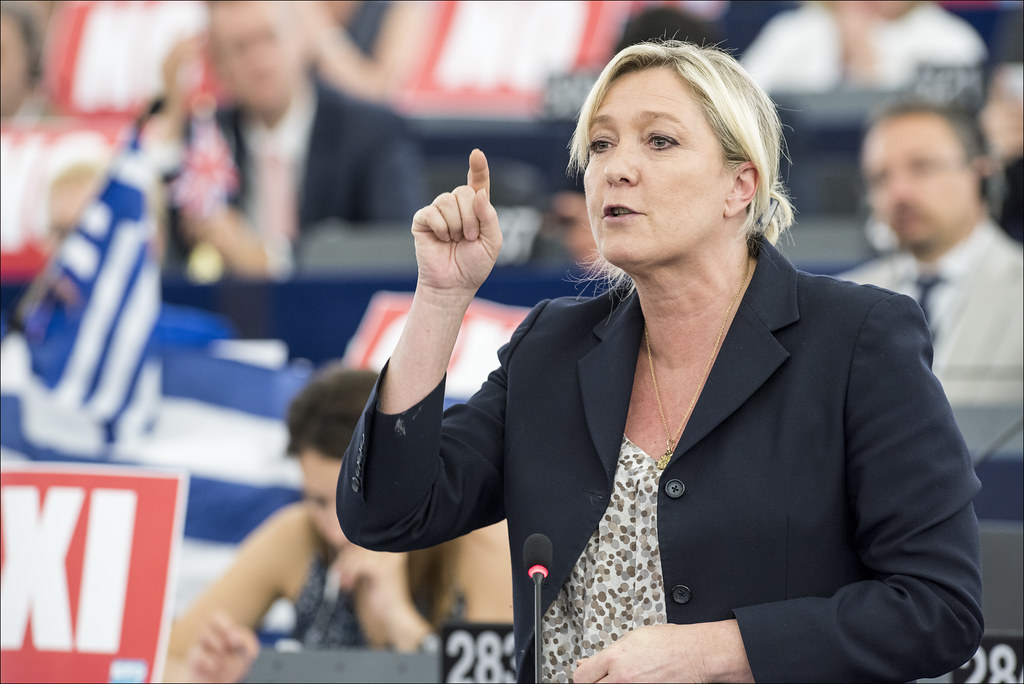
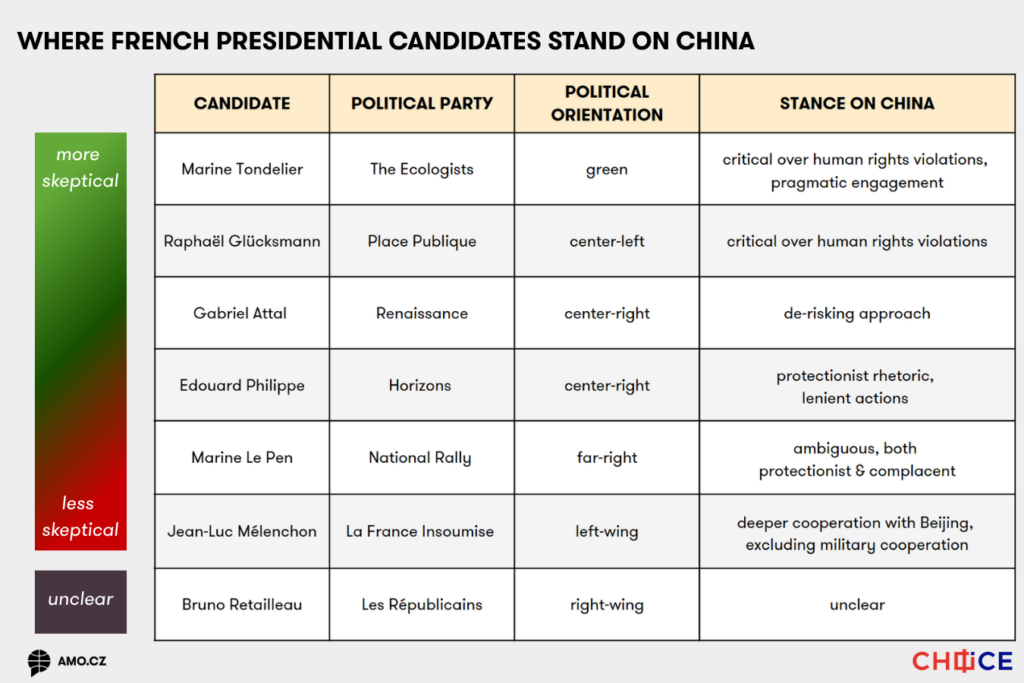
According to the latest polls, far-right veteran Marine Le Pen has an almost guaranteed spot in the second round of the elections. Her party, the National Rally (RN), holds a sovereigntist approach to foreign policy which it frames as a “free-hand policy.”
When it comes to China, the RN’s position is ambiguous, with protectionist and even hawkish comments on the one hand and signs of potential complacency on the other. In 2022, Le Pen declared that “the formation of a united Russia-China bloc would be the greatest threat to France and Europe’s security in the 21st century.” However, she also has a history of lenient positions toward authoritarian regimes: before the invasion of Ukraine, she notoriously defended closer ties with Putin’s regime and even publicly justified the annexation of Crimea.
In recent years, the RN has also cultivated ties with pro-Beijing essay writer, businessman, and a former MEP, Hervé Juvin, whom the French media once called Le Pen’s “China person.” Although excluded from the party after a condemnation for spousal abuse in 2022, Juvin was once described as a key thinker behind the RN’s doctrine, particularly on foreign policy.
On the commercial and economic front, the party officially defends a “sovereigntist protectionism” to shield French industries. Yet in recent years, Jordan Bardella, the RN’s president and Marine Le Pen’s protegé, has combined this line with a focused indictment of EU’s regulations. “It is not China which is killing our industry and our agriculture, it’s the European Union,” Bardella wrote on X in 2024. In practice, the RN was the only party to oppose a 2025 national resolution to impose a €2 tax on “small packages,” which primarily targeted the flood of Shein and Temu packages in France.
When it comes to defense, the RN’s position on China is caught between promises of increased military capacity in the Indo-Pacific and a commitment to non-alignment. Le Pen’s 2022 defense program, titled “Defense: Rearming a Powerful France” argued for an increase in capacity on and around France’s overseas territories, namely New Caledonia and French Polynesia, to face a “destabilization” in the Indo-Pacific attributed to the “rise of Chinese imperialism.”
Center-Right Candidates and China as a “Trade and Industry File”
Former Prime Ministers Édouard Philippe and Gabriel Attal are currently competing for the center-right spot left by incumbent President Macron. Both Philippe and Attal approach China primarily through the commercial lens and argue for the protection of the European market against China’s “unfair competition” through production quotas, imposed joint ventures, and larger technological transfers.
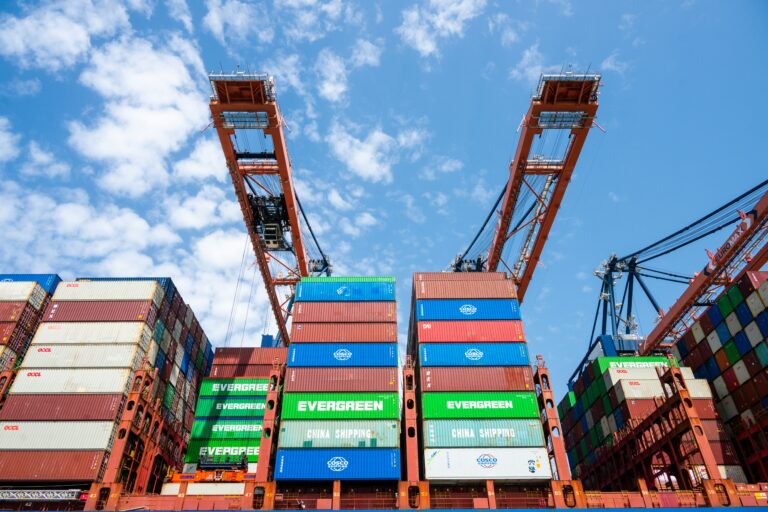
However, Philippe’s approach puts more emphasis on domestic deregulation and seems more lenient to large deals with China. While serving as prime minister, he pushed through – reportedly against the advice of both Foreign Affairs and Research and Innovation ministries – the “Sino-French House of Innovation.” More recently, in his capacity as mayor of Le Havre, Philippe unveiled France’s largest container ship, an AI-powered and LNG-fueled vessel produced entirely in China. It might be worth noting that Édouard Philippe’s party, Horizons, also counts Jean-Pierre Raffarin among its ranks, a known admirer of Beijing who was even decorated with the Friendship Medal by Xi Jinping himself in 2019.
Philippe’s rival, Gabriel Attal, adopts a firmer tone, which seems to echo the European Commission’s derisking strategy. His program outlines the need to use Europe’s “trade response tools,” including import taxes, strict FDI screening on sensitive infrastructures, and the necessity to push for “massive European investments” in key tech sectors, such as AI, quantum, and clean energies.
A Left Divided on China
The president of the left-wing party La France Insoumise (LFI), Jean-Luc Mélenchon, will be running for the fourth time in the presidential elections and might, for the first time, qualify for the second round, according to the latest EPOC poll.
Mélenchon is the only candidate who has exhaustively laid out his positions on China, both in interviews and on paper – he is also the most pro-Beijing candidate. Mélenchon defends a “pact with Beijing,” including not only a “measured and planned” economic and trade policy but also deeper cooperation on a wide variety of issues, such as space programs, while excluding military cooperation. In a May 2026 interview for Brut, he dismissed human rights and values-based concerns, arguing that they are “absurd” double standards and “a way to enroll us in the preparation of the war that the US is organizing against China.” LFI is also the only major party to break so radically with France’s official line on Taiwan by defending and echoing Beijing’s claims over the self-governing island.
The official 2027 program does not explicitly mention this plan for a wide cooperation, although it does mention America’s “endless competition with China” and its refusal to be part of “any permanent military alliance in the Asia-Pacific region.” On this ground, one could argue that there might still be some resistance and division within the party over its stance for a rapprochement with Beijing.
Mélenchon’s pro-Beijing stance sets him apart from the rest of the left. Green Party leader and presidential candidate, Marine Tondelier, signed a steadfast response on her blog titled “To End with the Fascination for China.” In the piece, Tondelier asks: “When will we learn, us the people of the left, that anti-imperialist criticism cannot compromise itself by promoting autocracies?” She then moves on to reasserting her party’s strong commitment to human rights and democratic values, and defending a pragmatic and united policy of European engagement with Beijing. The center-left candidate Raphaël Glucksmann has been equally critical of China. He was also one of the five MEPs blacklisted by Beijing in 2021 because of his vocal comments and concerns about human rights violations in Xinjiang.
The Critical Role of Journalists
Whether they are wary of China or pro-Beijing, the discourses of candidates in the 2027 presidential elections reveal that French politicians still struggle to perceive Beijing as a complex global power with its own political goals and geopolitical ambitions. In the section dedicated to China in a policy paper titled “At the Doors of a New World,” Mélenchon limits himself to the liberal geopolitical rationale that economic interdependence can mitigate conflict. He writes: “As the main exporting power, China has an interest in peace.” This outdated bias – that Beijing is predominantly driven by economic interests – appears deeply rooted in French political debates.
This may change once they take office. That was famously the case with Emmanuel Macron, whose approach to Beijing shifted once in office, marking a realist turn in France’s approach to China. But with Russia’s continued pressure on Europe’s eastern flank, and heightened tensions in the Indo-Pacific, France cannot afford a wavering period of naïve missteps and hesitations as its new president steps into office. French journalists and interviewers will play a crucial role in defining the foreign policy topics which will be debated during the campaign, and it will be their responsibility to push presidential candidates past generic and stale remarks.
Written by

Emma Belmonte
Emma Belmonte was a China Projects Analyst at AMO until August 2026, specializing in Beijing’s interactions with EU institutions, and its wider influence on European politics. Emma has been working as a reporter specialized on Chinese speaking regions, has conducted on the ground reporting in both Taiwan and China and written multiple feature articles for publications including Chinafile, GEO magazine, Figaro Magazine and the Green European Journal. She holds a Master’s degree in Modern Chinese Studies from the University of Oxford and a Bachelor’s degree in Philosophy from the Ecole Normale Supérieure de Lyon.