Is a Czech China Policy Reset Likely under Babiš 2.0?
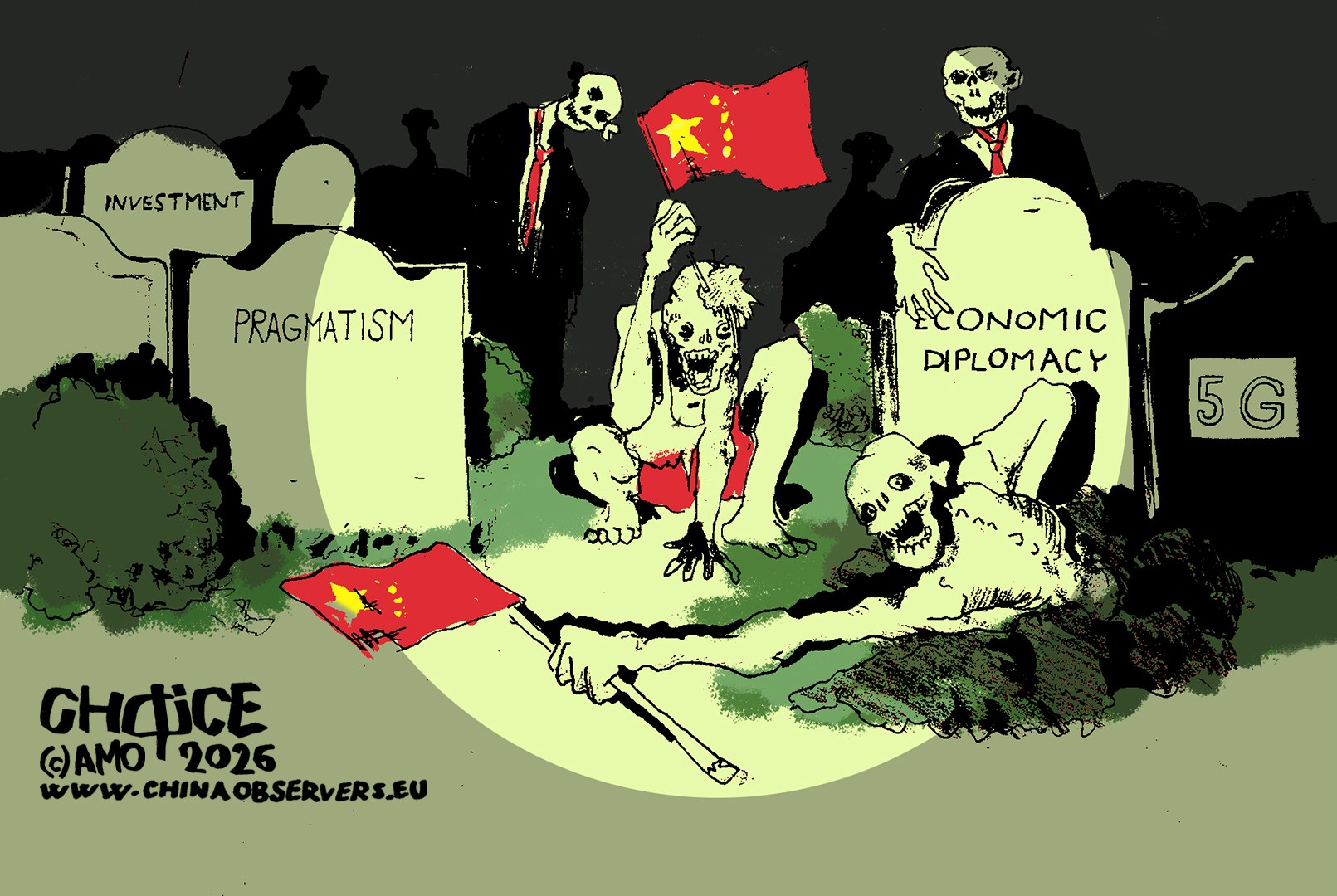
Since the late 2010s, Czechia has emerged as one of the EU’s more critical and politically assertive voices on China. The question now is whether this position will survive the return of Andrej Babiš to power after his October 2025 parliamentary election victory. The answer is likely yes, but with caveats.
The current Czech government seems to seek a tactical easing of tensions with Beijing, especially where it sees low-cost economic gains. Yet a deeper strategic reset remains unlikely as it is constrained by a growing realization that China offers less than many Czech politicians once assumed, while the political and security costs of visibly accommodating Beijing have grown.
Unfriendly by Default?
Czechia has historically been among the EU’s more critical voices on China, although its policy has never been entirely linear. Since the establishment of the independent Czech state in 1993, relations with Beijing have oscillated between values-based criticism – rooted especially in human rights concerns and support for Tibet and Taiwan – and shorter periods of economic pragmatism. Seen against this longer backdrop, Czechia’s flirtation with China during the 16+1 honeymoon of the early 2010s appears less as a durable strategic reorientation than as an anomaly in an otherwise cautious and often skeptical approach to Beijing.
Since the late 2010s, this exception had largely run its course. Czech China policy began to revert to its more skeptical default, now reinforced not only by values-based concerns but also by an increasingly explicit security reading of Beijing’s behavior. High-level Taiwan visits by Czech political figures, China’s subsequent pressure on and threats against Czech politicians, growing cyber concerns, and the wider context of China’s “pro-Russian neutrality” in Russia’s war against Ukraine all contributed to a marked deterioration of bilateral ties.
The clearest recent example came in June 2025, when Czech authorities disclosed that Chinese officials had planned intimidation against Taiwan’s Vice President Hsiao Bi-khim during her 2024 Prague visit. According to Czech security services, Chinese diplomats had attempted to track her movements and stage a deliberate car collision as a warning signal during the visit. Prague subsequently summoned the Chinese ambassador. The episode reinforced the view already expressed in Czech government strategies that China is not merely a difficult economic partner, but also a political and security problem.
The same logic was visible in other areas. In May 2025, the Czech government accused China of a cyberattack against the Ministry of Foreign Affairs. In July 2025, President Petr Pavel met the Dalai Lama during his visit to India, fully aware that the move would trigger a Chinese protest. Beijing responded by announcing that it would sever all contact with the Czech president. Pavel’s office dryly noted that since there had been no direct communication between Czechia and China at the presidential level, the Chinese step would not change much in practice.
Ghosts of the China Romance
The return of Babiš has nevertheless opened space for speculation about a China recalibration. In January 2026, the then national security adviser Hynek Kmoníček publicly announced that Prague was preparing a “certain shift” in relations with Beijing and that a Babiš visit to China was under consideration. Kmoníček’s role in this debate, however, should be treated with caution. His apparent move toward the post of Czech ambassador to the UN in New York suggests that he may no longer be central to Babiš’s immediate foreign-policy decision-making.
Nonetheless, there is still little evidence that Babiš himself has a strong political appetite to invest heavily in a China reset. His government is more sovereigntist, less inclined to increase defense spending, and less Ukraine-supportive than the previous cabinet. But that does not automatically translate into a pro-China line. The more plausible reading is narrower: Prague is testing whether it can recover some limited economic benefits, signal a domestic political break with the value-based foreign policy of the previous government, and do so without paying major geopolitical costs.
This is also where personnel matters. The foreign policy environment around the new government includes figures who have long argued for a more “pragmatic” line on China, or who are closely associated with the earlier period of Czech openness toward Beijing. One of them is Jan Zahradil, a former MEP from the Civic Democratic Party (ODS) and currently the Motorists’ foreign policy advisor. Zahradil’s record in the European Parliament (EP) carries considerable China-related baggage. He chaired the informal EU-China Friendship Group, which was criticized for operating outside the EP’s official China structures and for blurring the line between parliamentary diplomacy and Beijing-friendly networking. He also faced scrutiny over the failure to disclose Chinese sponsorship for an event connected to the group. Zahradil denied any wrongdoing.
Another figure worth watching is Miroslav Sklenář, the chief of cabinet of the current Minister of Foreign Affairs Petr Macinka. Before working as the head of the Czech president Miloš Zeman’s protocol, he worked for CEFC, the infamous Chinese conglomerate which turned into a Ponzi scheme that became the emblem of Czechia’s failed China investment romance in the mid-2010s. Sklenář’s presence does not in itself prove a pro-China shift, but politically, it matters. Together with Zahradil, it strengthens the impression that some of the networks, habits, and assumptions of the earlier “China opportunity” period have returned to the vicinity of foreign policy decision-making.
This makes the current recalibration politically more sensitive. A softer China line promoted by people with Zahradil’s record is unlikely to be read in Brussels or Washington as a purely technocratic attempt to restore trade ties. It may instead be interpreted through the memory of the earlier Czech flirtation with China, the CEFC period, and the subsequent collapse of inflated expectations.
A Reality Check
Privately, Czech government politicians appear increasingly aware that China has less to offer than many assumed while in opposition. This is consistent with the longer Czech experience documented in earlier work on inflated expectations around China engagement. Today, the gains discussed in Prague are modest: more Chinese tourist arrivals, the possible restoration of direct Shanghai-Prague flights, 30-day visa-free regime for Czech nationals visiting China, and perhaps some incremental commercial activity.
But these prospective gains remain limited, while the political costs of any visible rapprochement with Beijing could be substantial. This is especially true in relation to Washington. The dynamic was illustrated by Foreign Minister Petr Macinka’s reported January consultation with US Ambassador Nicholas Merricks over Babiš’s planned trip to China, during which Macinka signaled a commitment to follow Washington’s line on China. In other words, even a government interested in tactical de-escalation with Beijing understands that China policy is no longer a bilateral issue. It is also a test of Czech positioning within the transatlantic relationship.
Developments in 2026 have further complicated any straightforward return to warmer relations. In January, Czech authorities detained a Chinese national who had worked in Prague as an accredited journalist. In May, prosecutors indicted him for “unauthorized activity for a foreign power,” the first case brought under a new provision of the Czech Criminal Code. At the end of June, Chinese authorities detained a Czech businessman at an airport and later said that he was being investigated on suspicion of endangering national security. When confirming the case, Beijing also denounced the Czech prosecution of the Chinese journalist and demanded his release, publicly placing the two cases side by side. The tension did not prevent Chamber of Deputies Speaker Tomio Okamura from beginning a five-day visit to China on July 20 – the first by a senior Czech political representative since 2019. Yet the trip was criticized by opposition politicians because of its timing while a Czech citizen remained detained and because it risked signaling accommodation before Beijing had addressed Prague’s security concerns.
The Taiwan Factor
At the same time, Czechia is not willing to completely cease cooperation with Taiwan, which has become one of the most visible and promising parts of the Czech Indo-Pacific strategy – a strategy that, interestingly, does not directly mention Taiwan. The most important element of the bilateral exchange centers on semiconductors. Czech-Taiwanese cooperation in this field has moved well beyond symbolic politics into initial supply-chain building, industrial networking, skills development, and investment promotion.
Taiwan has explicitly used chip diplomacy to deepen ties with Central European partners, including Czechia. Prague has leaned into this by repeatedly participating in Semicon Taiwan, promoting the Czech semiconductor ecosystem, and organizing Czech-Taiwanese supplier events. This fits well with Czechia’s broader ambition to embed itself more deeply in the European chip ecosystem, including participation in the ecosystem connected to TSMC’s investment in the Dresden foundry, Onsemi’s large-scale expansion in Czechia, and the establishment of the Czech Semiconductor Center in 2025.
Despite a recent recalibration at the Czech government level, Taiwan still offers Czechia something China increasingly does not: a politically acceptable route into a high-value strategic industry. Beijing can promise tourists and flights. Taipei can offer semiconductors, skills, and industrial upgrading. For a small, export-oriented economy trying to move up the value chain, this difference matters.
This is why the recent signals from the Babiš government should not be read as a full break with Taiwan. They are better understood as an attempt to recalibrate relations with China, maintain credibility in Washington, and manage relations with Taipei differently from the previous government. This is because domestic politics plays an outsized role in any Czech-China or Taiwan-related affairs. This was visible in April 2026, when Babiš refused to provide a government aircraft for Senate Speaker Miloš Vystrčil’s planned Taiwan trip and criticized the visit as harmful to Czech economic interests.
A Low Ceiling
Czechia is therefore best understood as a security skeptic with some room for tactical de-escalation, not as a genuine opener to China. Babiš may eventually visit China, possibly in spring 2027. Foreign Minister Macinka may continue to speak the language of pragmatism, normalization, and economic opportunity. Beijing will welcome this rhetoric and try to present it as evidence that Czech China policy is returning to a “healthy track.”
Yet the ceiling on rapprochement remains low. The structural drivers of Czech skepticism have not disappeared: cyber threats, Taiwan, China’s coercive behavior, the Russia factor, and the lack of meaningful economic returns from previous engagement. What may change is the tone, not necessarily the substance.
The most likely outcome is therefore not a Czech China reset, but a Czech China softening at the margins. Prague may lower the temperature, avoid unnecessary symbolic clashes, and explore limited economic openings. But it is unlikely to abandon Taiwan cooperation, reverse its security concerns, or meaningfully detach its China policy from the transatlantic line. China offers too little, while the price of accommodating Beijing remains too high.
This article is part of the 2025-2026 CEE China Policy Audit published by CHOICE in September 2026.
Written by

Ivana Karásková
ivana_karaskovaIvana Karásková, Ph.D., is a Founder and Lead of CHOICE & China Projects Lead at the Association for International Affairs (AMO) in Prague, Czech Republic. She is a an ex-Fulbright scholar at Columbia University, NYC, a member of Hybrid CoE in Helsinki and European China Policy Fellow at MERICS in Berlin. She advised the Vice-President of the European Commission, Věra Jourová, on Defense of Democracy Package.