Chinese diplomacy does not just take place via Beijing’s Ministry of Foreign Affairs (MFA). The Chinese Communist Party (CCP) has organs that undertake diplomatic efforts too. Under Xi Jinping, these have evolved. This article combines hard data from MFA visits with a newly built dataset of International Department of the Communist Party of China (IDCPC) interactions to show the diversity of Chinese diplomacy visible in Czechia, Hungary, Poland, and Slovakia – the Visegrad Four (V4) countries.
To show the diversity of Beijing’s foreign policy toolkit, the article combines two data sources. The first is this author’s manually built database of Chinese MFA visits that provides an overview of the diplomatic priorities of the People’s Republic of China (PRC). The second is the newly produced database of publicly announced IDCPC interactions. This database was built using Anthropic’s Claude Opus AI model. The announcements were scraped mechanically from the IDCPC website using a Python script before they were turned into a categorized table with the help from AI.
It is important to note here that this approach does not fully display the diversity of Chinese diplomacy. This is because the scope of data captured by both databases is limited. The MFA database is based on website announcements that include only the ministerial level and above. The IDCPC database is based on announcements that only start at the vice-ministerial level, leaving out the important lower-level interactions as well as multilateral summits. Moreover, the manually created database carries risk of human error whereas the AI-created database is still a proof-of-concept. The initial output nevertheless provides useful insights into China-V4 dynamics and Beijing’s variable diplomatic toolkit.
The IDCPC’s Increasing Activity
China’s MFA never had a monopoly on the country’s foreign policy. But, since Xi took office in late 2012, party organizations like the IDCPC have become more active still. During the Cold War, the IDCPC was mainly known for exchanges with fraternal communist parties. Since the Opening and Reform, however, it has broadened its remit. Now the IDCPC talks to politicians of all stripes. More recently, as Xi strengthens the role of the Party, some countries are turning to it as another diplomatic entry point for non-political officials.
In particular, V4 bilateral interactions with China highlight the different roles IDCPC now assumes. Due to the limits of what is available on the IDCPC website, this article is roughly limited to Xi Jinping’s third term, starting in January 2023 and ending in April 2026.
Return to the Old Ways in Czechia
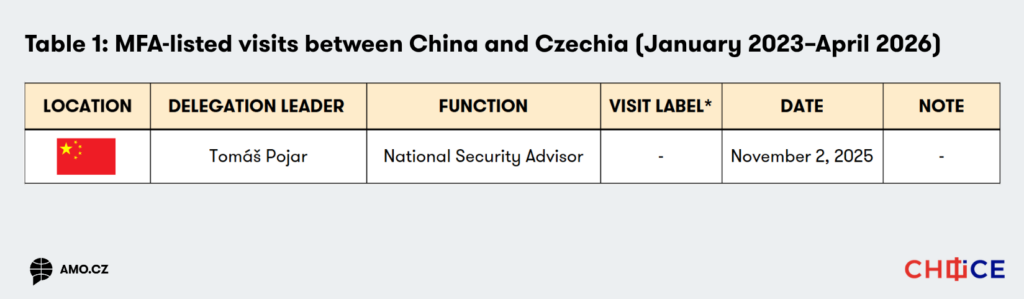
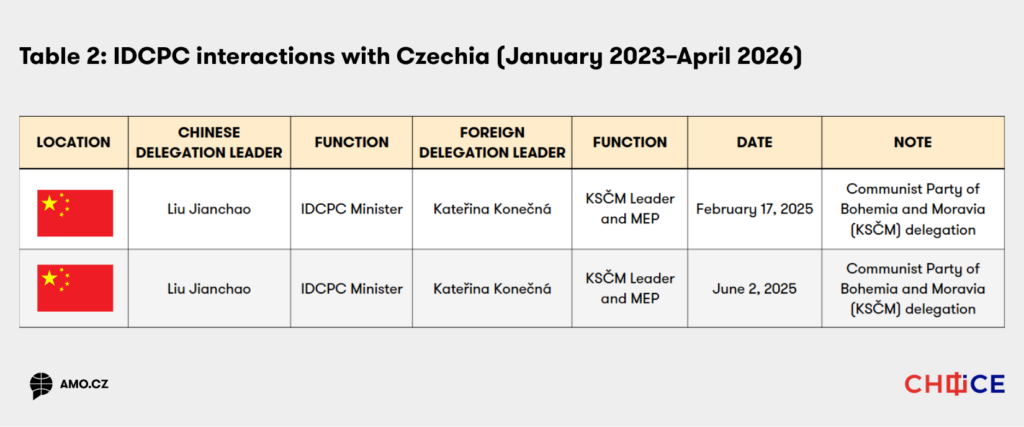
For most of Xi’s third term, Czechia and China have maintained troubled bilateral relations. This is reflected in the MFA database that logs only one visit above the vice-ministerial level: an incoming visit by Prague’s national security advisor Tomáš Pojar at the end of 2023.
IDCPC data, on the other hand, shows sustained interaction with the leader of the Communist Party of Bohemia and Moravia (KSČM), MEP Kateřina Konečná. KSČM is a marginal political force in Czechia. It has no national representatives and its ties with the CCP are representative of the old focus of the IDCPC on fraternal communist parties. KSČM is the inheritor of the Czech half of the former ruling party of Czechoslovakia under communism. Konečná’s position in the European Parliament might be an additional draw.
As previously noted, the scope of data captured in both databases is limited. The IDCPC data is too recent to capture the important role that party-to-party ties played under President Zeman to restore Sino-Czech ties after a difficult period 2008-12 following support for Tibet by a previous government. The MFA database also misses out on visits such as China’s Vice Foreign Minister Hua Chunying to Prague and Bratislava in January 2026 or Wang Yi’s meeting with his Czech counterpart Petr Macinka on the sidelines of the 2026 Munich Security Conference.
Making Friends with Hungary
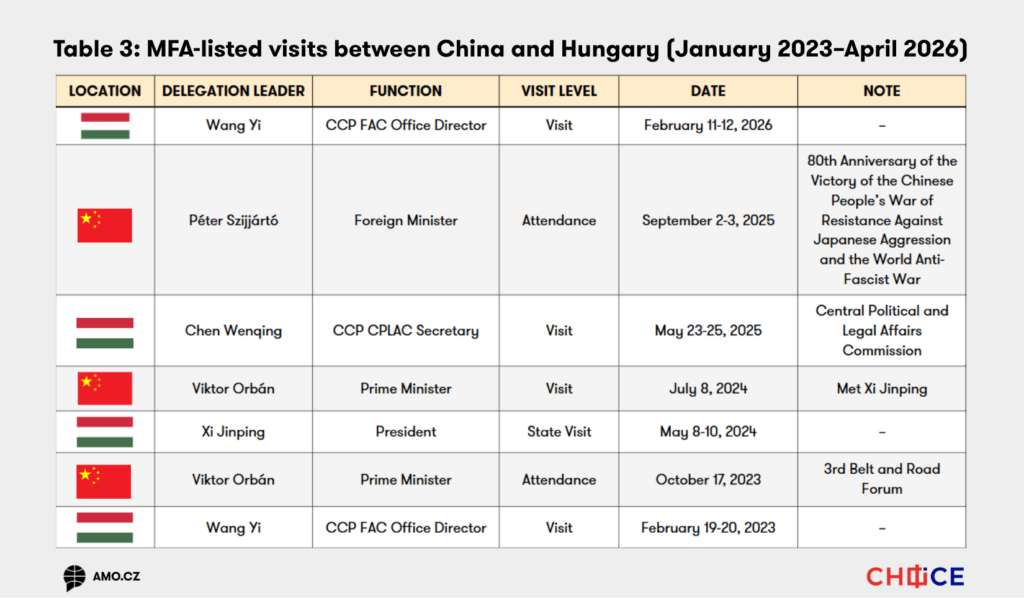
The data on Hungary demonstrates an approach common with politically friendly countries – although the situation is up in the air now that Viktor Orbán lost power. The MFA database shows that Chinese MFA maintained close diplomatic relations with Budapest under Fidesz. Hungary’s popularity for Chinese MFA-led visits of ministerial level or higher was out of proportion to its size with a total of 20 visits in both directions under Xi – though still less than one third of France’s and half of Germany’s visits. The MFA database excludes the visits Péter Szijjártó paid to Beijing in his capacity as trade minister, since his counterpart then was the Ministry of Commerce.
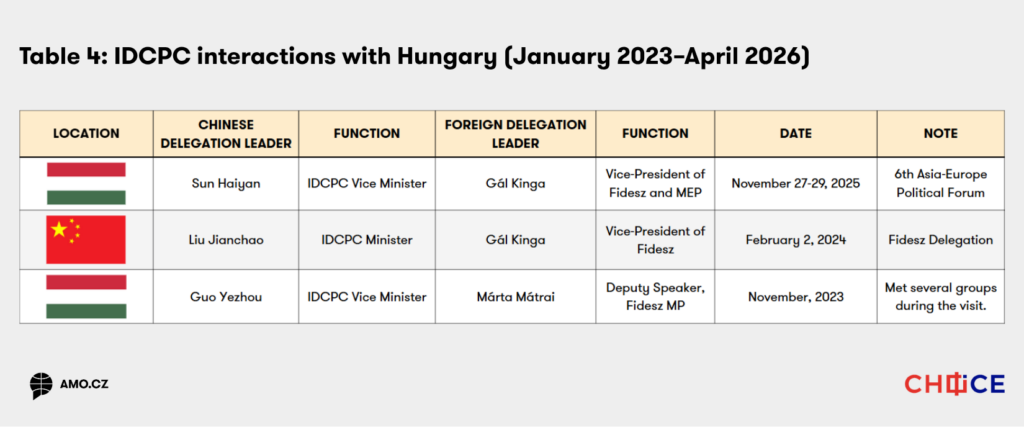
The IDCPC database demonstrates a sustained focus on government politicians in friendly countries. In November 2023, Deputy Speaker Márta Mátrai was the highest ranking of a series of Fidesz politicians meeting IDCPC Vice Minister Guo Yezhou. In 2024, the Fidesz MEP and party vice president, Gál Kinga, led a delegation to meet IDCPC Minister Liu Jianchao and received a delegation under Vice Minister Sun Haiyan in 2025.
Receiving Officials from Poland
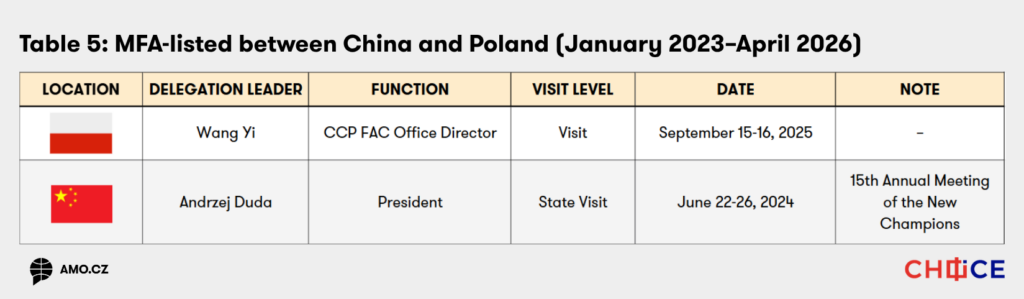
Poland perfectly illustrates the new role that the IDCPC takes on in recent years. The MFA database shows that Warsaw’s diplomatic interactions with Beijing’s foreign ministry in Xi’s third term were not substantial – though the 2023 change in Polish government might have played a role. Given the size of Poland’s population and economy, its diplomatic interactions with Beijing have always been on a lower side proportionally speaking.
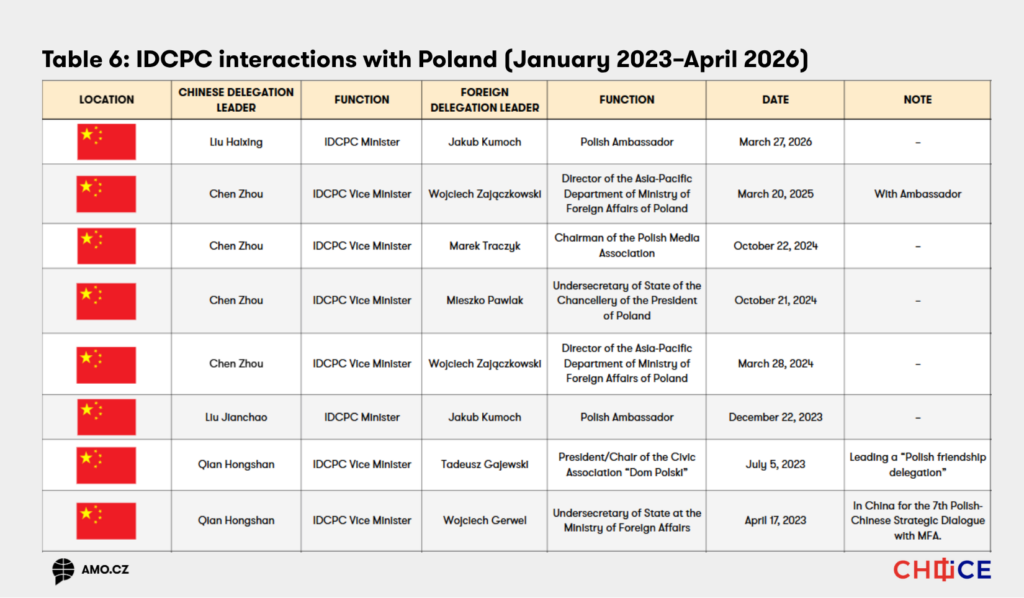
Yet, the newly built database shows Polish interaction with the IDCPC is sustained. Of the four countries in this sample, Poland had the most interaction with the IDCPC in Xi’s third term. Interestingly, these were mostly with Polish MFA officials. All recorded meetings took place in Beijing. Of the eight recorded interactions, only two were not with government officials. The groups in case were the Polish Media Association and Civic Association “Dom Polski” (Polish Home), the latter also serving as the delegation attributed to Poland at the June 2025 “Fourth Dialogue on Exchange and Mutual Learning Among Civilizations.” This is an example of the politicizing angle to bilateral interactions the IDCPC brings.
Settling in with Slovakia
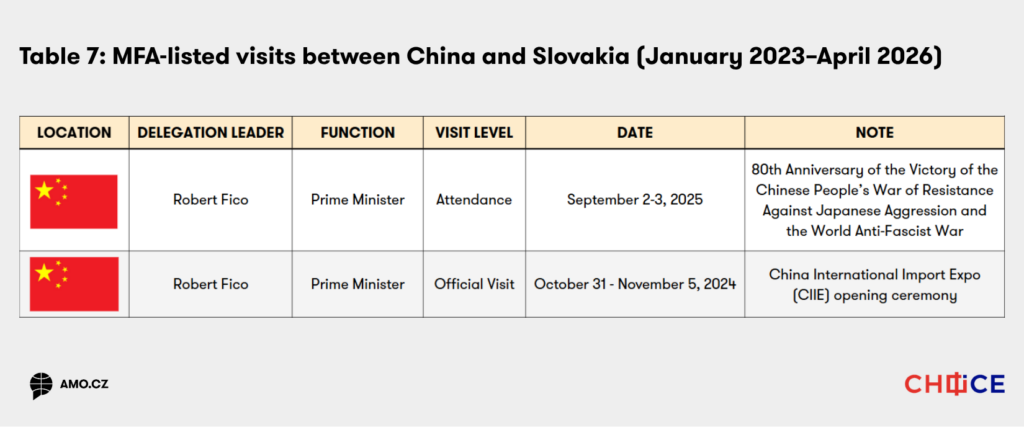
Slovakia is a case of a country with a government open to engaging with Beijing through available channels. The MFA database shows that Prime Minister Fico has been to China twice since 2024. It lists no Chinese diplomatic visits of ministerial level or above to Slovakia in that period.
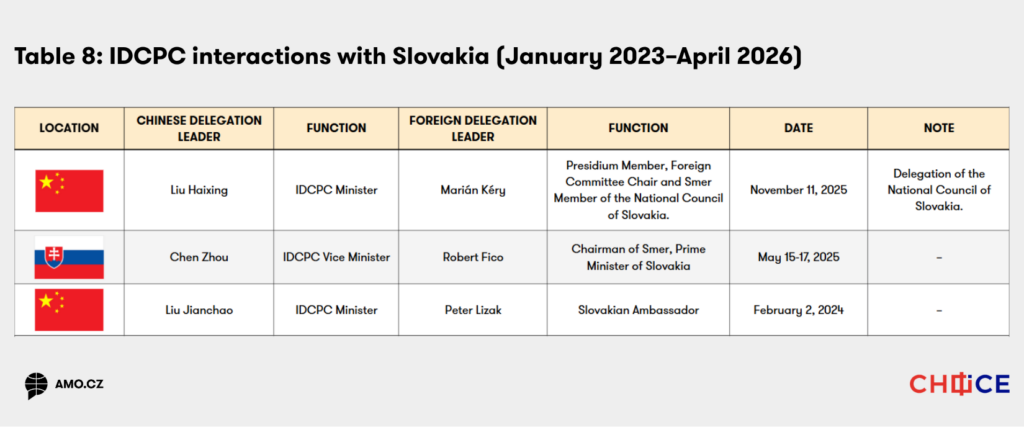
Yet, the IDCPC database demonstrates that in the absence of senior state officials visiting Bratislava, the country has dealt with the CCP directly. In 2025, Premier Fico received a CCP delegation that arrived for various exchanges. That same year, a parliamentary delegation under the Foreign Committee chair was received by IDCPC Minister Liu Haixing. A year earlier, his predecessor Liu Jianchao interacted with the Slovakian ambassador, showing Bratislava likely recognizes the IDCPC’s diplomatic role.
The Diverse IDCPC Modes of Interaction
This article outlined different ways in which Chinese party diplomacy operates. First, the Czech case highlights traditional exchanges with a fraternal communist party in the absence of substantial diplomatic exchanges. Second, the Hungarian case shows Beijing’s habit of focusing on building close ties with the ruling party in friendly countries. Third, the Polish case demonstrates a supplementing of bureaucratic contact with the MFA. Fourth, the Slovak case highlights how a smaller country ensures regular interaction using the party connection.
The January 2023–April 2026 period covered by this article finds more bureaucrats alongside the remaining party ties. This demonstrates the variation in China ties to V4 countries. It is not immediately clear from the data what drives this variation. It is probably correct, however, to presume that this has as much to do with political preferences and bureaucratic reality on the V4 side as with Chinese diplomatic tactics. More research is needed to understand what determines the mode of interaction. Yet, what remains clear is the versatility Beijing draws from having access to more diplomatic tools than just a foreign ministry.
Written by

Sense Hofstede
sehofDr Sense Hofstede is the Head of AMO’s China Team Brussels Office and a China Analyst. He is an expert in the influence of the Chinese party-state on foreign policy, cross-Strait politics, and the Indo-Pacific. He has completed his PhD in Comparative Asian Studies at the National University of Singapore and has previously worked as a Lecturer at Leiden University and a Research Fellow at the Clingendael Institute.