
The current decade brought about a series of high-profile news about China’s progress in space. This development raises several questions regarding innovation forging, as well as broader security implications. Last March, the Czech government banned a plan to build a space communications facility linked to China. At the same time, China itself continues its narrative offensive to present its space strategy as peaceful and globally open.
The Central and Eastern European (CEE) countries should be cautious and observe China’s rise not as a distant phenomenon, but as a strategic variable, while noticing its tangible diplomatic and security consequences. Space cooperation today sits at the intersection of infrastructure, data governance, and academic partnerships. Engagement with Chinese space actors may offer access to technologies and participation in cutting-edge projects, but it also raises questions about dependencies and long-term positioning within the emerging astropolitical frameworks. Understanding the logic of China’s space program is thus essential for policymakers seeking a balance in innovation opportunities and critical industrial resilience.
Chinese Way to the Stars
China Space Program was developed in a sequenced manner, beginning with the reliable launch vehicle. This milestone was achieved on April 24, 1970, when a modified ballistic missile was launched as Chang Zheng 1 (the “Long March”), successfully placing China’s first satellite in orbit. Over the following decades, China expanded its rocket family, ultimately deploying nearly 20 variants designed for all possible mission profiles.
The collapse of the Soviet Union and Russia’s financial difficulties in the subsequent years created opportunities for Chinese engineers to acquire space knowledge transfer, accelerating various key projects such as the Shenzhou program, adapting the Soyuz orbital capsule. This launcher-first strategy provided a technological foundation for subsequent activities. The next phase involved the human spaceflight capabilities, culminating in October 2003 (Shenzhou 5). Since then, crewed spaceflight has become routine. Since 2020, China has maintained a manned presence in space through the Tiangong space station.
In addition to technology development, both public and private space sectors expanded dynamically as well. China bases its launch capabilities on four rocket sites: three civil-military and one civilian spaceport. The fifth, Xiangshan, is nearing completion in Zhejiang, intended for use by smaller companies and aerospace startups.
Space Institutions
The internal logic of Chinese space policy operates differently from the American model: rather than a single agency governing all domains of the space economy ecosystem (like NASA), China operates through a sectoral division of competencies.
Although the China National Space Administration (CNSA) is nominally the main decision-maker for space activities, in practice, it is responsible only for the political framework and international marketing of the program. Alongside the CNSA, a significant player is the China Aerospace Science and Technology Corporation (CASC) – a state-owned company coordinating the production of satellites, maintenance and operation of space infrastructure on Earth, and overseeing a network of research and development institutions – the so-called “academies.”
Another entity is China Aerospace Science and Industry Corporation (CASIC). It focuses on launch vehicles, as the largest manufacturer of rockets and dual-purpose technologies. The final pillar is the China Manned Space Agency (CMSA) conducting the crewed program. There is no direct proof of integration between CMSA and the People’s Liberation Army Aerospace Force, however, such cooperation is likely due to the formal affiliation of the China Astronaut Corps (the taikonauts), who fly CMSA missions within the armed forces.
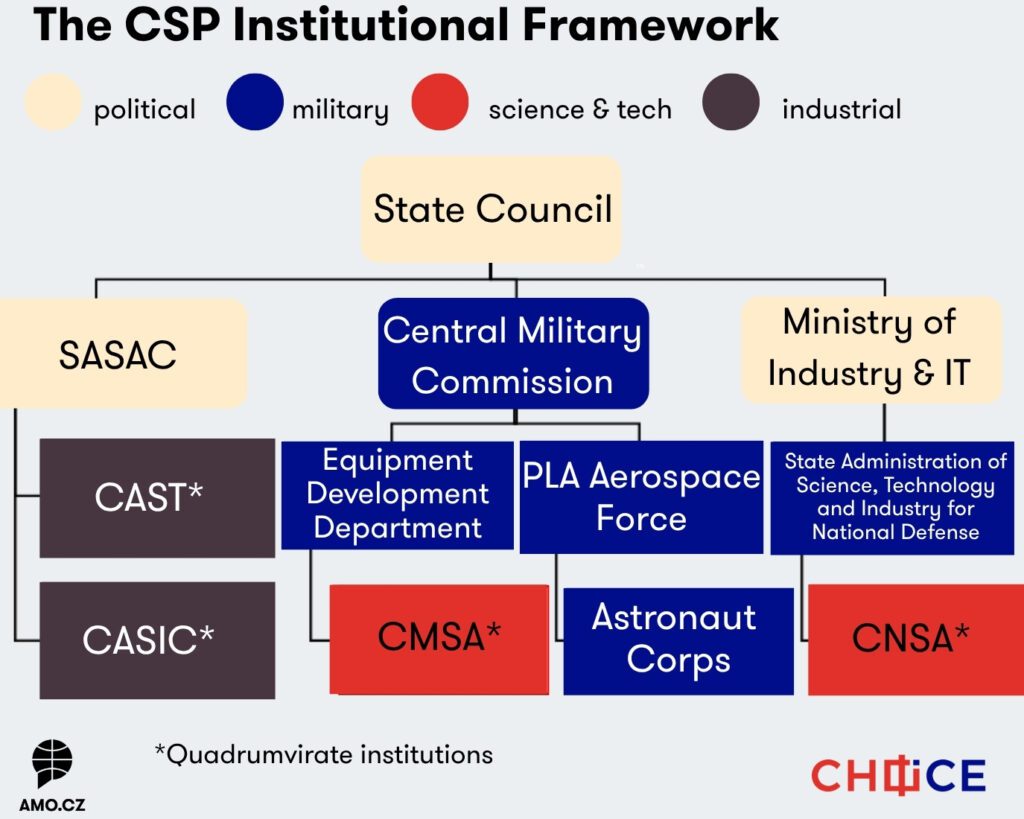
Fig. 1. The CSP institutional framework
Dragon’s Influence
The completion of Tiangong station, the Chang’e lunar program, and the construction of megaconstellations represent the consolidation of China’s transition into a space power with a variety of tools to conduct its own astropolitical plans. The new industrial strategies (e.g., Made in China 2025, 15th National Five-Year Plan, and the Plan for Space Science Development 2024-2050) outline China’s path to lead in advanced technologies. In addition, these plans also assume deepening international collaboration in space.
The primary format in this field is the International Lunar Research Station (ILRS) initiative. It aims to build a permanent base on the Moon, staffed by international researchers led by China and Russia before 2035. ILRS principles cover the scientific cooperation, equipment integrity, mission planning, and finally the construction and exploitation of the facility. The initiative was officially inaugurated in 2021, following the competitive format of the US-led Artemis Accords. Apart from a project aiming at returning to the Moon, Artemis is also a political platform establishing a modus vivendi in the emerging space economy.
Although both agreements do not constitute political alliances, and joining one does not formally exclude the other, there is a visible bloc-logic pushing states to apply for membership.
China in CEE
Cooperation between China and several CEE countries in space science has developed in the last two decades. Reflecting the differences in political choices and strategic priorities, it is uneven and adopted differently by individual states.
Belarus, as the first example, represents the consistent partnership on China’s side. Apart from Belarus joining the ILRS in 2023, the cooperation had already included China’s first satellite project in Europe, the Belintersat-1, launched in 2016 and operated by both Belarusian and Chinese telecommunications entities. Additional plans reportedly involve further satellite missions, student projects, and potential participation in lunar research.
Hungary presents a more ambiguous case. While Orban’s political and economic ties with Beijing are well known, Budapest has avoided a clear long-term alignment with Chinese space initiatives. In 2024, however, a Hungarian research foundation joined the ILRS independently, illustrating that cooperation can also develop at the institutional level. At the same time, Hungary has strengthened its links with Western partners participating in Hungarian astronaut and satellite missions conducted with the US and European actors, and joining the Artemis Accords in December 2025.
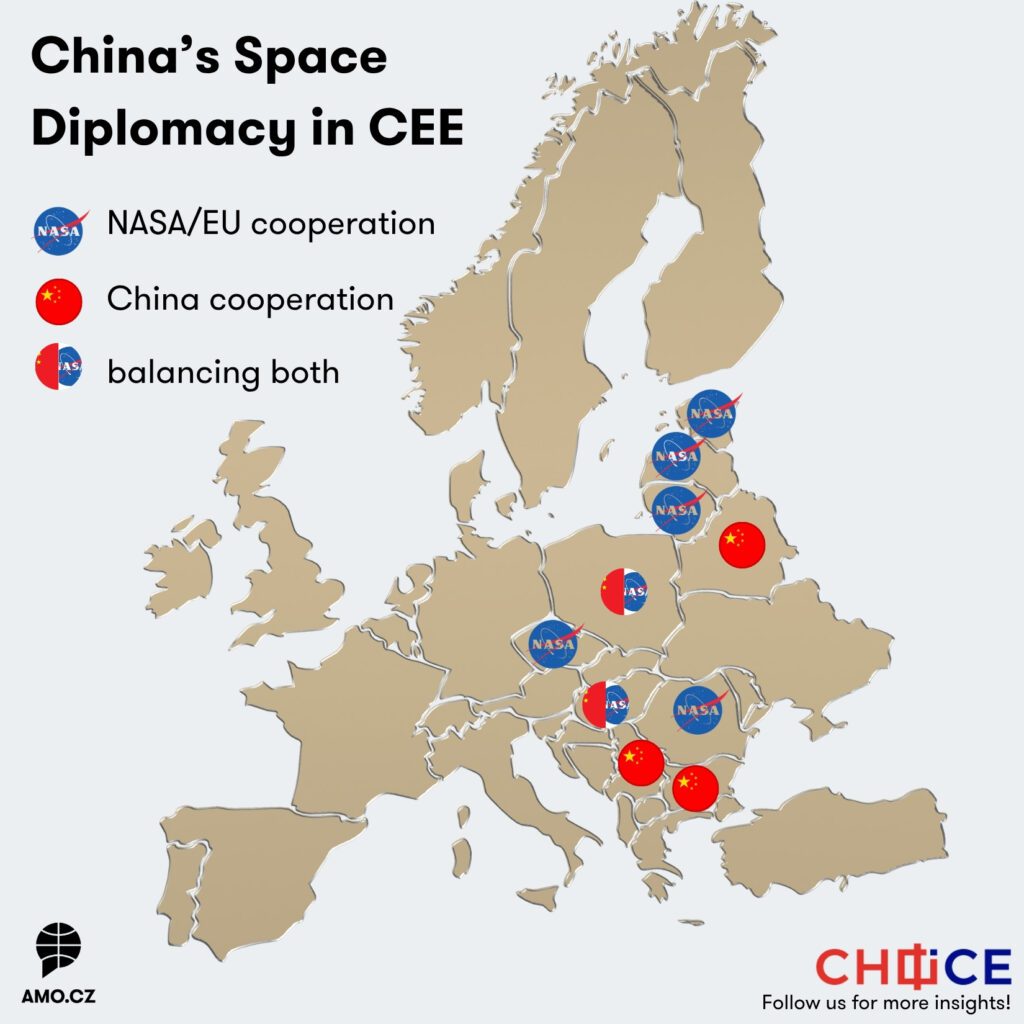
Poland’s interaction with China has been variable over time and primarily scientific. Earlier cooperation included the launch of the Polish “Heweliusz” small satellite on board a Chinese rocket in 2014, participation of a Polish instrument in a Chinese lunar mission, and the POLAR experiment conducted jointly with the Chinese Academy of Sciences aboard the Tiangong-2 space laboratory. Although Poland’s current strategy remains strongly embedded in cooperation with NASA and the European space ecosystem, a follow-up iteration of the POLAR project has been discussed in recent months.
Serbia, by contrast, has moved closer to China in the space domain. Institutional cooperation began in 2020 with a memorandum between the Serbian Space Office (SerbSpace) and the CNSA and was further strengthened in 2024 when Serbia joined the ILRS. The country is currently developing its first national satellite, likely to be launched with Chinese assistance, although the exact scope of its participation in the lunar program remains unclear.
Looking Ahead
Taken together, these examples illustrate a broader pattern: while China is gradually advertising its space partnership opportunities in CEE, the directions of cooperation vary significantly, depending on each country’s broader political alignment and the existing intensity of ties within the Euro-Atlantic order.
In all likelihood, China will continue to develop world-class space mission plans in the foreseeable future. Thus invitations to collaborate with other actors, including CEE countries, their agencies, and companies independently, will also continue – as exemplified by the return of Poland and the new collaborative actions in Bulgaria or Hungary.
The non-EU members like Serbia and Belarus may be increasingly inclined to join this collaboration. On the other hand, EU members have chosen the Euro-American, or even Indian path from the beginning. The examples include Romania, Slovenia, and Baltics. Countries with established spaceflight heritage, i.e. Czechia, have also shifted their focus from orbital flights on Russian rockets to NASA, SpaceX, or ISRO, bypassing China in their choices. Countries not involved in either of the two space blocs, Croatia, Albania, and Montenegro, are very likely to move towards the Artemis due to strong ties with NATO and existing space projects within ESA/EU.
CEE is thus becoming a testing ground for competing architectures of collaboration: the Artemis Accords and the Chinese-led model. At the same time, the space sector is ceasing to be a scientific domain alone, evolving into an arena of influence, diplomacy, and resilience of critical infrastructure. The future involvement of governments in space cooperations will increasingly be determined not only by access to technology or launching windows, but also by a strategic choice of alignment with a particular framework.
Written by

Krzysztof Karwowski
Krzysztof Karwowski is a Doctoral Fellow at SGH Warsaw School of Economics. His research focuses on Chinese science policy and China’s space program. He is also a tech Editor at “Układ Sił” magazine.