Following a gradual build-up over the past few years under the leadership of Prime Minister (PM) Pedro Sánchez’s Socialist government, the recently published Asia-Pacific Strategy for 2026-2029 places China at the forefront of Spain’s plans for the region. Growing geopolitical tensions between Trump and Sánchez, coupled with Beijing’s emergence as Madrid’s primary non-EU commercial partner and sustained institutional visits by Sánchez and various other ministers to Beijing, underscore China’s increasing significance in Spain’s foreign policy.
Tightening the Cooperation
China’s growing importance for European capitals – evident since the 2008 global financial crisis – signals the limits of the Western economic system. While the US, according to experts, is retreating from the liberal international order, some countries have taken advantage of this vacuum to grow closer ties with Beijing. Spain is one of the few European countries to do so.
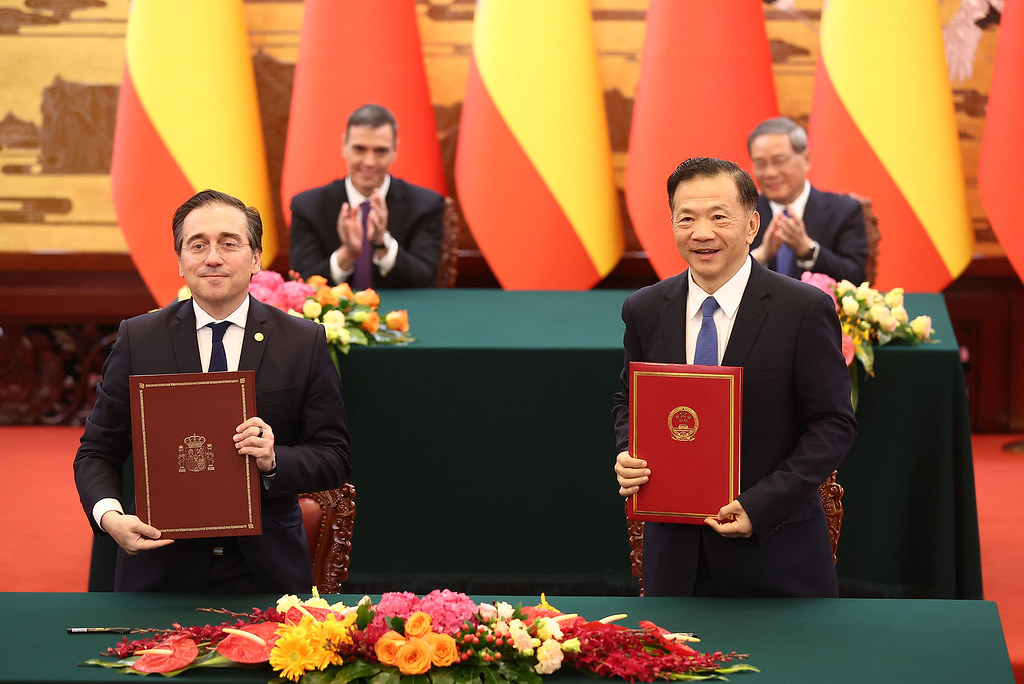
A good example of this trend is the establishment of a Joint Action Plan between Madrid and Beijing last year. The plan focuses heavily on commercial relations and envisages establishing a permanent mechanism to facilitate mutual investment, setting up a joint economic and industrial committee, strengthening intellectual property exchanges, and signing several memoranda of understanding on cooperation in the pharmaceutical and e-commerce sectors. Conversely, the Joint Action Plan does not focus on political relations between Madrid and Beijing, and refers to human rights in general terms only: “the importance of cooperation and exchange between China and the EU on the basis of equality and mutual respect.”
Furthermore, since taking office, the Spanish PM visited China more frequently than any other Asian country: in 2023, 2024, and 2025, with another visit planned for 2026. Similarly, King Felipe VI made a state visit in 2025, further strengthening the ties. These exchanges have resulted in numerous bilateral agreements between Madrid and Beijing, placing relations between the two countries at an all-time high.
What is New in the Strategy?
The newly revealed Asia-Pacific Strategy increases China’s importance in the context of overall Asia-Pacific region until 2029. If last year’s Joint Action Plan already delineated China as a key partner for Spain, then the new strategy reveals that China is the most important partner for Spain in the entire region.
China’s importance is reflected in the fact that it is mentioned more than any other country in the strategy document, ahead of India, Japan, and South Korea. When specific policy proposals are considered, China emerges as even more prominent, being one of only few countries with specific goals tailored to it. For example, the strategy document proposes establishing a Ministerial Forum for Strategic Dialogue – a measure not proposed for any other Asian country. This specific and positive treatment of Beijing by Madrid confirms that the importance of China is not a one-off but an established trend.
The Asia-Pacific Strategy in the Wider European Context
The close relationship between Spain and China raises a question of how well this position aligns with the EU perspective. The strategy addresses the issue, stating that Spain supports the EU position in the Asia-Pacific, provided that the European position answers to European interests and is based on stable relations. The most recent Council’s conclusions on the EU’s 2021 Indo-Pacific Strategy – a policy document most similar in its nature to Spain’s new strategy – state that the EU aims to promote a stable trading environment by supporting “a rules-based international order and access to open markets.”
While the new Spanish Asia-Pacific strategy shows support for international norms, it does not mention them in relation to China. When referring to Beijing, the document simply acknowledges that China presents both “challenges and opportunities” for Europe. Similarly, the strategy document only loosely refers to maritime dispute “controversies” without providing any concrete examples or expressing an overt support for the Law of the Sea on related matters.
The Spanish government’s pragmatic stance towards China differs significantly from the approach characterizing the EU-China relations, as displayed in the 2019 EU-China Strategic Outlook. For example, the Spanish Asia-Pacific strategy makes no mention of Taiwan or Xinjiang, despite the EU clearly supporting the political struggles in these territories. Furthermore, the Spanish strategy only references Hong Kong in relation to tourism and trade with little-to-no political nuance, whereas the EU made its support for Hong Kong’s Basic Law and high degree of autonomy clear. Regarding the nature of its relations with China, Spain deviates from the triad framework set out in the 2019 EU-China Strategic Outlook, which brands China as “an economic competitor in the pursuit of technological leadership and a systemic rival promoting alternative models of governance.” Spain’s Asia-Pacific Strategy makes no mention of the rival or competitor perspective.
Surprisingly, the EU has not yet penalized Spain’s diverging position. Following the 2024 European Parliament elections, Teresa Ribera, the Spanish candidate for the Commission, obtained the second most important position at the College of Commissioners, only placing behind President Von der Leyen herself. Considering that the Spanish officials met with their Chinese counterparts in a very positive atmosphere both before and after Ribera’s appointment, it is evident that Spain’s China stance has not damaged its position at the EU level. Furthermore, there have been signs of mutual understanding and support between Sánchez and Von der Leyen, despite some recent setbacks.
Balancing China’s Influence
One plausible explanation for Spain’s approach to China, and the relative leniency with which EU treats it, is the increasingly erratic US foreign policy. Trump, who has made curbing China’s rise the main priority of his administration, is seen by some in Europe as a disruptive ally. Repeated clashes over issues such as international security, tariffs, or elections in EU member states, have made the US President an unpopular leader in many European circles. That might be why the Spanish PM has been able to repeatedly use Trump as an antagonist to boost his domestic support – a strategy to which Trump responded by criticizing Spain’s international stances not only on China but also on NATO and Iran.
But these exchanges can only partially explain Spain’s closeness to China. Before Trump was elected and while Joe Biden was president, Spain’s stance toward China was very similar, albeit less pronounced. Madrid’s relationship with Beijing was already friendly under the previous Asia-Pacific Strategy for the 2018-2022 period and the more general 2021-2024 External Action Strategy.
Only time will tell whether Spain’s alignment with China is a permanent trend or simply a reflection of the current government’s pragmatic approach to diplomatic relations with non-democratic countries (as seen in the cases of Morocco or Kazakhstan). What has become clear in recent years, however, is that China is ready to fill the power vacuum left by the US in Europe, and that some European leaders are willing to take advantage of it. The new Spanish Asia-Pacific Strategy is among the latest examples of this trend.
Written by

Unai Gómez-Hernández
ugomezhernandezUnai Gómez-Hernández is a joint PhD candidate at the University of Edinburgh and KU Leuven. His research interests include EU-China relations, radical right populist parties, geoeconomics, and electoral dynamics at the European level.