Europe is battered from all sides and personalism in international relations is on the rise. It is not clear if the EU institutions are equipped for this situation. Seemingly alone among the great powers, Beijing sticks to its orthodox approach to sovereignty. Yet, Brussels finds it challenging to achieve serious progress in talks with Beijing. One cause is that China’s conception of diplomacy cannot treat the EU as a major power.
Many countries in the world have difficulty engaging with the EU’s collectively embodied diplomatic practice. The shifting constellations of EU and member state leaders on the world stage confuse counterparts used to traditional state structures – especially Chinese officials. This reduces the contributions diplomatic engagement can make to address the EU’s most fundamental Chinese challenges.
Major-country Diplomacy with Chinese Characteristics
The cliché narrative of great powers succeeding each other in clouds of violence presents more than a practical challenge for Chinese Communist Party (CCP) officials still deeply influenced by international relations (IR) theories coming from the US. To explain why China is supposedly not like earlier hegemons, the CCP’s state security services created the concept of China’s “peaceful rise.” In a similar vein, many Chinese IR scholars argue that the People’s Republic of China (PRC)’s unique morality will let it break free from the ‘curse’ of previous great powers’ hegemonism.
China is not unique in its claim to uniqueness. Every great power finds ways to justify its exorbitant privileges. Beijing, too, seeks to present itself as better than the great powers (dàguó 大国) that came before. Shortly after Xi Jinping took office, in 2013, his foreign policy stalwart Wang Yi presented a concept that translates that claim into foreign policy practice: “major-country diplomacy with Chinese characteristics” (zhōngguó tèsè dàguó wàijiāo 中国特色大国外交). This banner term is part of a broader framework now known as Xi Jinping Thought on Diplomacy.
Structurally, the Chinese party-state deals best with leader-centric systems. Xi Jinping strengthened this tendency further, out of a belief it was key to Chinese success. Xi Thought foresees a special role for the leader, arguing for special benevolent attention to China’s region, and defining the unique role of China in the world as stemming from its superior political system.
Ideologically, the CCP has difficulty accepting rejection of its views on political order as legitimate. Just like the Party leads the masses against the “extremely small minority,” so does the CCP position China as leading the Global South against the global minority – meaning the West.
Relations with Russia as an Ideological Example
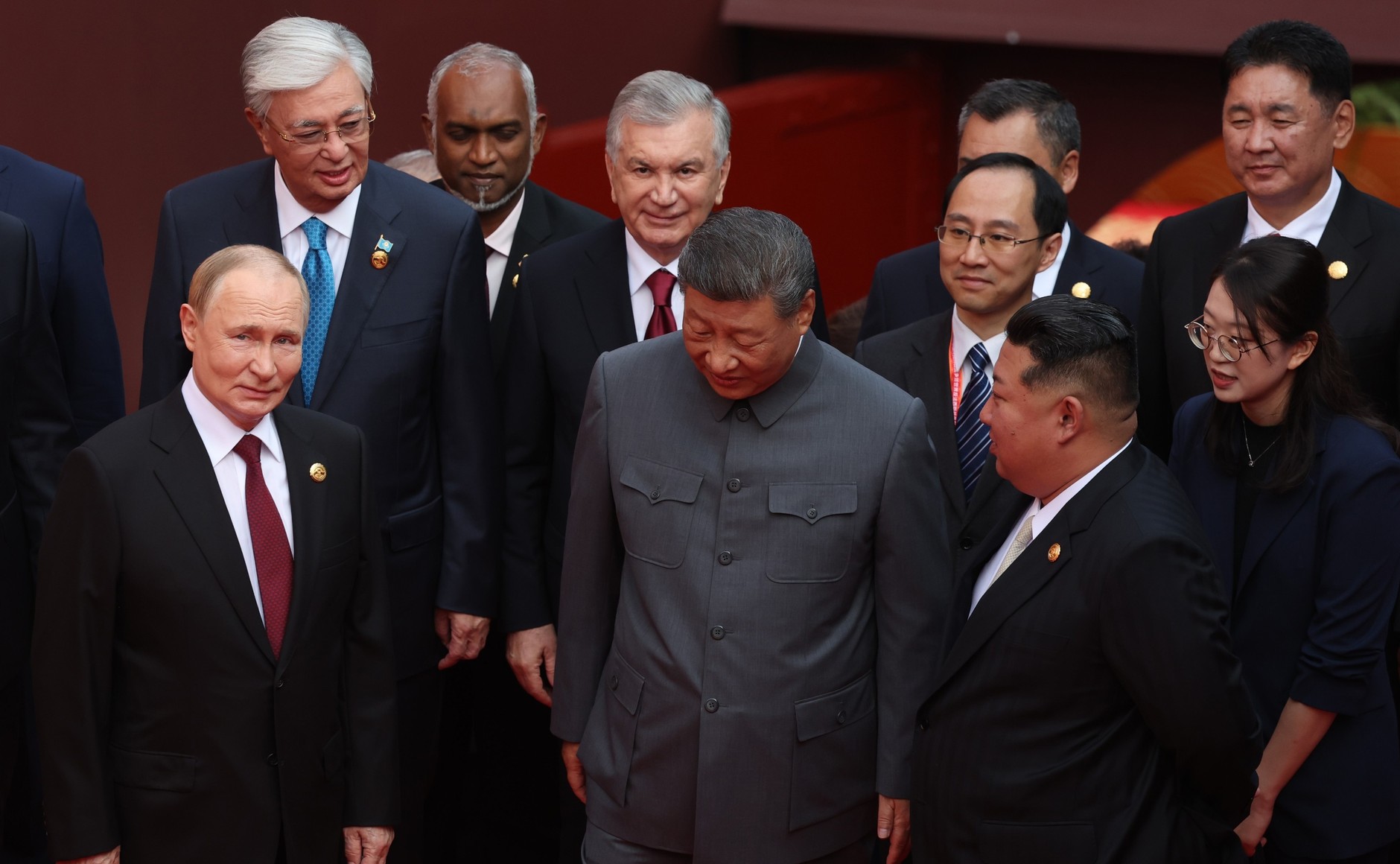
The slogan-based governance of China’s party-state depends on practical examples to give the phrases substance. In the international arena, a major case is the continued claim that the China-Russia relationship provides the world with an example of “major-country ties.” This is a relationship underpinned by personal respect between the countries’ leaders. The diplomatic interactions between China and Russia are intense. What stands out, however, is the personal connection that Xi and Putin show to the world, most strikingly when Putin offered Xi a birthday cake in 2019 for his 66th birthday.
This is a relationship underpinned by acknowledgement of the so-called “legitimate security interests.” In March 2022, China’s Vice Foreign Minister Le Yucheng responded to Russia’s full-scale invasion of Ukraine by comparing Indo-Pacific strategies to NATO’s eastward expansion. Under this view is the same notion of “indivisible security” that Putin used to justify meddling in neighboring countries and that Xi brings up in his Global Security Initiative (GSI). On the one hand, Beijing has called, right from the start, for “a balanced, effective and sustainable European security mechanism” as the “solution” to the “Ukraine crisis.” On the other, Moscow has become more explicit in recognizing Beijing’s claims to Taiwan.
Beijing is pleased when other countries follow China’s examples. China’s summits with the Global South spend a lot of time on Xi Jinping holding court for visiting leaders who come to learn from “Chinese solutions.” Liu Haixing, the new Director of the CCP’s International Department, recently signaled more universalist claims. In the People’s Daily, he described Chinese achievements in strengthening the socialist movement vis-à-vis capitalism in crisis (i.e. the developing world vs the West), and helping change the global balance in favor of developing countries.
Head of State Diplomacy
The attempted phrase of “new model of major-country relations” disappeared after the Trump and Biden administrations made clear to Beijing that Washington saw the rise of the PRC as a strategic challenge. The approach was replaced with a focus on binding lower-level US departments to “consensus” reached by Xi Jinping and his US counterpart. Beijing has now begun to tout the uniqueness of so-called “head of state diplomacy.”
Chinese organizations rely on their chiefs’ permission to act. In US-China relations, that raises the importance of authoritative joint statements by leaders from both sides for Chinese officials. To re-establish a working relationship after the acrimonious first Trump presidency, Biden and Xi met in Bali in 2022 and San Francisco in 2023. Afterwards, Chinese officials began calling on their US counterparts to behave in certain ways referring to the so-called “Bali consensus” and the “San Francisco consensus.” However, China watchers in the US were left somewhat befuddled, since Washington had not subscribed to either “consensus.” It appears Beijing began defining these to bind both sides to China’s preferred stabilization.
In Trump’s second term, the “Busan Summit” in October 2025 was turned into a benchmark by Beijing. In line with the special role that the “Chinese characteristics” of Beijing’s major-country diplomacy reserve for Xi, official statements stressed the “irreplaceable role of “head of state diplomacy” providing strategic guidance. The Chinese side hopes that this way future summits can achieve “progress” on major issues such as Taiwan.
Beijing is pleased when foreign leaders strengthen the position of its head of state. The recent lavish visit by Emmanuel Macron had Xi receive his French counterpart for “amicable” exchanges. Yet, Macron’s conclusions were unmistakably not on the same level of textual authority as Trump’s. German Chancellor Merz and European Commission President von der Leyen get even less, with neither of them being a head of state. However, in China’s eyes, no European leader affects the “forces of history” in the way Putin and Trump do – by driving Western dissolution.
EU’s Great Leader Vacuum
The EU now faces three countries – China, Russia, and the US – all having a major impact on its security and all ruled under personalist systems despite their different logics. In the case of China, Xi depends on a party-state set up to empower the top dog at each level of the bureaucracy. Internationally, major-power diplomacy with Chinese characteristics puts a special premium on a party-anointed national leader who pursues deals with his counterparts, creating examples for subordinates to follow.
The EU and its member states are uniquely disadvantaged for a global player of their size, because they have no empowered leader whom Beijing perceives as an equal to Xi, with the power to make lasting deals. Xi receiving Putin’s birthday cake contrasts starkly with the gaggle of European leaders receiving a lecture from Trump in the Oval Office. The EU and its member states need to realize they have little chance to get fundamental deals with China this way.
Brussels and the national capitals need to adapt their diplomacy to that realization. The more suitable approach is shaping the playing field. If the Chinese party-state is structurally unsuited for making deals with the EU on the most fundamental questions, the EU needs to create the conditions for the changes it wants to see. European diplomatic success depends on devising material signals that get through in Beijing’s Marxist minds: industrial resilience at home and friendship-building in China’s neighborhood.
Written by

Sense Hofstede
sehofDr Sense Hofstede is the Head of AMO’s China Team Brussels Office and a China Analyst. He is an expert in the influence of the Chinese party-state on foreign policy, cross-Strait politics, and the Indo-Pacific. He has completed his PhD in Comparative Asian Studies at the National University of Singapore and has previously worked as a Lecturer at Leiden University and a Research Fellow at the Clingendael Institute.