Women Insight on China (WiCH) is a European initiative dedicated to increasing the visibility and representation of women experts on China. Through research, networking, and mentoring, WiCH works to ensure that women’s expertise is recognized and heard in European policy debates. The initiative is made possible by the support of Stiftung Mercator and is designed and implemented by the Association for International Affairs (AMO), a leading independent Czech foreign policy think tank.
The WiCH Audit is the backbone of this effort – it tracks gender representation at China-focused public events and in podcasts across selected European organizations. Carried out annually, it has now reached its second edition. As such, it provides comparable data to track change over time, identify persistent gaps, and encourage more inclusive speaker selection. This year’s results show both progress and setbacks.
WiCH Audit Methodology
The latest, second audit covers the period between October 2025 and September 2026. It draws on publicly available information about events and podcasts organized by European think tanks, independent research institutes, and major university centers. Its geographical scope encompasses all 27 EU member states, plus Norway, Switzerland, and the UK.
The institutional sample, referred to as the WiCH Audit Panel, was chosen in September 2025 using the Open Think Tank Directory (OTT) as its sole source, with organizations subsequently screened for independence. To ensure consistent year-on-year comparisons, the panel was kept unchanged for the second edition, regardless of any subsequent changes to the OTT.
An event or a podcast episode was included if China appeared explicitly in its title, or if its title or description treated China as a substantive subject. Data came from a systematic review of institutional websites, supplemented by social media posts where data from websites were incomplete. For jointly organized events, attribution followed a hierarchy based on the first audit, thus falling on the main organizer if it belonged to the original panel, the consortium or project leader, or the first listed co-organizer within the panel.
Each standalone event, or each individual panel within a multi-panel event, and each podcast episode was counted as a separate unit. Figures for moderators, panelists, and keynote speakers in events, as well as guests and hosts in podcast episodes, represent the number of appearances rather than particular individuals, so experts speaking repeatedly are counted each time they appear. Because last year’s audit originally covered 13 months, its data were adjusted to a 12-month period (October 2024 to September 2025) to match this year’s audit.
The audit relies primarily on information that organizers made public, so its findings are affected by inaccuracies, omissions, or later changes in those sources. To address gaps, selected think tanks were contacted directly, and several provided summary breakdowns, which were used exclusively for aggregated reporting.
Events: More Women Moderating, Fewer Delivering Keynotes
Between October 2025 and September 2026, our monitoring of the WiCH Audit Panel across 30 European countries recorded China-related events in 22 of them. In these 22 countries, a total of 65 organizations hosted 330 China-related events, ranging from short seminars to multi-day conferences.
For events, we tracked women’s representation in three roles: moderators, panelists, and keynote speakers. Among the 307 moderations identified, women held 121 (39.41 percent) and men 185 (60.26 percent), while one moderator’s gender could not be determined. Compared with the 28.86 percent recorded in the first audit, this marks a notable gain of 10.55 percentage points, the strongest improvement visible in any role.
The panelist role shows a more modest improvement. Of the 1,138 speaking appearances recorded, women accounted for 429 (37.70 percent) and men for 709 (62.30 percent). This represents a slight upward shift of 3.17 percentage points from last year’s 34.53 percent.
Keynote speakers tell the opposite story. Of the 107 keynotes identified, women delivered only 25 (23.36 percent), against 82 for men (76.64 percent). Compared with 39.13 percent in the first audit, this is a steep fall of 15.77 percentage points, the sharpest swing in the dataset.
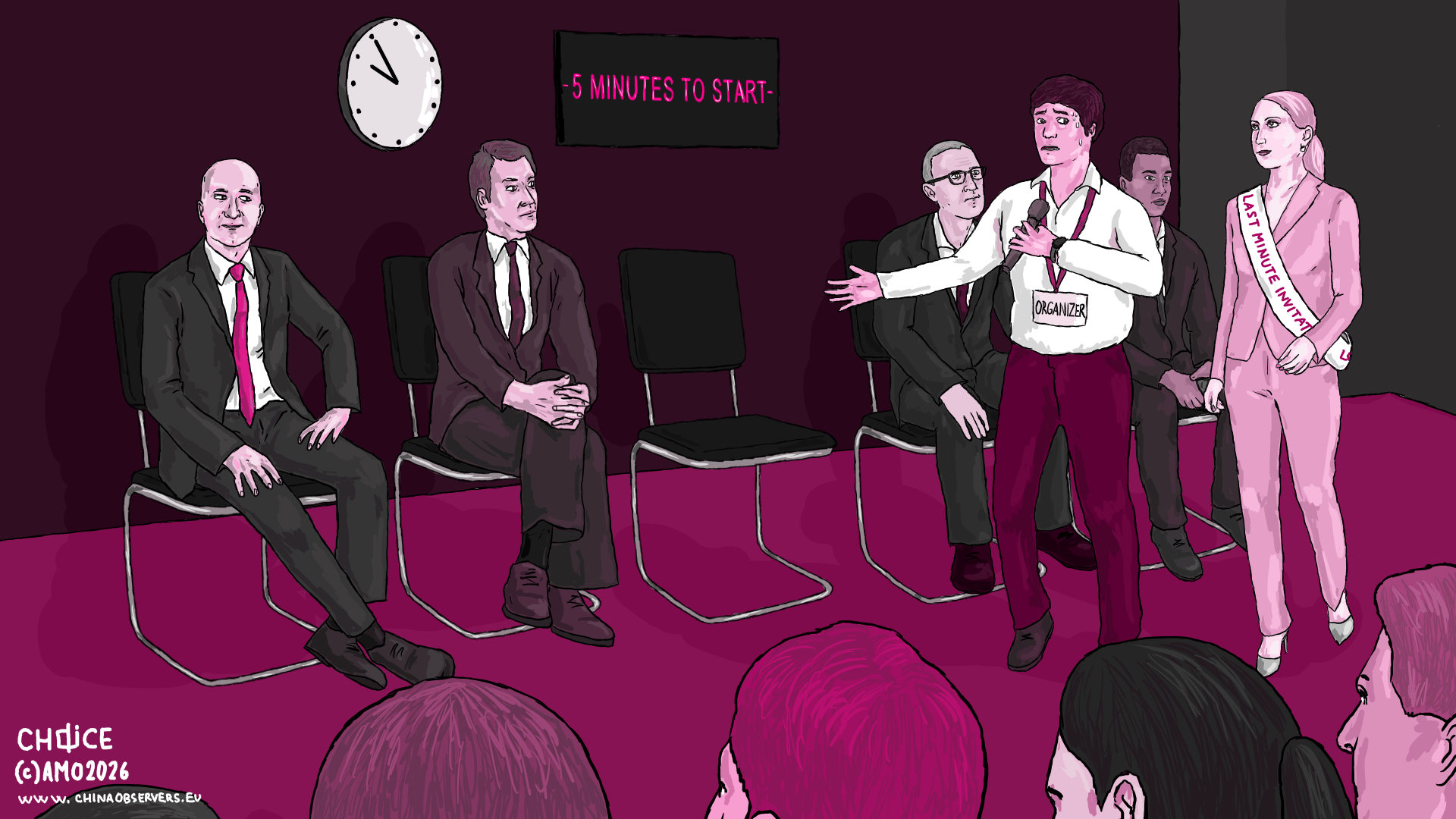
The progress is therefore uneven, and the gains in moderation warrant caution. Women’s share among moderators now exceeds their share among panelists. Yet moderators are often appointed internally, involve little additional cost, and can be added late in the planning process, making a female moderator a convenient quick fix for an all-male panel. The data show that panels moderated by a woman are one-third more likely to be all-male compared to male-moderated panels. Greater visibility in moderation does not necessarily translate into access to expert roles, and the keynote decline suggests equality for the most prestigious slots is still a challenge.
Podcasts: Fewer Women Hosting and Invited as Guests
Podcasts paint an even less encouraging picture. During the audit period, 42 monitored organizations across 19 European countries produced 268 China-related podcast episodes. These came from 46 distinct podcast shows, of which eight were China-specific series and the others only had occasional China-themed episodes.
Across all these podcast shows, we followed two roles: host and guest. Among the 75 unique hosts identified, 28 were women (37.33 percent). Counted per episode, women accounted for 37.19 percent of hosting appearances, down 3.12 percentage points from 40.31 percent in the first audit. Of 424 guest appearances, women accounted for 141 (33.25 percent) and men 283 (66.75 percent), a small but still visible decline of 1.89 percentage points from 35.14 percent.
Unlike public events, podcasts registered a decline in women’s representation in both roles. In comparison to the previous year, the drop among guests suggests that women have lost ground in access to expert visibility, reinforcing concerns raised by the sharp decline in female keynote speakers at events. The decline among hosts warrants a different interpretation. Hosts are typically tied to individual shows, so changes in their representation may reflect programs ending or new ones launching rather than deliberate changes in host selection.
Uneven Performance Requires Targeted Compensation
Delving into the numbers, we see interesting variations within the data. This year’s audit for the first time tracked the topics that speakers were asked to cover. Women speakers are relatively better represented when events or podcasts discuss human rights or societal issues. When it comes to, for example, supply chains, US–China relations, or technology, women are invited less often in comparison to the total average of female participation.
The lack of female representation is also not spread equally among all organizations. Of the 65 institutions that organized tracked events, 27 had fewer than 60 percent male panelists, indicating a good effort among more than two-fifths. Meanwhile, 12 organizations had more than 80 percent male panelists. The story is a bit less positive for podcasts, where 13 out of 42 organizations had fewer than 60 percent male guests and ten more than 80 percent.
Taking into account the discussion on moderator roles in the previous section, the above two trends offer important lessons for remedies to female underrepresentation. Uneven performance requires targeted compensation. Any improvement should come by correction in specific roles, topics, and institutions – not by female overrepresentation in places where they already perform well. That also means that the responsibility for correction is not shared equally.
Written by
Selena Orly
Selena Orly holds a PhD in China Studies and serves as Deputy Lead of the AMO China Team. Her research focuses on modern and contemporary Chinese intellectual history, the translation and amplification of Chinese women intellectuals’ voices through Reading the China Dream project, and China’s engagement with CEE, particularly the Western Balkans.

Sense Hofstede
sehofDr Sense Hofstede is the Head of AMO’s China Team Brussels Office and a China Analyst. He is an expert in the influence of the Chinese party-state on foreign policy, cross-Strait politics, and the Indo-Pacific. He has completed his PhD in Comparative Asian Studies at the National University of Singapore and has previously worked as a Lecturer at Leiden University and a Research Fellow at the Clingendael Institute.