The research and the publication have been supported by a grant from the European Dialogue Program of the Friedrich Naumann Foundation (FNF Europe). The Association for International Affairs (AMO) gratefully acknowledges the support of a former colleague who, owing to current professional commitments, prefers to remain anonymous, and Nele Fabian and Katharina Osthoff for their insightful comments on an early draft of the article.
Relations between the European Union and China have become one of the central issues of European economic, foreign, and security debates. The combined impact of China’s dumping of its overproduction, rare earth export restrictions, its ‘pro-Russian neutrality’ in the war in Ukraine, and its increasingly dismissive attitude towards Europe has contributed to China being viewed in Brussels less as a partner and more as a competitor and systemic rival. Against this backdrop, the European Parliament (EP) has emerged as another arena in which competing visions of how to engage with China are articulated, contested, and translated into political signals. Parliamentary votes on China-related motions and legislative files do not merely register preferences, they also help shape the EU’s external posture, inform the positions of other EU institutions and national governments, and send important normative messages to both domestic and international audiences.
Building on earlier research by the Association for International Affairs (AMO) that examined the positions of Members of the European Parliament (MEPs) from the far-right (ID) and far-left (The Left) factions on China, this article shifts the focus to the European Parliament’s mainstream groups. It tracks how MEPs voted on 23 China-related motions on trade, human rights, and foreign policy adopted between September 2019 and October 2024 – so in total 21 during the 9th term and two at the start of the 10th. Where available, roll-call data are complemented by debate transcripts and explanations of vote to assess whether positions reflect individual preferences or party-line discipline, and to identify patterns of groups or factions voting in unison. For the analysis of national party behavior, parties from the United Kingdom are excluded, as their departure following Brexit before the end of the 9th term would otherwise distort the results.
Alignment of Moderate Factions on China
Renew Europe (RE) was one of the most supportive factions on China-related (and mostly China-critical) motions, with the highest share of votes in favor and practically no opposition, indicating near-universal support as well as strong internal alignment and minimal hesitation. Similarly, the European People’s Party (EPP) showed strong internal cohesion, with very few abstentions or votes against, and a consistent pattern of backing most proposals. The Socialists and Democrats (S&D) and the Greens/European Free Alliance (Greens/EFA) also showed high levels of support but exhibited relatively greater internal divisions, reflected in higher abstention rates compared to the EPP and RE. For the Greens/EFA, the June 2023 motion on foreign interference appears to have been the main point of contention, with significantly higher levels of abstention and opposition.
The European Conservatives and Reformists (ECR) showed greater variability in their voting patterns. For instance, issues dealing with foreign interference and security received slightly higher abstention or opposition rates. Specifically, the motions concerned foreign electoral interference and disinformation in national and European democratic processes, foreign interference in all democratic processes in the European Union, including disinformation, and the EU and the security challenges in the Indo-Pacific. On the first motion, seven MEPs abstained while six MEPs voted against. On the second motion, 16 MEPs abstained while five voted against. On the third motion, 47 of ECR’s MEPs abstained.
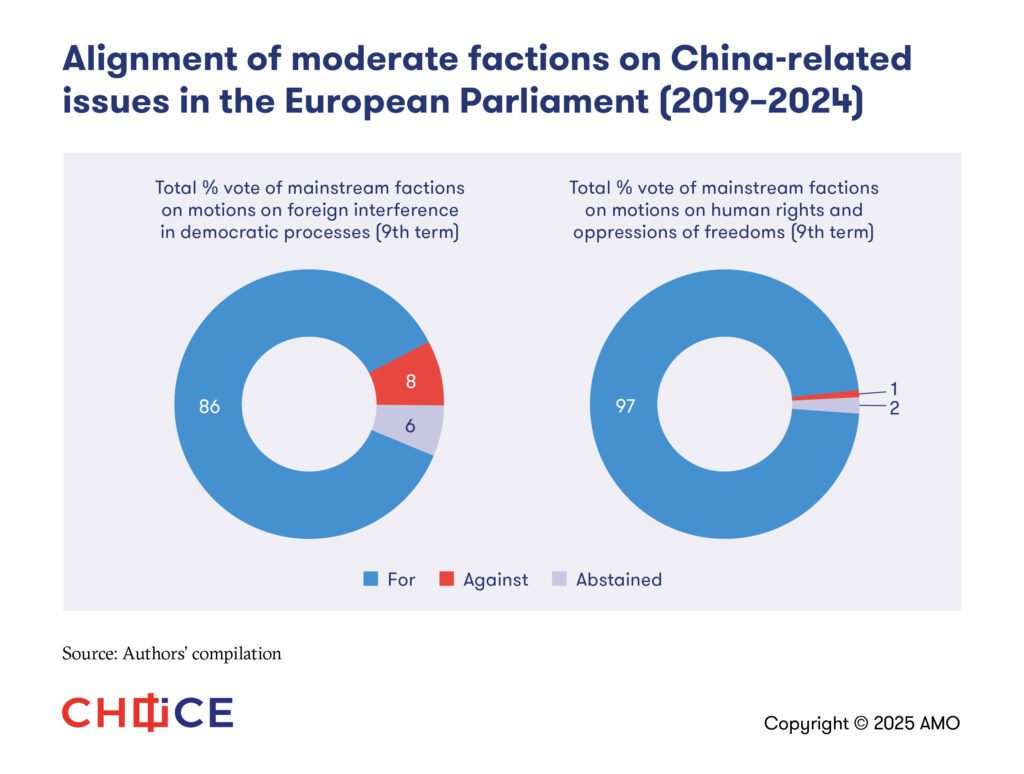
Despite the moderate factions’ varying degrees of endorsement pertaining to motions on foreign interference, their overall support of China-related motions was still significantly higher than what had been observed with regards to far-right (gathered in Identity and Democracy, ID) and far-left (part of The Left faction) parties. These have systematically voted against such motions, with the 2019 motion on foreign electoral interference being rejected by 94 percent of MEPs from these factions. This, however, was not a surprising outcome, as the motion explicitly called out right-wing, populist, and extremist parties as benefiting from foreign interference in electoral processes.
On human rights-related motions, an even clearer pattern of inter-factional alignment emerged.
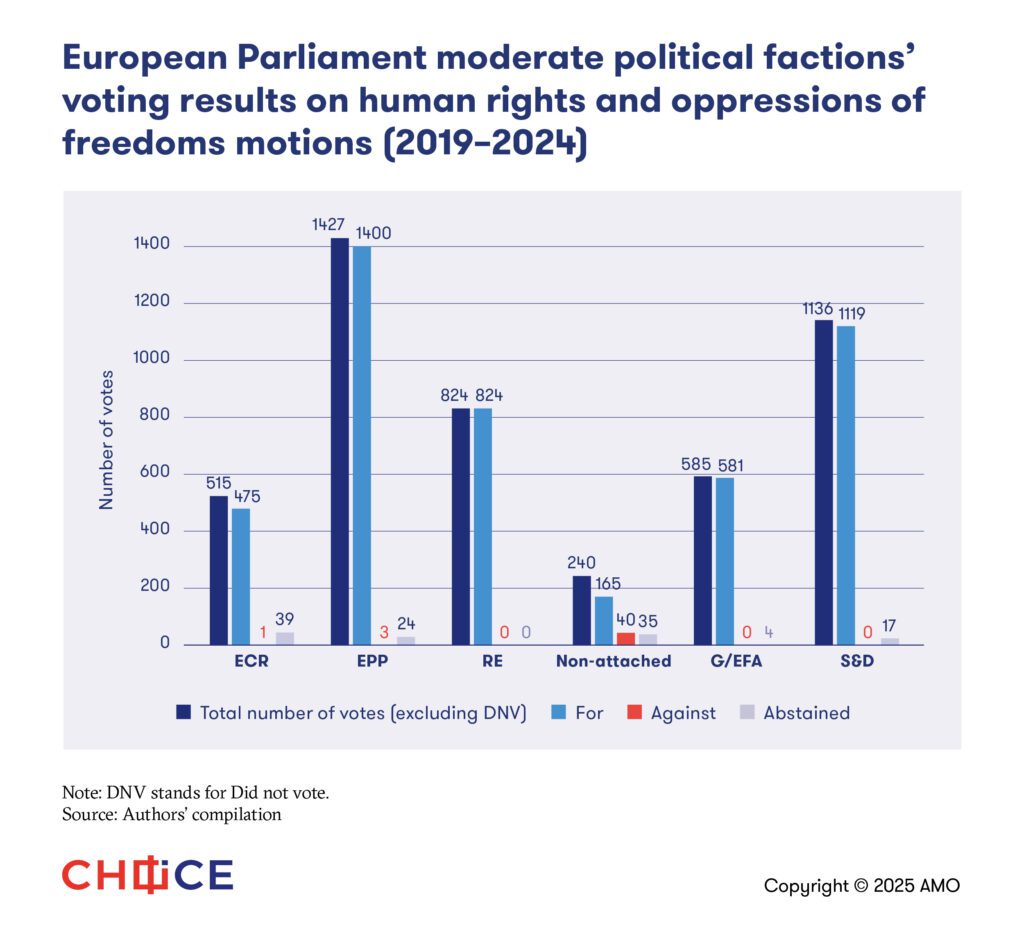
The motion on the human rights situation in Xinjiang, including the Xinjiang police files, is a particularly illustrative example of political factions’ alignment on the issue. The motion received a nearly 98 percent support rate with no opposition and a mere two percent abstention rate, mainly from MEPs which were not affiliated with any political faction. The motion on the so-called China Cables – a collection of leaked Chinese documents obtained by the International Consortium of Investigative Journalists and showing the internal workings of mass crackdowns on minorities in Xinjiang region – had a similar level of endorsement, with a 97 percent approval rate, and minor opposition from non-attached MEPs.
In contrast, voting patterns of MEPs from the ID and The Left showed deeper intra-faction divisions, particularly with regards to motions on Hong Kong and Tibet. Less of a divide was present in terms of motions focused on Xinjiang. Overall, the driving forces behind abstentions or opposition to these motions were mainly the MEPs’ skepticism of the West and EU’s ‘higher moral ground’ and their criticism of the West’s own shortcomings (The Left), or the impact these motions would likely have in reality (ID).
A broad majority across factions is evident also on issues directly affecting EU institutions or members, such as the motion condemning Chinese countersanctions on EU entities, MEPs and individuals. The motion passed with 96 percent support, facing minimal opposition from only 16 unaffiliated MEPs and one MEP from the Greens/EFA. Although this motion addressed a specific instance of Chinese coercion, which likely mobilized widespread support, it also exemplified a broader trend observed in the analysis: China-related motions on narrowly defined issues tend to garner a higher level of cross-faction support in the European Parliament. Interestingly, some motions addressing the direct impact of Chinese activities on the EU (specifically, these included the motion on the implications of Chinese fishing operations on EU fisheries and the way forward and the motion on economic coercion by third countries were widely supported by MEPs from both extreme and moderate factions.
Party Lines and Stances of Individual MEPs
An examination of voting patterns among political parties of moderate factions (plus non-attached) represented in the European Parliament reveals distinct outliers with significantly higher percentages of abstentions or votes against proposed motions.
It is important to stress that the analysis of debate transcripts indicates that, in most cases, MEPs who vote against or abstain from voting on motions are not necessarily advocating for China or Russia. Rather, their contributions often reflect critiques or frustrations directed at the EU itself. Additionally, certain political parties with strong nationalist orientations may demonstrate caution regarding support for an expanded EU interest in regions which they consider beyond the EU’s immediate security interests.
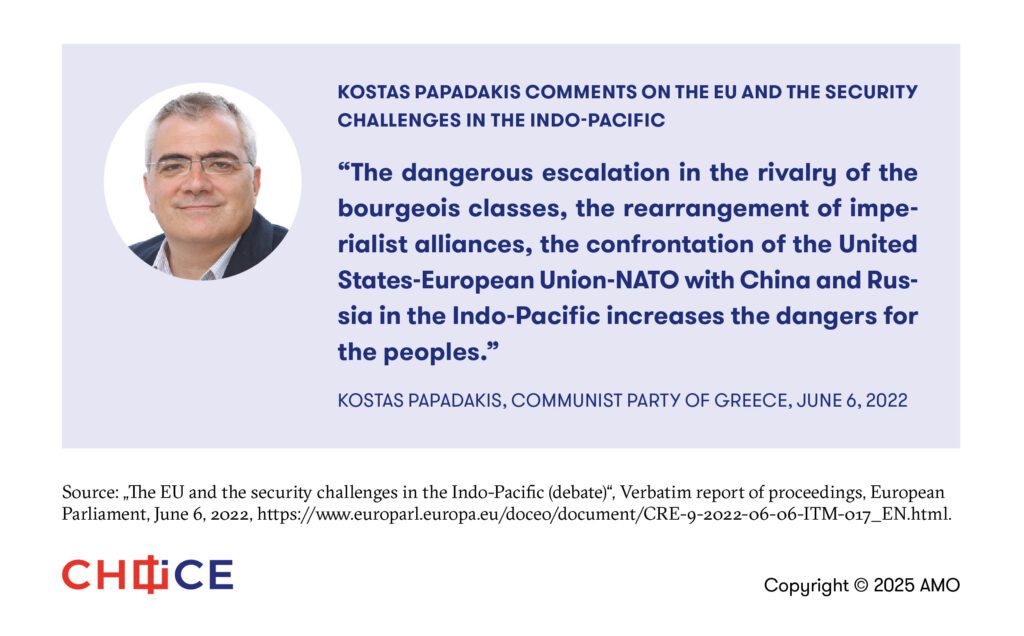
During the 9th term, the Communist Party of Greece (non-attached, NI) held two seats in the European Parliament and had a track record of voting against or abstaining from voting on analyzed motions. The two MEPs had an identical voting pattern, as they abstained from voting on motions on Xinjiang police files and the case of Jimmy Lai (a media tycoon and Hong Kong pro-democracy activist who was arrested by China and accused of endangering China’s national security by colluding with foreign forces) and voted against all other motions. The MEPs also did not attend the vote on the motion regarding the situation in the Taiwan Strait. A potential explanation for their voting behavior may be the synergy between the ideological framework of the Communist Party of Greece and the one of the Communist Party of China.
Another clear pattern was observed in the voting behavior of Hungary‘s Fidesz. While until January 2021 the Fidesz MEPs voted in favor of the proposed motions, during later plenary sessions they either did not attend, voted against or abstained from voting. This was likely the result of the departure of the Fidesz Party from the center-right EPP in March 2021 following years of mounting tensions between the political faction and Viktor Orbán. Orbán’s decision to withdraw from the bloc was a reaction to the changing of the internal rules of the EPP, which would have made it easier to expel political parties, like Fidesz, on the count of not adhering to the bloc’s values and politics. The departure from the EPP further allowed Orbán to push forward his party’s anti-EU rhetoric and is likely the main cause behind the change of voting patterns of the Fidesz party.
The Fidesz MEPs voted in unison against the motions on Chinese countersanctions on EU entities and MEPs, the case of Apple Daily (a daily founded by Jimmy Lai and published in Hong Kong from 1995 to 2021), economic coercion by third countries, and the two motions on foreign interference in the EU’s democratic processes. The MEPs also had the same abstention pattern as they abstained on two motions. Fidesz MEPs more frequent absenteeism coupled with their voting behavior largely in opposition to the motions could indicate that they only attended those plenary sessions which they considered to be vital, and where they wanted to voice their disagreement.
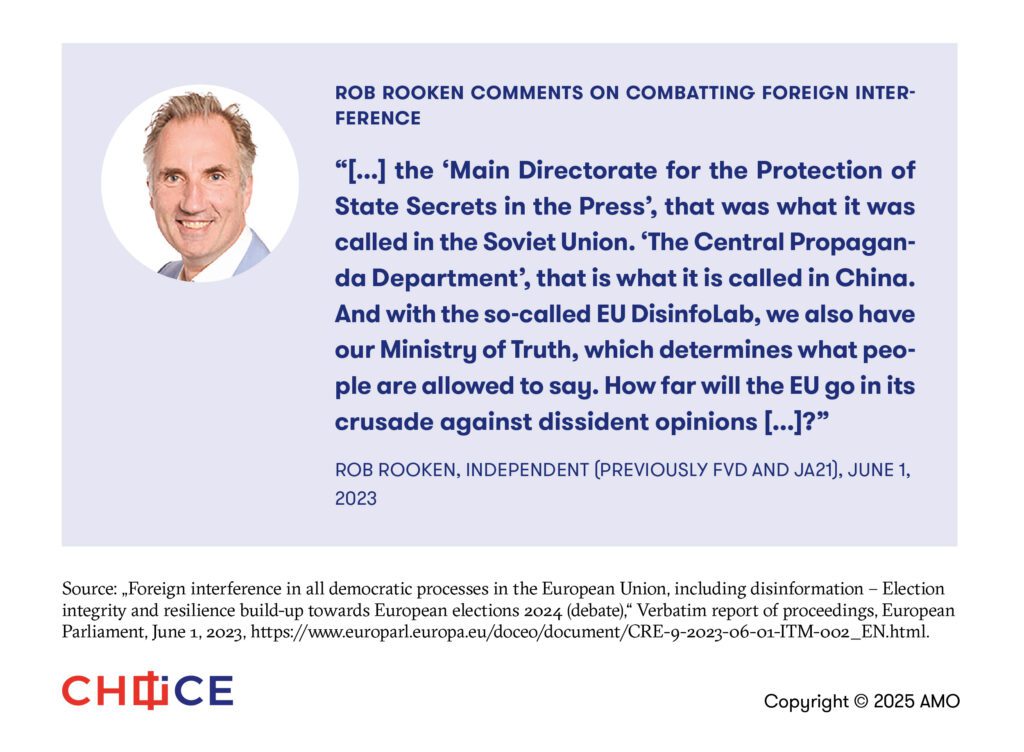
The MEPs from the Netherlands’ Forum voor Democratie party (Forum for Democracy, FvD), who later moved to JA21 (an offshoot of FvD) and then participated as independents, also predominantly abstained or voted against the proposed motions. However, there is not a clear pattern, and the voting behavior seems to follow individual MEPs’ preferences and agendas. All MEPs opposed the motions centered on foreign interference and abstained on most motions that addressed violations of human rights and oppressions of freedoms – a stark contrast to the overall voting patterns of moderate political factions of the EP, which seem to have strong alignment on the issues of human rights.
On the other hand, the issue of EU-Taiwan relations, the situation in the Taiwan Strait, and Chinese countersanctions on the EU received no opposition from FvD. This voting behavior may be explained by the party’s and MEPs’ political ideology, as FvD is a far-right political party with a Eurosceptic background.
While Belgium’s political parties voted predominantly in favor of the proposed motions, there was less endorsement of the motion on foreign interference in 2023. All MEPs from the political parties Nieuw-Vlaamse Alliantie (New Flemish Alliance, N-VA) and Écologistes Confédérés pour l’Organisation de Luttes Originales (Ecolo) abstained from voting. The MEPs belonging to Ecolo also abstained from voting on a similar motion in 2019, indicating that there may be a clash of interests or other factors at play.
Among Bulgaria’s political parties represented in the EP, Българска социалистическа партия (Bulgarian Socialist Party, BSP) and Българско Национално Движение (Bulgarian National Movement, VMRO) had a higher abstention rate in comparison to others. In the case of VMRO there is a clear pattern of its MEPs abstaining on the foreign interference motions from 2019 and 2022 and on China cables. Most of the MEPs from the Bulgarian Socialist Party then abstained on the issues of the national security law in Hong Kong and the 2019 foreign interference motion.
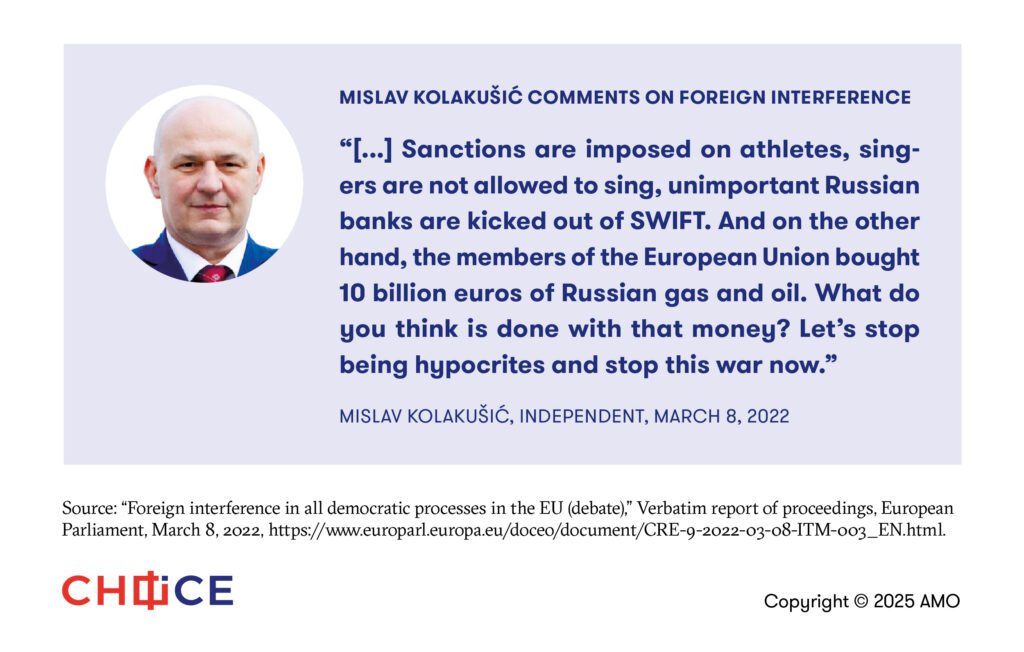
Two Croatian MEPs with a greater number of abstentions and opposition votes were Ivan Vilibor Sinčić, the president of the political party Ključ Hrvatske (the Key of Croatia), previously known as Živi zid (Living Wall), and Mislav Kolakušić (without a political affiliation). MEP Kolakušić voted against two motions on foreign interference (in 2022 and 2023) and on the two motions specifically addressing EU-China relations and EU-China strategy. Though his motivations on the China-related motions are not clear, the debate transcripts show his criticism of mainstream media, ‘quasi-journalists,’ and their role in spreading disinformation. Though not directly against the motions, Kolakušić considered the EU as behaving hypocritically.
In the case of MEP Sinčić, no direct support of China can be observed from his debate contributions. Rather, his criticisms were directed at the EU and the lack of enforceability of international documents as well as the EU’s fear of economic repercussions from China. This was demonstrated in a debate on the motion regarding forced labor and the situation in Xinjiang, which he endorsed.
After he decided to rename his party as ‘Key of Croatia,’ Sinčić seems to have become more hawkish towards the EU. He opposed the motion on foreign interference from 2023 and blamed the EU itself for interfering in democratic processes of the bloc.
An interesting pattern can be observed in the voting behavior of all political parties from Cyprus (Democratic Party, Democratic Rally, and Movement for Social Democracy). Although all MEPs voted in favor of motions on human rights and foreign interference, they either abstained, voted against, or did not participate in plenaries focused on issues that are highly sensitive to Beijing – namely the adoption of a strong stance on Beijing’s ‘core interests’ related to sovereignty and interference in domestic affairs. These plenaries included the national security law in Hong Kong, EU-Taiwan ties, the motion on the abduction of Tibetan children, and the situation in the Taiwan Strait.
Regarding Czech political parties, motions on foreign interference seem to have a higher sensitivity attached to them as there is a greater alignment between parties on voting against or abstaining. This is particularly evident in the case of Občanská demokratická strana (Civic Democratic Party, ODS) and Piráti (Pirates). Furthermore, motions on EU-China relations and the implications of China’s influence on EU infrastructure have also received lower endorsement, particularly from ANO 2011 and Svoboda a přímá demokracie (Freedom and Direct Democracy, SPD). It is also significant that SPD used to be part of the ID, which tended to lean towards voting against or abstaining from voting on China-related motions.
Zooming in on individual MEPs, Jan Zahradil (ODS) abstained from or voted against the proposed motions on China during the 9th term. During the same period of time, he was in charge of the EU-China friendship group and faced accusations that he received financial support from Beijing without having properly declared it. The MEPs Michaela Šojdrová from Křesťanská Demokratická Unie – Československá Strana Lidová (Christian and Democratic Union – Czechoslovak People’s Party, KDU-ČSL) and Markéta Gregorová from Pirates were relatively vocal during plenary debates, in favor of the motions. Overall, many Czech MEPs participated at least once in the plenary debates, yet no explanations of abstentions or opposition were provided. Throughout the 9th term, out of all Czech MEPs, Markéta Gregorová in particular, was expressive in her contributions – touching on topics such as human rights, the boycott of China’s Winter Olympics, the imposition of sanctions, strengthening relations with Taiwan, and having a more coherent and pro-active EU strategy.
In terms of French political parties, Reconquête! (Reconquest!) seems to be particularly diverging from the overall majority support for proposed motions. In a majority of cases, its MEPs voted against the motion, abstained from voting, or did not attend the plenary. Only Maxette Pirbakas, who left the party in July 2022 and has acted as an independent ever since, appeared to refrain from following this trend, as she participated in more plenary sessions and endorsed several motions others did not vote on. This trend could be explained by the political ideology of the party, as Reconquête! is an ultra-nationalist party that seeks to strengthen its autonomy vis-à-vis the EU. In the debate regarding the motion on foreign interference in 2022, the MEP Jérôme Rivière called the EU hypocritical and the motion an attempt to limit freedom of expression and democracy.
Curiously, a very sensitive issue for French political parties Europe Écologie (Europe Ecology) and Alliance Écologiste Indépendante (Independent Ecological Alliance, ÉAC) was the 2023 motion on foreign interference, as most of the MEPs abstained from voting. A comparable pattern emerged during the 2019 vote on the same topic, when most MEPs from Les Républicains (Republicans) similarly refrained from casting a vote.
The 2023 motion on foreign interference also appears to be unusually sensitive for German MEPs from the political party Sozialdemokratische Partei Deutschlands (Social Democratic Party of Germany, SPD), where a majority either abstained, did not vote, or voted against the motion. Although some MEPs from this party voted similarly on the 2019 foreign interference motion, almost no opposition or abstention was noted in relation to the 2022 foreign interference motion. Martin Buschmann, who resigned from the European United Left-Nordic Green Left (GUE/NGL) after it was revealed that he used to be a member of Germany’s far-right and ultranationalist Nationaldemokratische Partei Deutschlands (National Democratic Party, NPD) in the 1990s, had the highest percentage of votes against or abstentions from all German MEPs. During the 9th term, Buschmann had no party or faction affiliation.
Irish political parties all voted predominantly in favor of proposed motions, except for the motion on EU-China strategy. The MEPs from Ireland’s Green Party abstained from voting on the motion. Similarly, MEPs from Italian political parties Movimento 5 Stelle (Five Star Movement), Fratelli d’Italia (Brothers of Italy), and Forza Italia (Forward Italy), abstained from voting on the 2019 motion on foreign interference. Brothers of Italy also largely abstained from voting on the motion on the EU and the security challenges in the Indo-Pacific.
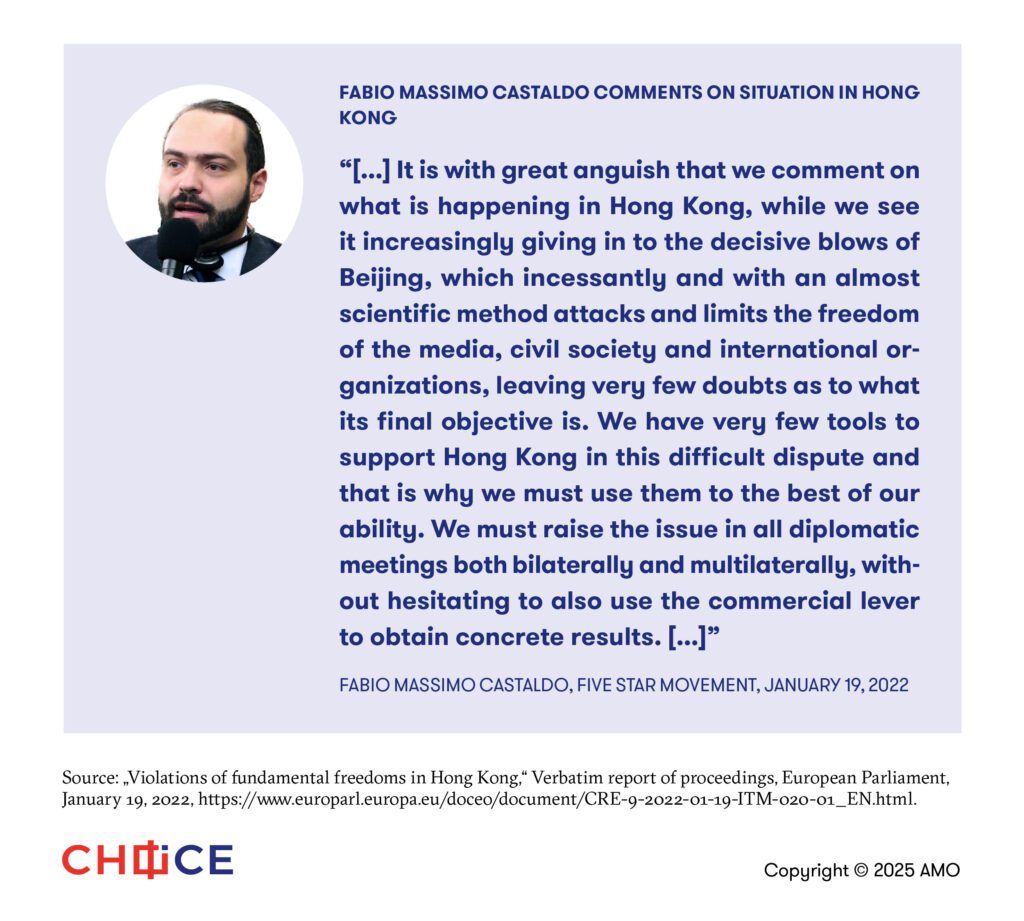
In terms of the Five Star Movement, its political leaning is not clear. While the party has left-wing origins, it has been able to attract voters from across the political spectrum. One of the party’s founders, Beppe Grillo, himself described it as “neither left-wing nor right-wing – it is a movement of Italians.” The party’s foreign policy has also seemingly been leaning towards pro-Chinese, and to a lesser extent, pro-Russian stances. Within the party, there can also be found Eurosceptic and mild anti-US sentiments. As such, MEPs’ individual motivations should be examined when looking for explanations of voting behavior. For instance, Fabio Massimo Castaldo from Five Star Movement (during the analyzed period) was particularly vocal during the debates and spoke against China’s regime on issues of human rights violations in Hong Kong and Xinjiang, in favor of strengthening ties with Taiwan, and in support of Taiwan joining international organizations. He also called for the implementation of targeted sanctions against Beijing. Ignazio Corrao also spoke up against China’s human rights violations, voicing his concerns about Beijing’s persecution activities against Uyghurs and other minorities.
Among individual Italian MEPs, Francesca Donato (no affiliation), stands out as not voting, abstaining, or opposing proposed motions more often than others. However, she did not contribute to the debates or submit any explanations of her votes.
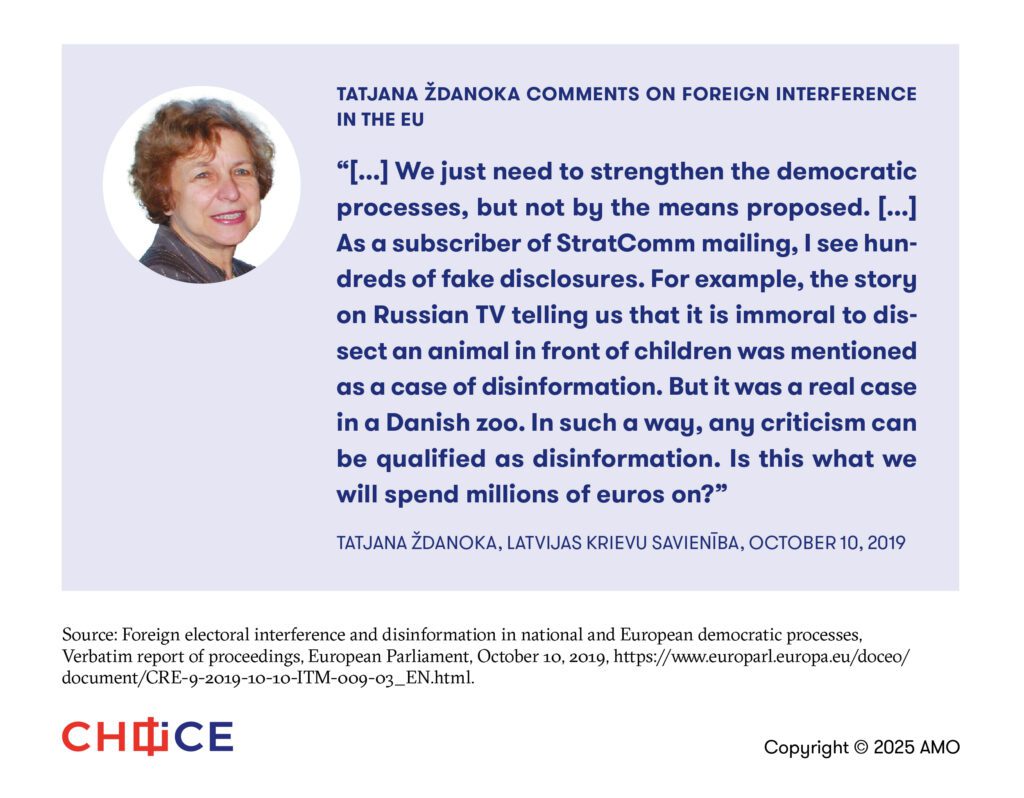
The party Latvijas Krievu savienība clearly stands out from other Latvian political parties. Its MEP, Tatjana Ždanoka, who was accused of working with Russia’s secret service, endorsed only two motions included in this research, namely China-cables, and the forced labor and situation of Uyghurs in the Xinjiang Uyghur Autonomous Region. In translation, the political party’s name is “Latvian Russian Union.” Domestically, the party is supported primarily by ethnic Russians and other Russian-speaking minorities. In the explanation of her voting position on one of the motions on foreign interference, Tatjana Ždanoka, while not opposing the idea of strengthening democratic processes, criticized the EU’s strategies to strengthen democratic processes by combating foreign interference and disinformation, as she claimed that this strategy leads to false disclosures and classification of any criticisms as disinformation.
The motion on the EU and security challenges in the Indo-Pacific also saw MEPs from Latvia’s Nacionālā apvienība “Visu Latvijai!”-“TēvzemeiunBrīvībai/LNNK” (National Alliance) party abstaining from voting. Looking at the statements from the debates, it is possible that their voting decisions on the motion on the Indo-Pacific might be driven by the Russian invasion of Ukraine. One of the MEPs, Dace Melbārde, made two statements related to the foreign interference motions, where she took a stance against Russia and advocated for defending freedom of expression. The second MEP, Roberts Zīle, made a similar statement and urged his colleagues to take the matter seriously.
For Lithuanian political parties and MEPs, there does not seem to be anyone with a voting behavior that would indicate clear support for Chinese or Russian positions. Stasys Jakeliūnas, an independent from Greens/EFA, abstained from two motions on foreign interference and did not vote on several other motions. The 2023 motion in particular saw lower levels of endorsement than was usually the case across all political factions and a significantly lower support of political parties belonging to Greens/EFA, S&D, and ECR. Similarly, Viktor Uspaskich the founder of Darbo partija (Lithuania’s Labor Party, considered to be a center-left populist party with ties to Lithuanian businesses), affiliated with the Renew group, abstained on the 2019 motion on foreign interference and on the motion regarding the implications of China’s influence on EU infrastructure. MEP Uspaskich also did not attend the plenary sessions for several of the remaining motions. He has a controversial history stemming from funding a disinformation website, which started operating in April 2023. Neither Jakeliūnas nor Uspaskich contributed to the plenary debates.
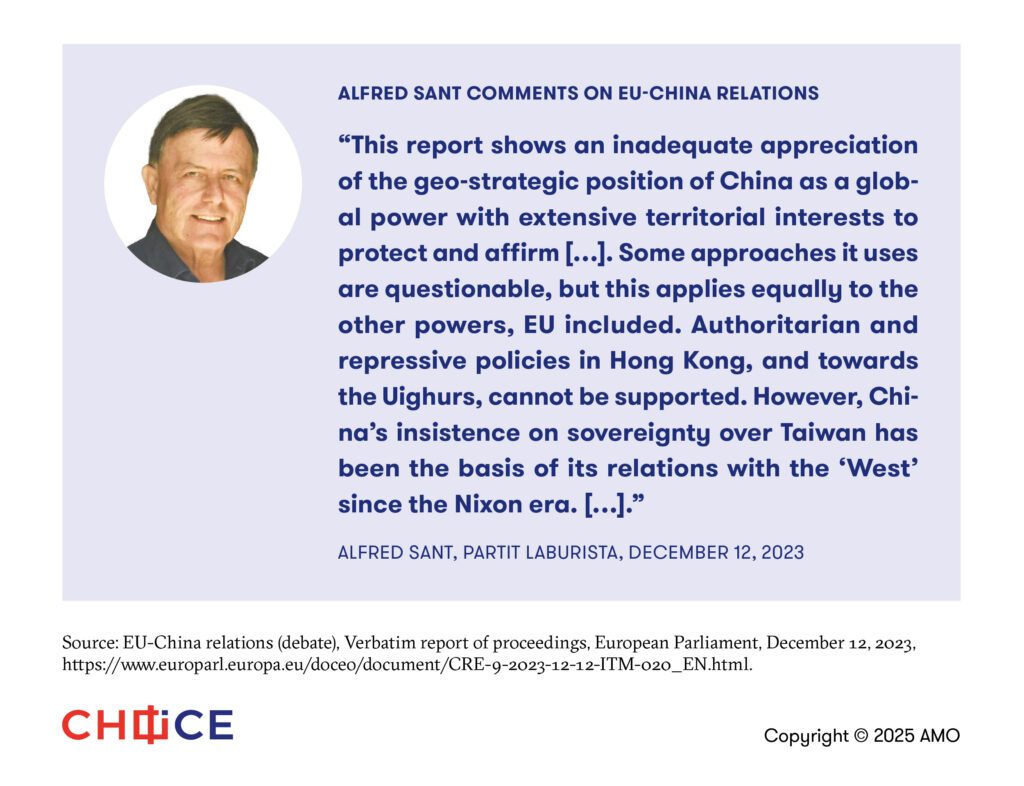
In the case of Malta‘s Partit Laburista (Labor Party), there does not seem to be a clear party voting pattern. The affiliated MEPs tended to vote against or abstain from voting on motions more often than they voted for them. Alfred Sant had a relatively higher level of abstentions (ten abstentions, one against, three did not vote). The debate transcripts showed that his voting behavior was fueled by his belief that the EU’s actions are hypocritical – criticizing other actors for foreign interference and unfair competition strategies, yet oftentimes adopting the same approach.
Polish political parties voted predominantly in favor of the proposed China-related motions. One outlier is the motion on the EU and the security challenges in the Indo-Pacific, which saw a high abstention rate from MEPs from Prawo i Sprawiedliwość (Law and Justice, PiS). Amongst Polish MEPs, Marek Paweł Balt from Nowa Lewica (New Left), previously belonging to Sojusz Lewicy Demokratycznej (Democratic Left Alliance), and Ryszard Czarnecki from PiS stand out as showing lower endorsement rates. However, at least in terms of MEP Czarnecki, the debate transcripts do not show any clearly formulated pro-Chinese or pro-Russian stances. He only contributed to the debates on motions that he endorsed but even within those his frustration with the EU was palpable as he called it hypocritical. As such, his voting behavior on China-related motions may be linked primarily to his views on the EU.
A motion on foreign interference was also opposed by MEPs from Romania‘s Uniunea Democrată Maghiară din România (Democratic Alliance of Hungarians in Romania, UDMR) which in other cases voted in favor of the motions.
With regards to Slovakia, two motions and two MEPs standout. Interestingly, the foreign interference motion and the motion on EU-China relations received relatively low support from Slovakia’s MEPs across different political parties. Both motions saw the same three MEPs abstaining and the same two MEPs voting against (out of Slovakia’s 16 MEPs from mainstream factions). Milan Uhrík, from Hnutie Republika (the Republic Movement), previously belonging to Kotleba – Ľudová strana Naše Slovensko (People’s Party Our Slovakia) regularly showed opposition to the proposed motion, as during the 9th term, he did not support any of the analyzed motions. Drawing on his only contribution to the debate on foreign interference, instead of supporting pro-Chinese or pro-Russian sentiments, Uhrík’s voting patterns may stem from his dissatisfaction with the EU and the fear that it is using its fight against Russian disinformation to silence any opposition media or views.
Another MEP from Slovakia with a high abstention or against rate was Miroslav Radačovský, from Slovak PATRIOT (without a faction affiliation). However, rather than voicing his position on Russia or China he also seemed to be critical of the EU, similarly to several other MEPs across political parties that tend to refrain from backing proposed motions.
Slovenia‘s MEPs and political parties have, in great majority, supported the proposed motions, except for Milan Brglez from Slovenia’s Socialni Demokrati (Social Democrats). He endorsed most of the proposed motions and abstained from voting on the motions touching on foreign interference, EU-China strategy, and the case of Apple Daily. His voting behavior, however, is not in line with the other MEPs from his political party and as such might be driven by his own personal political interests and beliefs.
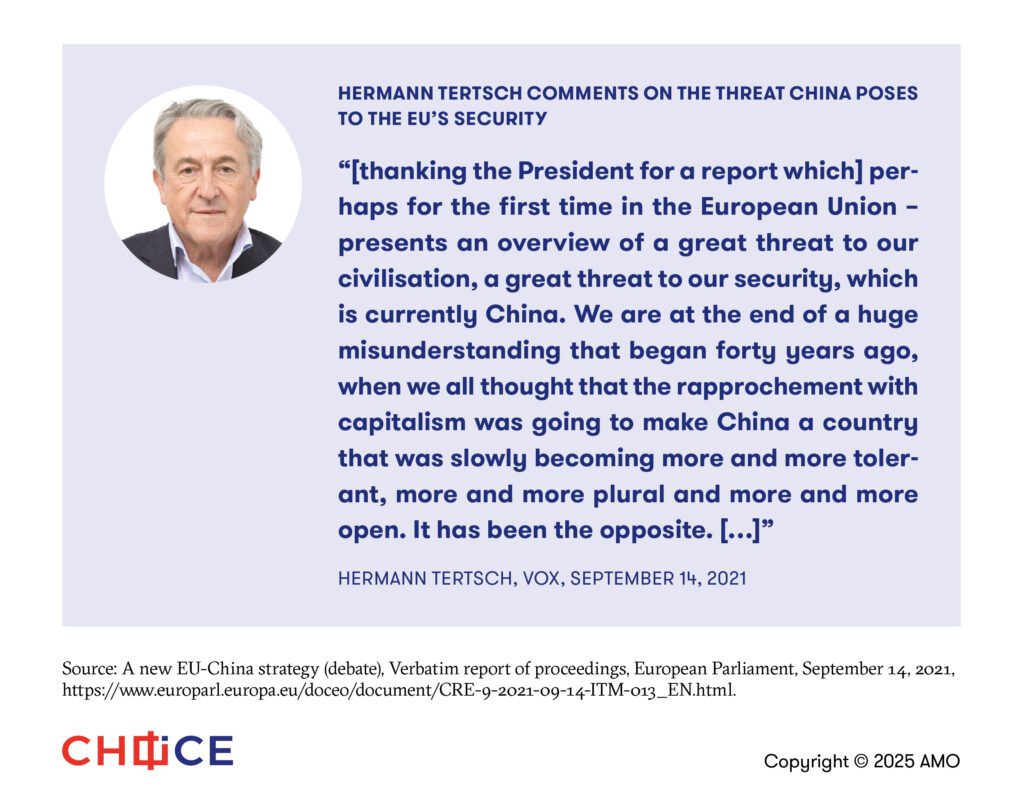
With regards to Spain, political parties Vox and Junts per Catalunya – Lliures per Europa (Together for Catalonia, JxCat) showed a clear voting pattern with regards to abstentions and voting against motions. Both parties did not endorse the 2022 motion on foreign interference. However, while MEPs from Vox abstained, MEPs from JxCat voted against, indicating a stronger sensitivity to the motion in general or to the procedures and approaches included in the motion. MEPs from JxCat Catalunya also voted against the foreign interference motion from 2023. MEPs from Vox also abstained from voting on the motion regarding the EU and the security challenges in the Indo-Pacific. Vox’s MEP, Hermann Tertsch, made a strong statement against China during one of the debates on EU-China strategy, calling China increasingly aggressive and a “threat to our security.” As such, rather than pro-China or pro-Russia, Tertsch and potentially other MEPs from Vox may see their voting behavior as being shaped by other factors like Euroscepticism and a focus on achieving national interests.
Similarly to Tertsch, the debate contribution from Clara Ponsatí Obiols from JxCat regarding the crackdown on democratic processes in Hong Kong suggests that she opposed Beijing’s actions, yet did not find the EU’s responses satisfactory. MEPs from Esquerra Republicana de Catalunya (Republican Left of Catalonia), Bloque Nacionalista Galego (Galician Nationalist Bloc), and Catalunya en Comú (Catalonia in Common – We Can) also voted against the motion on foreign interference from 2023.
Many Swedish political parties were predominantly in favor of proposed motions, except for Sverigedemokraterna (Sweden Democrats, SD), a Swedish nationalist right-wing party with Eurosceptic tendencies. The MEPs from this party abstained from the first two motions on foreign interference and the motion on the EU and the security challenges in the Indo-Pacific. Some MEPs also abstained from the third motion on foreign interference and from the motion on implications of Chinese fishing operations on EU fisheries. Charlie Weimers had the highest rate of abstentions from all Swedish political parties (five abstentions, three of those on political interference). However, MEP Weimers was also the rapporteur for the EU-Taiwan Political Relations and Cooperation motion which was passed in October 2021. This was an important milestone as it was the very first EP motion explicitly talking about EU-Taiwan relations. In his opening speech, he not only expressed support for strengthening the EU’s ties with Taiwan but also called for the EU to “more strongly condemn China’s continued military belligerence against Taiwan.” MEP Weimers also advocated for the EU to further push for Taiwan’s inclusion in international bodies, at least with the status of an observer.
Dynamics after the 2024 Elections
Following the July 2024 elections, the 10th European Parliament consists in 54 percent of new MEPs. Although gains by far-right parties were observed across the majority of EU countries, they were particularly visible in the cases of Italy, France, and Germany. The broader trend of the rise of far-right parties, though not as significant as anticipated, testifies to a growing support for populist and Eurosceptic parties which continues to influence the debates on domestic as well as foreign policy issues in the EP.
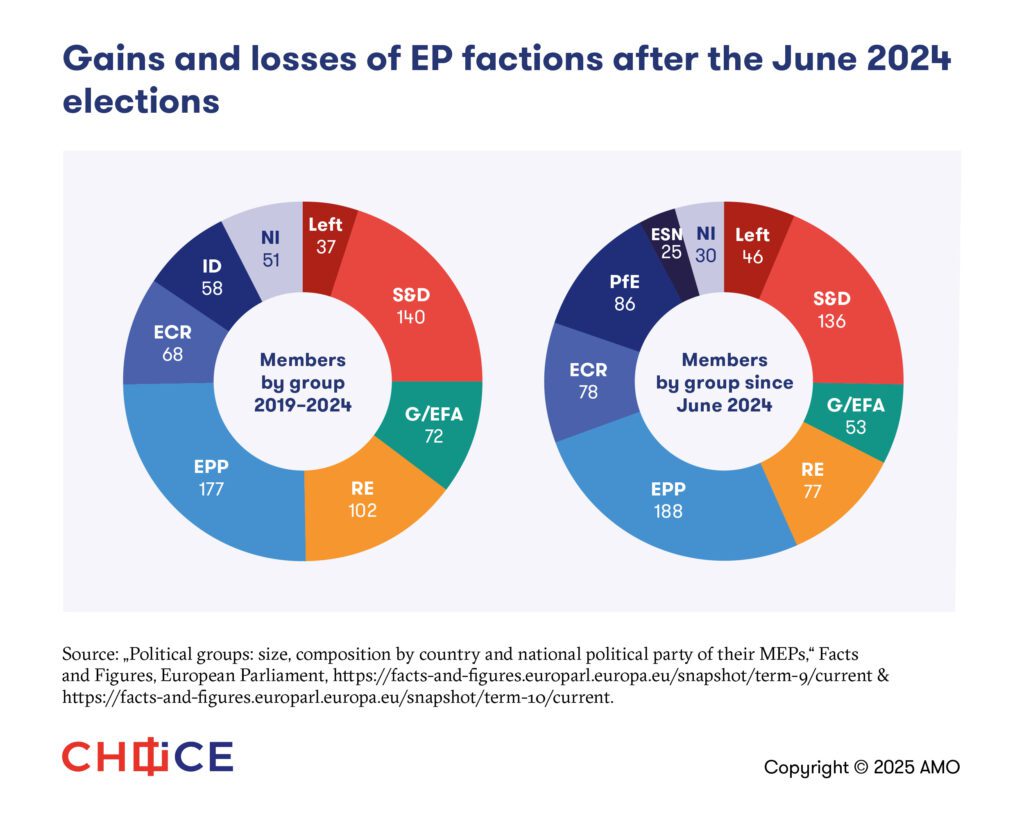
The political factions that comprise the EP underwent a significant restructuring. While the EPP remains the largest group in the EP with 188 MEPs, the change has been particularly significant in terms of the EP’s right-leaning groups. The 2024 elections marked the end of the ID group, with its former members joining the ECR (78 MEPs) or, in a majority of cases, Orbán’s newly formed far-right Patriots for Europe (PfE). The Patriots is now the third largest faction in the EP, comprising 86 MEPs. A minor far-right faction, the Europe of Sovereign Nations (ESN) group, was created, holding just 25 seats. The ESN group is made up mainly of MEPs from the Alternative for Germany (AfD), a far-right German political party. Together, the two far-right factions secured 111 seats in the new EP.
Apart from the EPP, S&D remains the second largest political faction in the newly constituted EP with 136 MEPs. However, the election was a particular blow to the liberal RE group (77 MEPs), whose influence significantly eroded. The Greens/EFA group found itself in a similar position, shrinking in number to 53 MEPs, while the Left gained 9 seats (46 MEPs in total).
After the new European Parliament convened, it adopted two motions on China by the end of the period covered in this article (October 2024). The first one addressed the cases of unjustly imprisoned Uyghurs in China, notably Ilham Tohti and Hulshan Abbas. The motion received strong support, with 540 out of 610 voting MEPs in favor, highlighting a continued broad consensus across most political factions and parties on human rights issues and the repression of freedoms. A majority of MEPs from all mainstream factions endorsed the motion. In total, 23 MEPs opposed the motion, including members from the newly formed ESN, The Left, S&D, and most non-attached MEPs. Additionally, 47 MEPs abstained, the majority from ESN, The Left, and PfE.
The second motion addressed the People’s Republic of China’s interpretation of UN Resolution 2758 and military provocations around Taiwan. Although it was endorsed by a substantial majority of MEPs (432 out of 563 voting), this motion encountered higher levels of opposition and abstention compared not only to the prior motion on Uyghur imprisonment but also to the two Taiwan-related motions from the previous parliamentary term. This divergence may be attributed to the motion’s relatively more hawkish language and direct criticism of China.
Although no MEPs from mainstream parties directly opposed the motion, several members from the EPP, Greens/EFA, and S&D abstained. In contrast, several MEPs from the far-right ESN, along with Filip Turek (Motoristé sobě, Motorists for Themselves, PfE group), some non-attached MEPs, and members of The Left, voted against it. In total, 60 MEPs opposed the motion, while 71 abstained.
The push to advance the 2024 Taiwan motion was led by Miriam Lexmann (EPP), Engin Eroglu (RE), Michael Gahler (EPP), Bernard Guetta (RE), and Charlie Weimers (ECR). Similar to the 9th parliamentary term, the debate transcripts from the current term predominantly reveal anti-US sentiments and criticisms of the EU. While some minor pro-China sentiments have been noted, these alone do not indicate that MEPs voting against, or abstaining did so explicitly in support of China.Based on the debate transcript, the only slightly pro-Chinese sentiment was expressed by Danilo Della Valle speaking on behalf of The Left. In his contribution, he disagrees with the framing that China misinterprets the UN resolution 2758 and criticizes the United States for being a confrontational power.
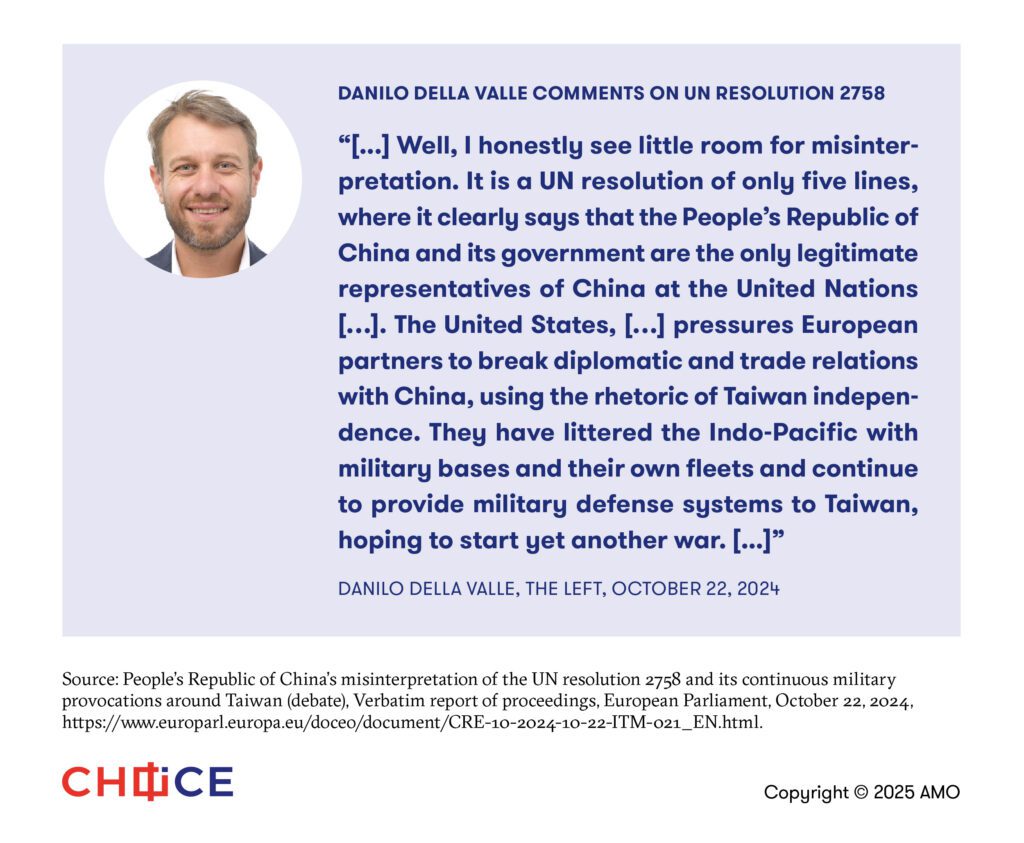
However, though his statement was put forward on behalf of The Left, there seems to be an internal division within the faction. A statement by Merja Kyllönen, a Finnish MEP from the Vasemmistoliitto (The Left Alliance) party, shows a more levelled approach, as she raised her concern over China’s military incursions around Taiwan and the possibility of Beijing embarking on the same path as Putin’s Russia. Though she did not vote, her statement at least sheds some light on other perspectives within her faction.
A similar narrative has been observed in the contributions of MEPs from the far-right faction, ESN. MEP Hans Neuhoff blamed the US for the EU’s need to contain China. Although his contribution could be seen as reflecting a relatively pro-Chinese stance, the emphasis should be on his direct criticism of the US and his call for greater strategic autonomy of the EU. This position was further reinforced by Stanislav Stoyanov an MEP from Bulgaria’s Revival party (ESN), who argued that the UN resolution 2758 should be adhered to and the EU should not abandon the One-China policy.
A potential new voices on China may include non-attached MEPs Ruth Firmenich (NI) from Germany’s Bündnis Sahra Wagenknecht – Vernunft und Gerechtigkeit (Sahra Wagenknecht Alliance – Reason and Justice, BSW) and Grzegorz Braun (NI) from Poland’s Konfederacja Korony Polskiej (Confederation of the Polish Crown). The BSW is considered a left-wing party with a voter base similar to that of the AfD, while the Confederation of the Polish Crown has been described as traditionalist, monarchist, and far-right.
During the debate, Firmenich warned against ‘fuelling tensions with China’, with her narrative aligning closely with those of ESN and The Left, particularly in her critiques of the US.
Juan Fernando López Aguilar (S&D) also contributed to the debate, ultimately abstaining from voting on the motion – possibly not due to disagreement with its substance. His stance might be better understood as a nuanced position: respecting the One-China policy while also prioritizing the prevention of conflict around Taiwan and the protection of Taiwan’s democratic governance. Although his perspective may not reflect the views of other MEPs, it offers insight into some of the potential motivations behind the recorded abstentions.
Solidify, Fragment or Shift?
Across the 2019–2024 legislative term, the European Parliament exhibited a wide spectrum of approaches to China, even as all China-related motions ultimately passed with comfortable majorities. Criticism or hesitation came predominantly from non-attached MEPs, while most political groups aligned behind resolutions addressing trade practices, human rights, and China’s external influence. The strongest consensus emerged on motions condemning repression in Xinjiang, Tibet, and Hong Kong – an outcome that stands in sharp contrast to pre-election findings from May 2024, which revealed deep fractures within the far-right (ID) and far-left (The Left) over similar human-rights issues, particularly those concerning Hong Kong and Tibet.
Although this research captures the entirety of the 9th term and only the opening months of the 10th, it already hints at continuity in the underlying drivers of parliamentary behavior. Debates and voting patterns across both terms point to a consistent conclusion: MEPs’ positions on China are seldom formed in isolation. Instead, they are anchored in broader geopolitical orientations – above all, their attitudes toward the EU’s role in the world, its relationship with the US, and the wider confrontation with Russia. In practice, the adage ‘tell me where you stand on the US and the EU, and I will tell you where you stand on China’ continues to hold explanatory power. These alignments transcend party families and frequently explain divergences within them.
It is equally important to note that, although some pro-China rhetoric emerged, this does not in itself demonstrate that MEPs who voted against or abstained from China-related motions did so out of explicit support for Beijing.
Looking ahead, the current 10th Parliament – constituted with a high share of newly elected MEPs – offers an important testing ground for how these dynamics evolve. With mounting tensions between the US and China, a more assertive Chinese posture toward Europe, and growing EU–US frictions on trade, pressure will increase on European legislators to articulate a position that situates the EU neither fully aligned with Washington nor naïvely open toward Beijing. This may sharpen internal splits within some political groups, especially where maintaining a strong human-rights line and support for Taiwan competes with calls for strategic pragmatism. The coming years will thus be crucial for assessing whether the emerging patterns observed at the very start of the 10th term in 2024 solidify, fragment, or shift under the weight of accelerating global developments.
Written by

Association for International Affairs (AMO)
Association for International Affairs (AMO) is a Prague-based independent foreign policy think tank founded in 1997. Its main aim is to promote research and education in the field of international relations, and serve as a watchdog of the Czech foreign and security policies. AMO represents a unique and transparent platform where academics, business people, policy makers, diplomats, media, and NGOs can interact in an open and impartial environment.