Debt-Trap or Diversification? Montenegro’s Highway and the Limits of China’s Leverage
Montenegro’s Bar–Boljare highway is often cited as an example of Beijing’s “debt-trap diplomacy.” However, although the project has strained public finances and alarmed the EU, it failed to translate into political leverage for China. Montenegro’s case suggests that infrastructure can entangle small states economically without capturing them politically, while also spelling out important policy lessons for the EU’s approach in the Western Balkans.
In December 2025, China opened the world’s longest highway tunnel, a 22-kilometer stretch in Xinjiang province. This shortened a mountainous drive of several hours to just 20 minutes. The highway, spanning 325 kilometers with an investment of about €5.6 billion, exemplifies China’s capacity for large-scale engineering feats in challenging terrain.
Half a world away, on a smaller scale, but facing similar geographic conditions, China has been building the key A1 highway in Montenegro, which critics have dubbed “the world’s most expensive road” and a “highway to nowhere,” echoing concerns about ballooning costs and underutilized infrastructure more reminiscent of China’s ghost cities than its vaunted infrastructural achievements.
Montenegro’s ambitious Bar-Boljare highway project has become a focal point in debates about China’s influence in the Western Balkans. While the highway has burdened the country with significant debt, the expected political leverage for China remains limited, revealing the complex realities that go beyond the “debt-trap” narrative.
The Costly Road to Connectivity
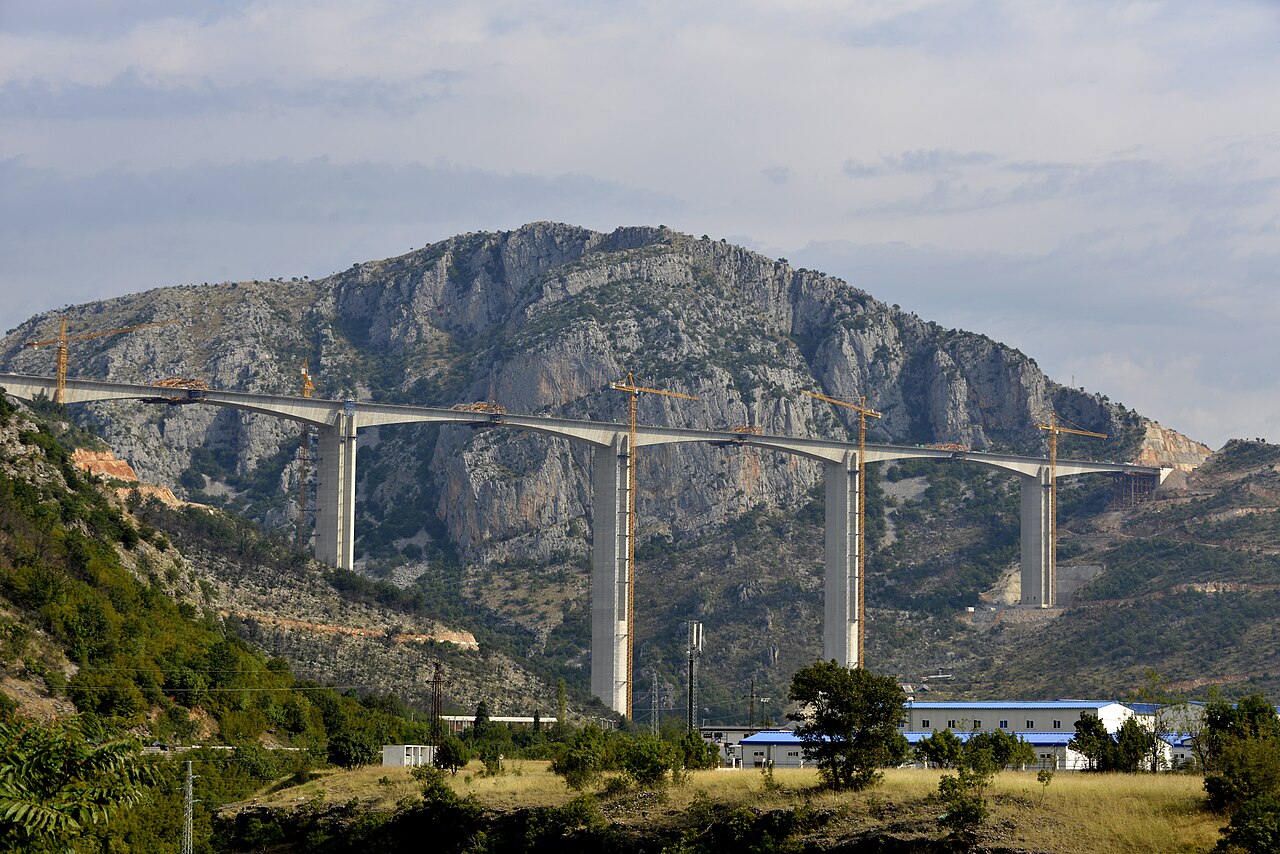
Montenegro, a Balkan country of around 630,000 people, embarked on the Bar-Boljare highway project in 2014. Funded by a nearly €1 billion loan from China’s Export-Import Bank and constructed by the China Road and Bridge Corporation, the highway aims to link the Adriatic port city of Bar with Serbia. About 60 percent of the 163-kilometer highway consists of tunnels and bridges cutting through Montenegro’s mountains and gorges. After eight years of delays, controversies, and mounting costs, only 41 kilometers were opened in 2022.
Despite its partial completion, the first stretch of the highway cost around €1 billion – almost double the estimates from independent feasibility studies. Because Montenegro did not hedge against currency fluctuations or include toll infrastructure, the costs spiraled out of control, with the debt accounting for more than one-third of Montenegro’s annual state budget. This pushed the country to the brink of financial collapse in 2021.
Montenegro’s topography has long posed significant challenges to infrastructure development. Even during Yugoslav times, connectivity projects like the Belgrade-Bar railway, completed in 1976, were contentious. This 500-kilometer route required 254 tunnels and 435 bridges to traverse the rugged terrain, making for a scenic trip but at a huge cost. The railway was viewed by wealthier and more fiscally conservative republics like Slovenia and Croatia as less strategic and more a means for Belgrade elites to secure access to the Adriatic Sea.
The fact that the train journey still takes 11 hours also underscores the need to invest in alternative highway infrastructure. In fact, plans for a highway connecting Serbia and Montenegro date back to 1969 and predate the construction of the railway. They resurfaced in the late 2000s, but the initial European construction tenders failed, with Croatian and Greek companies withdrawing from the project. Only afterward did the Montenegrin government turn to China for financing and construction.
Debt Trap That Failed to Snap?
While the scale of Montenegro’s debt to China sounded alarm bells in Brussels, the feared “debt-trap” scenario – where China would leverage economic dependence for political gains – has not materialized. Montenegro’s case illustrates the limits of Chinese leverage in a region where multi-vector diplomacy and external support play crucial roles.
While Montenegro is regarded by the EU as the “frontrunner” candidate country, this alone does not explain why the EU stepped in with diplomatic and financial support to restructure its debt. The EU’s stake in the project is more than preventing Montenegro’s default, as the highway is part of the larger European transport Corridor XI, connecting Bari in Italy to Bucharest in Romania.
Besides the irony of China funding and constructing European transport corridors, the opening ceremony for the first part of the highway also uncovered Chinese and Montenegrin differences in perception of the newly constructed highway. The Chinese charge d’affaires talked about “selfless” assistance and donations to local communities. One of these – hailed by the China Daily – was a renovation of a primary school costing a modest €4,000. By contrast, Montenegro’s prime minister expressed vague gratitude to all people who worked on the project, framing it as Montenegro’s physical reconnection with Europe.
On the one hand, while China seeks to increase its influence in the region, it is highly unlikely that it sought to trap Montenegro through this highway construction project. On the other hand, Montenegro’s foreign policy is a multi-vector one characterized by both balancing and bandwagoning, which reflects the agency of small states in managing great power competition. Montenegro has not passively accepted economic dependence on China but has sought to diversify its partnerships and balance competing interests.
New Rules, Similar Outcomes?
In addition to being costly and politically contentious, the Bar-Boljare highway also sparked criticism regarding environmental degradation, including damage to the Tara River and UNESCO biosphere reserve. Public opinion in Montenegro remains deeply divided, with many citizens seeing the highway as a potential economic boost, while others criticize its high costs and limited benefits.
Despite the controversies, the government has pushed ahead and awarded new contracts to Chinese firms. However, seemingly having learned from earlier mistakes, it decided to do so under the EU’s supervision and financing. In January 2026, Montenegro’s state motorway operator Monteput picked a consortium of Chinese firms PowerChina and Stecol, to build the 22-km Matesevo-Andrijevica section of the same highway set to be completed by the end of 2030. This time, the construction will be financed by loans from the European Bank for Reconstruction and Development (EBRD) and the EU, as well as from Montenegro’s state budget.
While the selection of the contractor through an open public tender, and financing and supervision by EBRD and the EU are all positive steps, the choice of PowerChina raised eyebrows, as the company has been expanding its operations in the Western Balkans. This includes building the Ivovik wind farm in Bosnia and Herzegovina, which has been controversial due to land disputes. It is also set to build the first phase of Line 1 of the Belgrade Metro. Details of the €720 million investment in Montenegro have been declared “trade secrets” at the company’s insistence, raising concerns about transparency.
China as an Addition, Not an Alternative
While continuing to rely on Chinese engineering equipment and know-how, Montenegro’s foreign policy course has not changed. The country is committed to joining the EU by 2028, and its foreign policy is fully aligned with that of the EU. In 2021, Montenegro signed the Joint Statement on the Human Rights Situation in Xinjiang along with 42 (mostly Western) countries, provoking outrage from Beijing. More generally, Montenegro’s alignment against China in the UN bodies is ahead of Serbia, Bosnia and Herzegovina, and even Greece, but behind North Macedonia and Albania.
For Montenegro, Chinese construction is more of a“forced solution than an ideological choice”. In this, it is far from alone. In 2022, Croatia opened the Pelješac Bridge, constructed by a Chinese company but funded by the EU and implemented under the EU’s regulatory framework. This hybrid approach may become a model for other Western Balkan countries grappling with similar challenges. Rather than a substitute for the EU, Western Balkan countries – like Montenegro – see China as an additional source of funding, particularly in the context of geopolitical volatility and the stalled EU enlargement process.
As such, the case of Montenegro offers valuable insights for the EU’s approach to its neighborhood and beyond. The most obvious is that the EU’s response to Montenegro’s debt crisis demonstrated the importance of early engagement and support to prevent economic coercion. Small states in the region are not mere passive recipients of influence but active agents weighing alternatives, hedging, and balancing geopolitical risks. The EU should support this agency by respecting national interests and fostering diversified partnerships. After all, even external big powers often have to play by local rules. The EU would make its job easier if it got to co-create these rules, for instance through institutional oversight along with EBRD. Strengthening transparency and enforcing competitive tendering are – more than matching China’s financing – key to ensuring infrastructure projects align with European norms and values.
Written by

Urban Jakša
Dr. Urban Jakša is a researcher and analyst focusing on conflict, peace, and security in Southeastern and Eastern Europe. He currently heads the European Union Training Initiative (EUTI), which trains staff at EU CSDP civilian crisis management missions. Urban previously worked for the UN, NATO, and OSCE on disarmament, anti-corruption, and election monitoring, respectively. He has a PhD in Politics from the University of York and has held fellowships at Columbia University (Fulbright), UN Alliance of Civilizations (UNAOC), European Leadership Network (ELN), and International Republican Institute (IRI).