CHOICE Newsletter: How Europe and Southeast Asia De-risk from China
Dear reader,
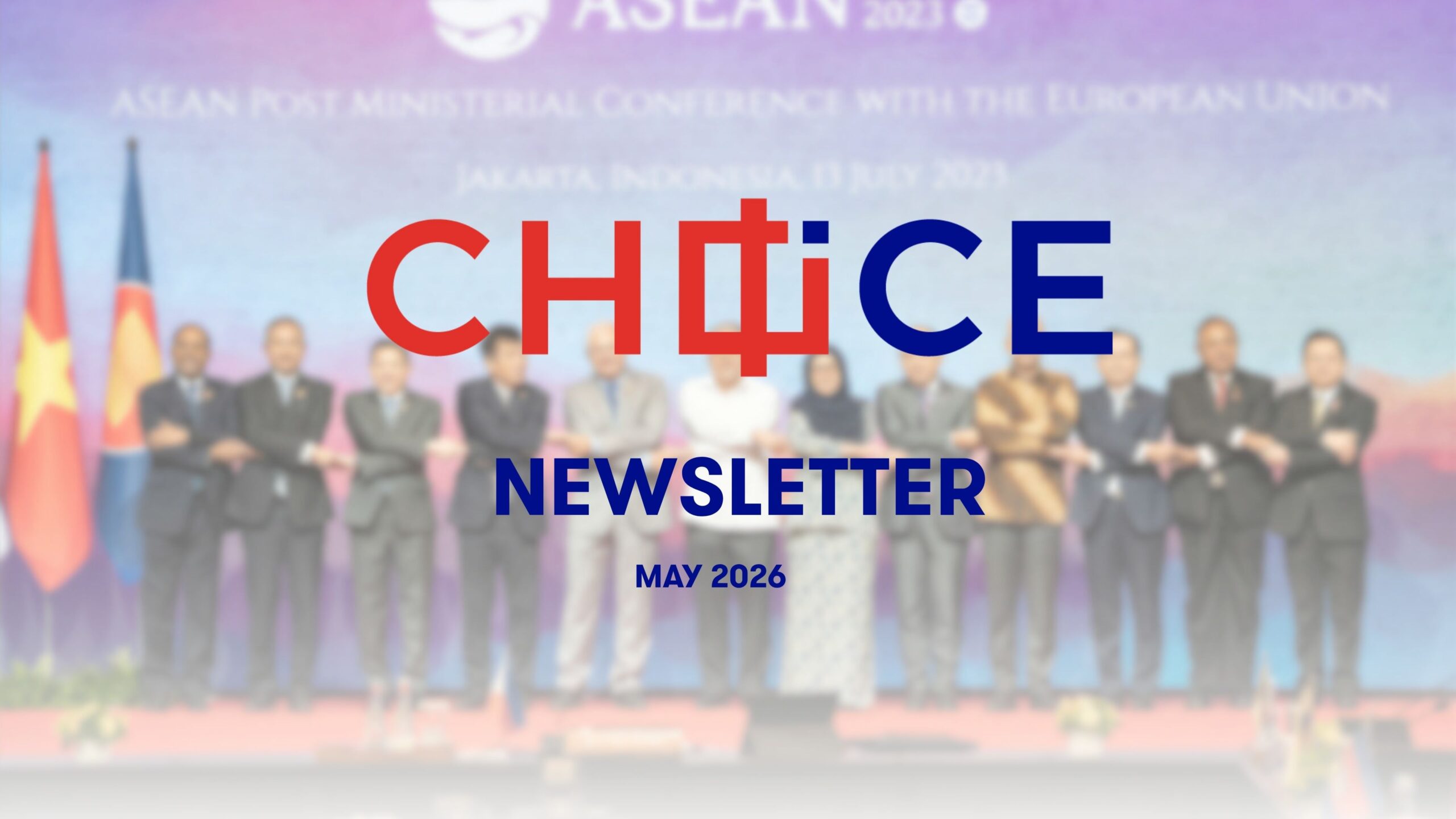
As Europe continues to recalibrate its approach to China, Southeast Asia is becoming an increasingly important partner in diversification and de-risking efforts. This month’s newsletter looks at EU–ASEAN relations, growing ties between Central and Eastern Europe and Southeast Asia, and Brussels’ quietly expanding China policy toolkit.
Last month was also exceptionally active for CHOICE. We joined a closed roundtable in the Czech Senate on supply chain security, attended by Senate President Miloš Vystrčil and Vice-President Jiří Drahoš; spoke on drones at an EU–Taiwan cooperation panel in Rome, hosted by Istituto Affari Internazionali; and co-hosted a Brussels conference with ECFR and OSW on Russia–China cooperation, Europe’s response to the second “China shock,” and Chinese influence in the Balkans. Our team also held targeted briefings for EU institutions, including a meeting with EU Defence Commissioner Andrius Kubilius, and concluded the month with an on-demand briefing in Vienna, where we continue to track China’s influence.
As always, we hope you find these insights useful – and we look forward to continuing the conversation with you.
By Ivana Karásková, CHOICE Founder and Team Lead (based in Prague)
CHOICE Quick Takes
Europe’s Relations with ASEAN Countries Amid De-risking Efforts from China

by Sophie Boisseau du Rocher, Former Research Associate, Institut Français des Relations Internationales
Reimagining the EU-ASEAN relations in the late 2010s was a convergent move to diversify risks and pursue common interests. By launching new schemes of cooperation, the 2021 EU Indo-Pacific Strategy was set to provide necessary support, with Southeast Asia and ASEAN at the very core of the transformation. Five years later, the lack of concrete outcomes is regrettable. At a time when world order is being continuously disrupted, Europe risks being sidelined. ASEAN, and Southeast Asian states, raise several fundamental questions for Europe. While it took less than ten years for the Regional Comprehensive Economic Partnership – the largest free trade agreement in the world – to be launched and implemented between 15 Asia-Pacific members, Europe is hampered by institutional mechanisms that take time and constrain actions. The EU-ASEAN Free Trade Agreement, launched in 2007, is still being negotiated. Between intentions and achievements, programmes and resources, principles and realities, consistency remains the EU’s greatest challenge. Another crucial question concerns China. ASEAN chose early to compromise by embedding China in the web of regional institutions, while the EU’s three-pronged approach of promoting the EU competitiveness, protecting the EU from economic security risks, and partnering with like-minded countries, did not yet prove efficient. Being collectively more pragmatic will serve our positions and interests.
There Are Real Cooperation Opportunities Between CEE and Southeast Asian Countries

by Barbara Kratiuk, Head of the Asian Observatory, Centrum Stosunków Międzynarodowych
The last few years, especially since the beginning of the Russian-Ukrainian war, have seen a definite acceleration of relations between Central and Eastern Europe (CEE) and Southeast Asia (SEA). The increased engagement included cooperation on AI and FinTech, led by states like Estonia and the Czech Republic. It also included a notable strengthening of bilateral relations in the case of Poland and Vietnam with a focus on growing cooperation in pharma and food industries. Lower entry costs and markets that have not yet been oversaturated by foreign investment make these partnerships not just viable, but very attractive. Philippines and Indonesia have also both been courting closer engagement with Central Europe, seeing these states not just as a gateway to the wider European Union but also as states with similar experiences of close proximity with great powers and a long history of asymmetric relations. Both sides see the Russia-China nexus as a major source of insecurity and as such are looking for alternative partnerships to strengthen their own international engagement. If the will for increased cooperation continues, this could have a very positive impact on both SEA and CEE.
CHOICE in Brussels
Can Brussels’ Quiet Offensive Find its Window of Opportunity?

by Konrad Szatters, China Analyst & Editor at AMO (based in Brussels)
Three new pieces of legislation have recently sharpened Brussels’ stance on China. Firstly, Cybersecurity Act revisions lay the legal groundwork to restrict “high-risk vendors” – including China-based ICT suppliers – from critical sectors. Secondly, the Industrial Accelerator Act (IAA) – alongside measures to speed up industrial investment and decarbonization – introduces conditions such as joint-venture structures on foreign investments above €100 million coming from countries controlling more than 40 percent of global production in strategic sectors (batteries, EVs, solar panels, critical raw materials). This “country-agnostic” threshold is widely read as aimed at Beijing. And finally, in mid-April, the Commission quietly decided to cut EU funding for clean-tech projects that use Chinese inverters. In all these cases, the Commission’s approach is “do more, say less.”
This logic was further tested on April 23 when the Council adopted the 20th sanctions package against Russia – and, for the first time, used its anti-circumvention tool to target 27 entities from mainland China and Hong Kong suspected of supplying dual-use goods to the Russian military-industrial complex. Beijing’s response was immediate. The Ministry of Commerce issued a “resolute protest” demanding the firms’ immediate removal from the list, and within 24 hours retaliated by placing seven European defence companies on its own export control list.
The package’s path through the Council took a familiar route. It only advanced after Hungary and Slovakia dropped their long-standing vetoes once the Druzhba pipeline dispute was resolved. But the complexity of EU’s China policy extends beyond Central and Eastern Europe. The IAA, one of the EU’s most consequential China-related files, for example, is the ground of a prolonged Paris-Berlin standoff. The proposal was pushed back even before publication, survived 44 last-minute changes, and emerged with watered-down ambitions in key areas like clean lead markets. France pushed hard for a strict “Made in EU” label, while Germany, fearing higher costs and disrupted supply chains, countered with a softer “Made with Europe” formula.
This clash reaches beyond technicalities and procurement, and is symptomatic of competing strategic cultures within the EU as well as divergent readings of what China is to Europe. As the IAA already drew criticism from Beijing, and with the Commission aiming for its adoption by the end of the year, the months ahead will show whether it can deliver a more unified European stance vis-à-vis China.
WiCH Highlights
Abigaël Vasselier, WiCH Co-Chair for Belgium, will speak at a webinar on Europe’s Indo-Pacific security gap: Discussing the EU coordination deficit next Monday, May 11. Watch it here!
Nataliya Butyrska, WiCH Co-Chair for Ukraine, wrote an article in Ukrainian about the possibilities of a Ukraine’s alliance with South Korea. Read it here!
Meia Nouwens, WiCH Co-Chair for the United Kingdom, discussed how European countries are adapting to emerging security threats in a podcast. Listen here!
CHOICE News
 Sense Hofstede wrote an article on Beijing’s perception of Japan’s rearmament for The Jamestown Foundation (read it here) and gave a lecture on the 15th Five-Year Plan for China Knowledge Network (watch it here).
Ivana Karásková spoke about Taiwan-EU economic and technology cooperation at an Institute of International Affairs event held in Rome (read about it here) and presented the geopolitical dimension of supply chain reselience at a seminar at the Czech Senate (read about it here).
We’re on Bluesky, LinkedIn, X, and Instagram! Stay updated with our latest articles, insights, and news by following our accounts – don’t miss out on valuable content and updates.
This is the web version of our newsletter. If you’d like to receive the CHOICE newsletter in advance, straight to your inbox, sign up here:
Written by

CHOICE
CHOICE is a multinational consortium of experts providing informed analysis on the rising influence of the People’s Republic of China within the countries of Central and Eastern Europe (CEE).