To ensure the development of China-Belarus trade relations, factors such as free access to each other’s market as well as uninterrupted conducting of cross-border transactions are of utmost importance. However, the uncertain position of Belarusian enterprises on Chinese market, China’s concerns regarding business expansion outside of the Great Stone Industrial Park, and Western sanctions imposed on Belarus, undermine further efforts to improve trade relations between the two countries. Nevertheless, both China and Belarus seek ways to mitigate their discrepancies and conduct transactions against the backdrop of Western sanctions.
Entering the Chinese Market
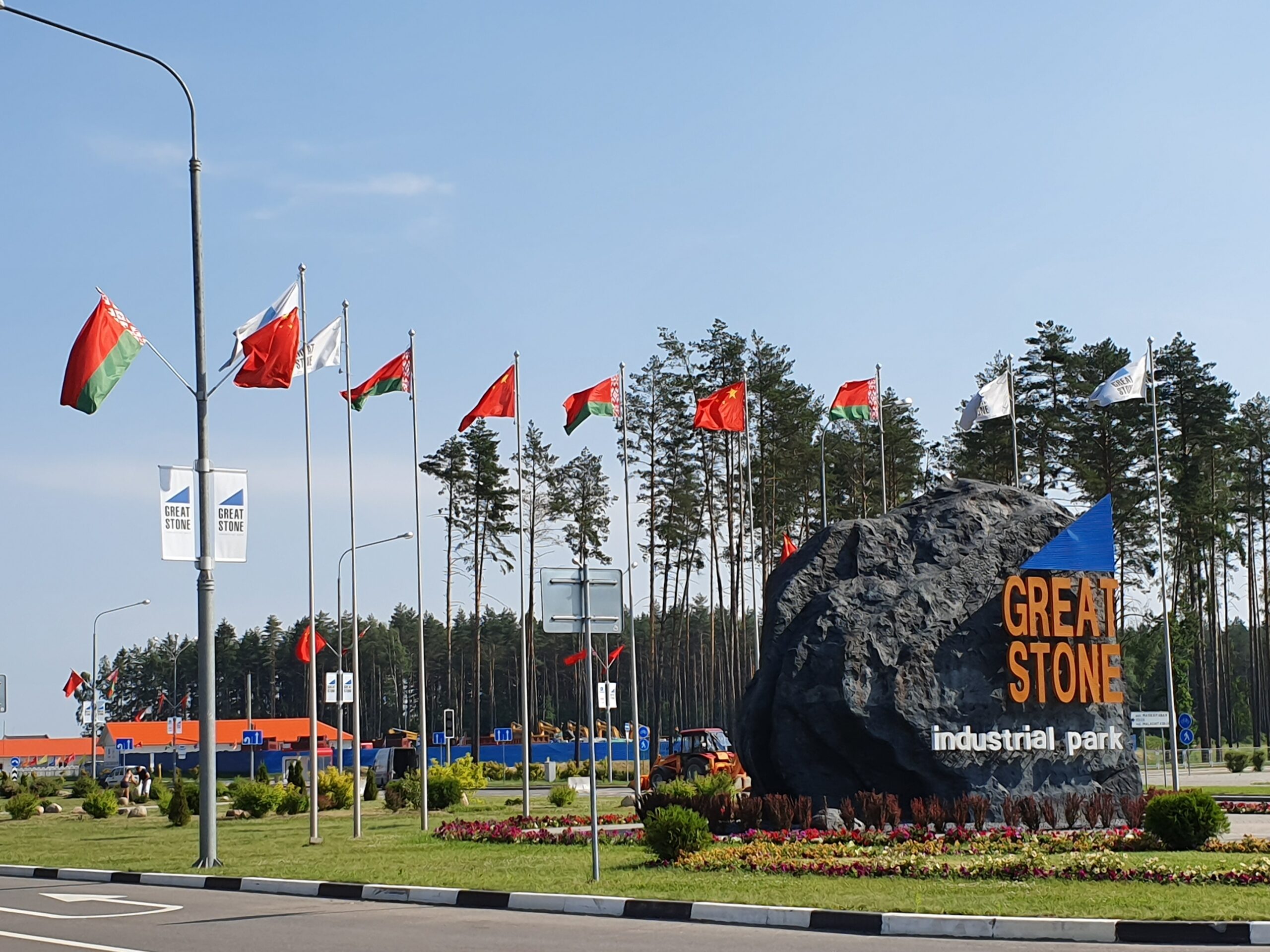
While operation of Chinese companies in Belarus is largely represented by joint ventures located within the Great Stone Industrial Park – supplying vehicles, machinery, electronics, and clothing –the presence of Belarusian businesses on the Chinese market is rather underwhelming. It primarily takes place in the form of China-Belarus joint ventures, such as the establishment of a modern dairy production facility and a joint venture for distribution of dairy products in China. Belarus’s strategy for entering Chinese market involves the development of a comprehensive network of distribution channels. Belarusian national pavilion, operating in China, serves not only as retail outlet, but also as showroom and marketing hub, showcasing predominantly agricultural products and consumer goods such as confectionery, alcoholic beverages, and dairy products. Belarusian goods also have been introduced on major Chinese e-commerce platforms, including JD.com, Tmall, Douyin, and PinDuoDuo.
Belarus’s exports to China are diversified beyond these sectors. Other commodities massively supplied by Belarus to China are various types of mineral fertilizers, timber, and cellulose. Nevertheless, despite ensuring promising prospects for Belarusian businesses in China, Belarus’s total export volume to China in 2025 reached around $1.7 billion, which was 8.4 percent lower than in the previous year.
One of the key factors contributing to the decrease in Belarus’s export to China was the loss of the access to the Chinese poultry market. When China revealed that Belarus’s large supplies of chicken feet were obtained by purchasing the product abroad and selling it to China as domestic, in December 2024, China almost completely blocked import of poultry products from Belarus. Losses suffered by Belarus in the first year of the ban were estimated at $140 million.
Attitudes of Chinese and Belarusian Businesses
According to a survey on cooperation between Chinese and Belarusian enterprises, conducted by Yuliya Pavlovskaya, for 89 percent of major Belarusian industrial companies, the most common form of cooperation is purchasing of Chinese materials, components, and technological equipment. Interest in establishing an assembly plant for Belarusian products in China was expressed by only 5 percent of respondents, making it a completely unattractive form of cooperation for Belarusian enterprises. This response is likely due to the abundance of engineering industry in China, which does not require Belarusian components for assembling finished products on its territory. Additional challenges in cooperation with Chinese partners include: scarce information about potential partners, lack of business experience with Chinese organizations, and differences between Belarusian and Chinese standardization and certification systems.
The proper mitigation of these issues necessitates the creation of a joint coordinating body for the development of trade relations between Belarus and China, which would accumulate information on the potential for cooperation between the two countries to overcome existing limitations. First steps in this direction have already been made. In 2025, Belarus and China have established a commission on industrial cooperation, further strengthening trade relations as well as joint investment and coordination of large-scale projects.
At the same time, in a study of Chinese small and medium-sized enterprises operating in Belarus, conducted by Zhao Qingqiu, 85 percent of the surveyed business representatives indicated a significant impact of sanctions on their operations. In addition, most Chinese businesses in Belarus are concentrated in areas with high population and economic activity, namely in Minsk and the surrounding region, creating a regional asymmetry. The most significant obstacles for effective operation on Belarus’s regional markets are the low level of demand, limited capacity of regional markets, and insufficient level of workforce qualification.
Nevertheless, Chinese companies intend to expand their operations in Belarus. Among them, 45 percent of respondents plan to more actively collaborate with Belarusian companies, 35 percent intend to develop new markets for exporting products and services, and 25 percent are focused on creating new production facilities and launching new products.
Helping China-Belarus Cross-border Settlements
One of the key factors for conducting cross-border transactions between Chinese and Belarusian enterprises is a reliable payment system. After the adoption of the US and EU sanctions, the number of payment rejections from Belarus to China has increased, thus complicating shipments of technological equipment for the Belarusian industrial complex.
Another approach to circumvent sanctions is to join or create a separate dollar-free payment system. Connection of Belarusian banks to China’s national payment system CIPS proved to be unsustainable after major Chinese bank popular with Belarusian importers has suspended payments via CIPS due to SWIFT payment system pressuring China’s CIPS by requesting information on the volume of financial transactions with Belarus and Russia. The most promising alternative to CIPS is the BRICS Pay – a BRICS-backed project of a decentralized and independent payment system rivaling SWIFT. Since Belarus has become a BRICS partner state in 2024, in case of a successful BRICS Pay implementation together with Belarus’s full membership in BRICS, financial transactions between Chinese and Belarusian companies could be carried out without the threat of additional sanctions.
Conducting mutual settlements in the national currency can also be considered as one of the viable solutions to ease international sanctions’ pressure. By the end of 2025, major Belarusian bank VTB has increased its payment volume to China by 60 percent. In addition, Belarusian government started creating regulatory framework and specialized software to introduce the digital Belarusian ruble, which is likely to be used as a tool for executing payments with Chinese banks using China-led mBridge cross-border digital currency platform. This poses certain challenges, since settlements will most likely be made in Chinese yuan due to Belarusian ruble being a closed domestic currency, leading to appreciation of the yuan on Belarusian market and making Belarusian goods more expensive.
Trade Relations Development
The expectations of Belarusian and Chinese enterprises regarding the conditions for effective operation in each other’s market vary significantly. For China, major hindrance for broader access to Belarusian markets is the inability to expand business beyond the Great Stone Industrial Park due to the economic underdevelopment of other regions in Belarus, while for Belarus, the main obstacle for entering Chinese market is the insufficient data on potential partnerships and lack of experience in doing business with Chinese partners. These challenges, however, do not discourage the intention of both countries to intensify their business partnership. The establishment of China-Belarus Industrial Cooperation Commission together with the registration of the first project with Belarusian investment in China signals further rapprochement in China-Belarus trade.
China and Belarus are working on identifying and eliminating factors that may negatively affect operating conditions in each other’s market, as well as developing mechanisms to mitigate the impact of international sanctions on China-Belarus cross-border transactions. Lifting of sanctions imposed on major Belarusian state banks and leading potash producers by the US is likely to further boost bilateral trade between the two countries, while the ongoing geopolitical turmoil in Middle East is expected to strengthen Belarus’s role as a strategic link in China-EU supply chain. In this case, the EU should prioritize diversification of supply chains with China to avoid overreliance on a single supply route as well as pay attention to the price dynamics for Belarusian products, crucial for European economy, such as potash fertilizers and adjust sanctions pressure on Belarus accordingly.
Written by

Danylo Stonis
Danylo Stonis is an independent researcher focusing on Sino-Russian and Sino-Belarusian relations. He obtained his PhD in political science at the Matej Bel University in Banská Bystrica (Slovakia) in 2025 with a dissertation focusing on security dilemma between Russia and China. His articles have been featured in various scientific journals, including New Eastern Europe, Polish Political Science Yearbook, Czech Journal of Political Science and Stockholm Journal of International Affairs.