CHOICE Newsletter: Europe’s China Debate You Missed in 2025
Dear reader,
As 2025 draws to a close, Europe’s China debate feels busier than ever. At CHOICE, we’ve tried to match that pace: over the past twelve months we’ve published more than 130 outputs, from articles and policy papers to podcasts and cartoons. You’ve been with us for many of the most interesting developments not only in Europe–China relations, but also within our own team.
One highlight of this busy year came on November 26, when together with MERICS and ECFR we co-organized the annual European China Conference in Berlin – now the largest China-focused conference in Europe. Off the record and by invitation only, it brought together around 140 registered participants and a strong line-up of speakers and topics, from security and tech to the evolving role of Europe.
At the same time, we have also been looking at who gets to shape this debate. Last month, our sister project, Women Insight on China (WiCH), published the first-ever audit of gender representation in China research in Europe. WiCH mapped 63 European think tanks. Its findings are uncomfortable: women remain far from parity in key public events and podcasts, revealing specific gaps the European China-watching community must address.
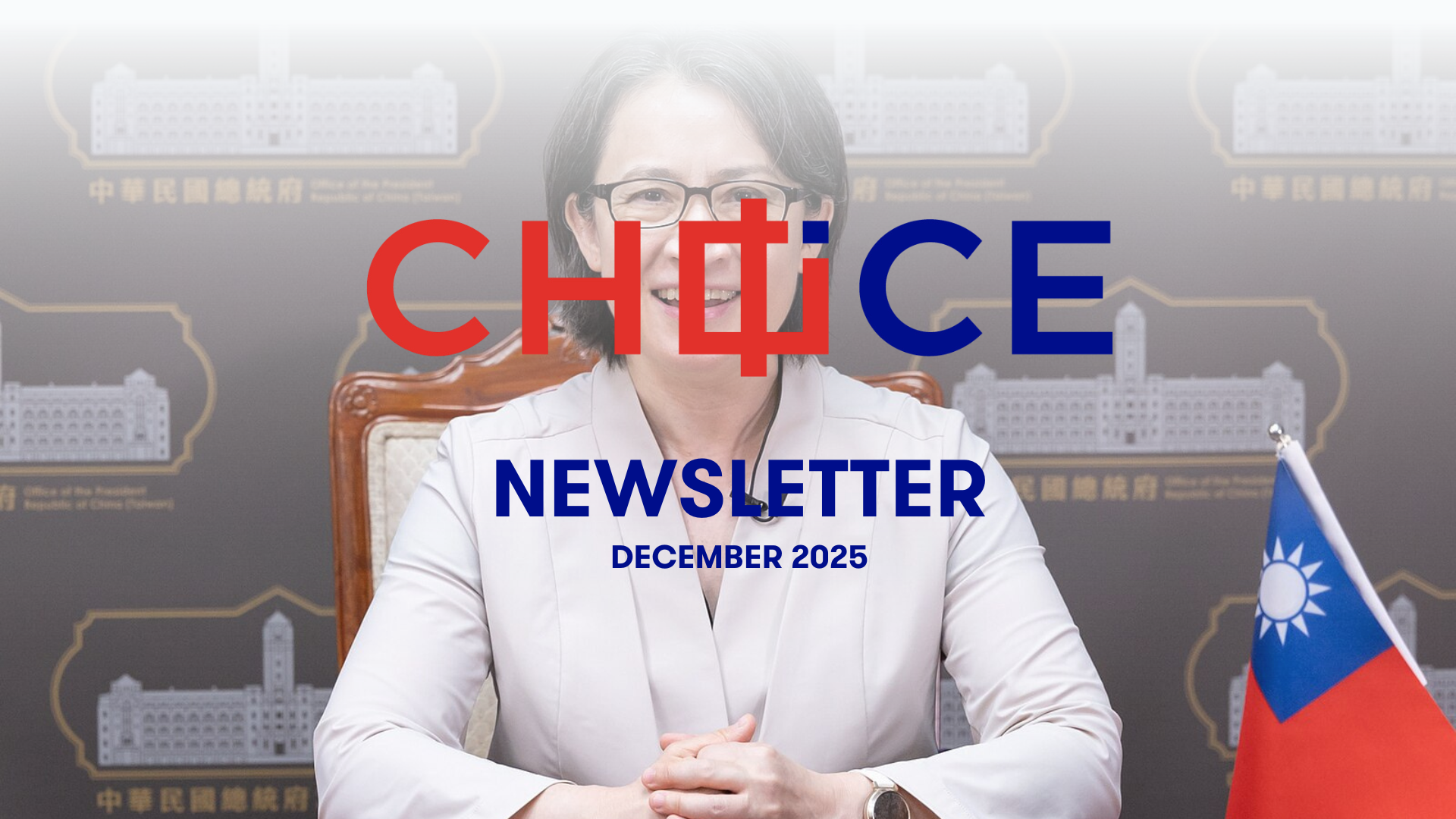
Against this backdrop, in this month’s CHOICE Quick Takes we look back at what shaped Europe–China relations in 2025. In CHOICE in Brussels, we take you behind the scenes of Taiwanese Vice President Hsiao Bi-khim’s landmark speech at the European Parliament.
Since we’ll be sending out a special year-end edition soon, I’ll save my holiday wishes for later. For now, I would like to thank you for reading and for engaging with our work!
By Ivana Karásková, CHOICE Founder and Team Lead (based in Prague)
CHOICE Quick Takes
Poland: The Visit That Changed Nothing

by Joanna Nawrotkiewicz, China analyst at the CAA at the University of Łódź (based in Warsaw)
This year, Polish China watchers were drawn by one particular event: Wang Yi’s visit. When China’s foreign minister arrived in Warsaw in mid-September – the first Chinese foreign minister to do so in six years – both sides kept the optics flawless. The meeting ran three hours, the smiles were plentiful, and the separate statements spoke of stability and mutual respect. On paper, it looked like a perfectly good visit; in practice, it showed how little trust remains between both sides.
The broader context of the meeting was impossible to ignore. Days earlier, Poland had faced Russian drone incursions and shut its border with Belarus during the Zapad drills, effectively freezing BRI freight in Małaszewicze. The route accounts for only 4 percent of China’s exports to Europe, but up to 80 percent for inland provinces like Sichuan – enough to spark Chinese cyber-nationalist outrage accusing Poland of “playing with fire” for Washington’s sake.
Warsaw’s actions reflect a deeper shift: security beats commerce. What once looked like economic opportunity is now framed as risk, and Beijing’s alignment with Moscow has drained what little enthusiasm remained. Not even the fan-favourite poultry export deal could make the relationship feel alive again.
At the same time, Warsaw shows no appetite for high-profile unilateral moves – wary of a Lithuania-style backlash despite growing business ties with Taiwan – and prefers to follow broader EU positions. Poland stays polite but disengaged, and nothing suggests this will change in 2026.
China and Taiwan on the Map of Romania

by Andreea Brinza, Vice President of The Romanian Institute for the Study of the Asia-Pacific (based in Bucharest)
For the past five years, Romania-China relations have essentially operated on autopilot without any notable diplomatic or economic engagement. Instead, the relationship has continued largely on the momentum of the past. No major official visits took place, no significant Chinese investments appeared on Romania’s economic radar, and no notable diplomatic or cultural events marked the 75th anniversary of Romania-China relations in 2024.
However, 2025 seems to bring a slight recalibration. On the diplomatic front, according to several sources, the Romanian MFA prioritized and accelerated the procedure for receiving the new Chinese ambassador at its headquarters, and the ambassador was even welcomed by the Minister of Foreign Affairs, Oana Țoiu, a practice that is not particularly common within the MFA.
In the economic sector, reports indicate that an unnamed Chinese company leading the market for insulating materials used in electrical transformers plans to open a factory in Oradea, near the Hungarian border. Meanwhile, on Romanian roads, Chinese car brands (mostly non-EV), such as Chery, have become increasingly visible, driven by intensive branding campaigns at auto fairs, TV ads and promotional displays in major shopping malls.
Taiwan, once a non-topic in Romania’s political landscape, also entered the public conversation in 2025, when nine members of Parliament nine members of Parliament signed an open letter addressed to the President, the Prime Minister, and the Minister of Foreign Affairs, calling for enhanced Romania-Taiwan relations. The Chinese Embassy responded by reiterating its familiar “One China principle” line but refrained from publicly engaging in wolf-warrior diplomacy.
Tracing China’s Footprints in the Western Balkans

by Arta Haxhixhemajli, Research Officer at The Balkan Forum (based in Pristina)
China’s involvement in the Western Balkans in 2025 gained greater attention and strategic consistency. Although the level of diplomacy of senior officials was not as strong as in the 17+1 initiative’s peak, China continued to hold its position through the combination of economic pragmatism and selective political signals. Western Balkans for China is a door to the EU market, a testing ground for its diplomatic strategies, and a place where Beijing can demonstrate that multipolar partnerships remain high on its agenda. In the region, Serbia is China’s most prominent partner and their strategic partnerships have been strengthened through investments in energy, mining and digital infrastructure, despite increasing pressure on public health and labor standards.
Meanwhile, China is moving on softer in other countries. With Montenegro and North Macedonia, Beijing pursued very limited cooperation in terms of technology and green transition, while Albania, as China’s slightly more reserved partner, took a closer stance in the EU. Kosovo also maintains its position towards Western countries. Connected to that, one of the main features of the Western Balkans in 2025 was the change in attitude in the region. Western Balkan countries are seeking to offset the current relationship with China by promoting their integration into the EU, tightening control of foreign investment and increasing supply chain diversification between the United States and Europe. Therefore, China’s presence continues to be felt but is increasingly dependent on the local political situation and less on Beijing’s direct actions.
CHOICE in Brussels
Behind the Scenes of the Taiwanese Vice President’s EP Speech
Taiwanese VP Hsiao Bi-khim made an eye-catching entrance through the doors of the European Parliament on November 7: she was the first-ever senior member of the Taiwanese government to deliver a speech in a European legislature.
Unsurprisingly, the Chinese mission to the EU displayed customary grievances about European doors being opened for Hsiao, a former Taiwan’s representative to the US whom Beijing has blacklisted as a “die-hard Taiwan independence separatist.”
What did European lawmakers think? The EP was not in session that day. The Parliament served as a venue for the Inter-Parliamentary Alliance on China’s (IPAC), Annual Summit, an international, cross-party alliance of lawmakers focused on relations with China. According to our sources who attended the event, only one third of the 23 MEPs showed up. Out of the third, a couple of them were seen leaving shortly after the event started.
The ones who did stay were reportedly impressed with Hsiao’s “great charisma and human approach.” Praised, back in 2023, as one of the most influential diplomats in Washington (although she did not enjoy official diplomatic status), Hsiao Bi-khim reportedly called herself a “cat warrior” for her agile maneuvering of informal diplomacy.
At the November event, I was told by sources that Hsiao arrived ahead of her speech to listen to a presentation by a Japanese scholar, making a good impression. The pièce de résistance, her speech, “hit the right spots” by targeting topics on the top of European lawmakers’ minds: trade instability and the various aspects of security. She boldly used a value-based rhetoric, stressing a principle of solidarity between democracies. But Hsiao also skillfully portrayed Taiwan as a “critical global economic player” and a “responsible international partner,” multiplying parallels between the security challenges faced by her home island and European countries. Finally, she made a grand exit, taking time to speak individually with over 60 IPAC members present – a move which was apparently still talked about during dinner.
One has to wonder: is the low turnout a counterpoint to a generally growing interest of the EP for Taiwan? The messaging sent by the speech and its venue remains strong given China’s efforts to hijack any form of international interaction with Taipei. And according to whispers in Brussels, there will be new opportunities for Taiwan to interact with European parliamentarians in 2026.
By Emma Belmonte, CHOICE Analyst (based in Brussels)
WiCH Highlights
WiCH conducted a new research on gender balance in this year’s China events and podcasts in Europe. We presented the results at a WiCH event on November 17. Take a look at the results here!
Ana Krstinovska, WiCH Co-Chair for Macedonia, co-authored a research paper on Navigating Multipolarity: Southeast Europe in the EU’s China Strategy. Read it here!
Janka Oertel, WiCH Co-Chair for Germany, shared her take on how Europe should respond to Chinese export restrictions. Check it out here!
Meia Nouwens, WiCH Co-Chair for the United Kingdom, wrote a chapter on AI and the PLA’s New Revolution in The PLA’s Long March toward World-Class Status. Download it here!
CHOICE News
 Ivana Karásková’s testimony at the European Parliament was quoted by Asia Times (read it here).
An article based on the WiCH investigation into gender (in)equality among China watchers by Ivana Karásková & Emma Belmonte was reposted by NüVoices, (read it here), quoted by the Dutch-language Chinese Wouden newsletter (read it here), and mentioned in Bill Bishop’s Sinocism (read it here).
We’re on Bluesky, LinkedIn, X, and Instagram! Stay updated with our latest articles, insights, and news by following our accounts – don’t miss out on valuable content and updates.
This is the web version of our newsletter. If you’d like to receive the CHOICE newsletter in advance, straight to your inbox, sign up here:
Written by

CHOICE
CHOICE is a multinational consortium of experts providing informed analysis on the rising influence of the People’s Republic of China within the countries of Central and Eastern Europe (CEE).