Sino-Russian Cooperation in Spreading Disinformation: Implications for Europe
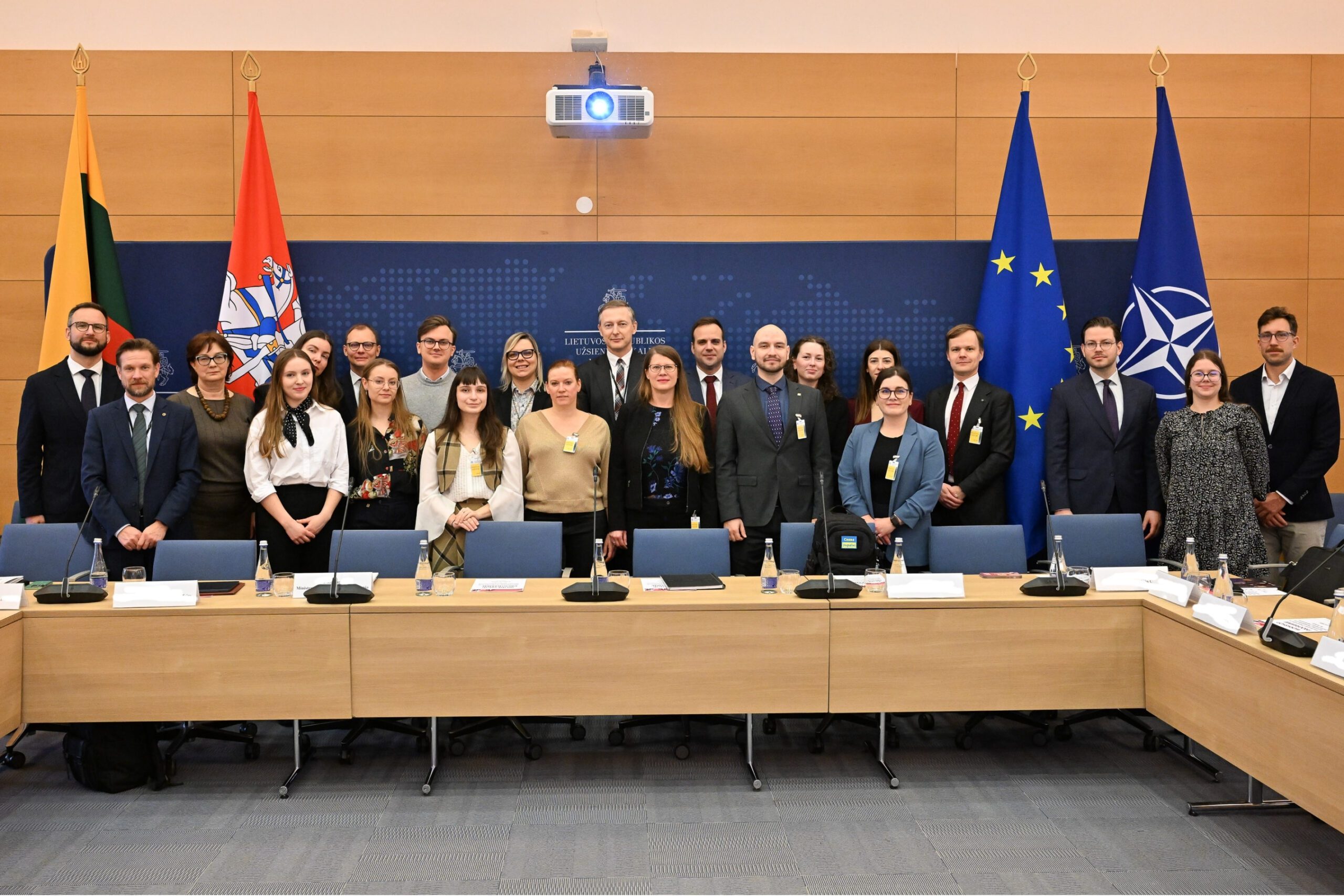
In cooperation with the Ministry of Foreign Affairs of Lithuania, AMO, ECFR, and OSW convened another workshop examining the confluence of Russian and Chinese influence-building efforts in Europe. Held in Vilnius, the event brought together participants from the Baltic region, Western Balkans, and Central Europe to discuss China’s foreign information manipulation and interference (FIMI) in the era of global geopolitical and economic turmoil. The discussion was conducted under the Chatham House Rule.
The event was opened by Ivana Karásková (AMO China Team Lead) and Mindaugas Lašas (Department Director at the Lithuanian MFA), who set the stage by discussing the current CEE positioning vis-à-vis China, the region’s underwhelming engagement with Beijing since the 2010s, and its historical experiences with Russia.
Perspectives on FIMI in the EU and its Neighborhood
The keynote speakers, Alicja Bachulska (ECFR Policy Fellow) and Konrad Szatters (AMO China Analyst), provided insights of their research on China’s FIMI efforts in Central and Eastern Europe and discussed what it means in a broader European context. Throughout the subsequent open discussion, practitioners from across the region offered candid accounts of China’s information-related activities observed on the ground in their respective countries as well as their efforts to map and counter these activities.
A recurring observation was that China’s FIMI in Central and Eastern Europe (CEE) tends to be aimed locally – at municipalities rather than capitals – suggesting a deliberate strategy of working below the threshold of national political attention. In some regions, Chinese actors target minority communities through placing content in minority-language newspapers and organizing official diplomatic visits to schools of these communities. This strategy reflects an evolution of Chinese FIMI caused by official channels of communication, such as ambassador op-eds in mainstream media or embassy correspondence, largely failing to resonate with wider national and European audiences.
Conversely, the participants from the EU also discussed China’s notable progress in reaching EU audiences and leveraging social media platforms – particularly TikTok and Instagram. As a result, younger generations, who used to be critical of Beijing due to human rights issues, now tend to see China in a more positive light. Social media accounts portraying China’s technological rise and the recent decision to grant visa-free access for many European countries, which led to a surge in visits and generated organic positive perceptions. Effectively, these phenomena constitute effective and not-so-costly soft power tools for Beijing.
On the other hand, participants from non-EU states brought distinctly different perspectives. In Serbia, close political ties with both Russia and China have created a media environment in which most outlets are amplifying narratives favorable to Moscow and Beijing. While Chinese infrastructure investment in the country has generated confirmed instances of corruption, these have received seemingly minimal media coverage. In North Macedonia, despite limited direct exposure to Chinese or Russian disinformation, domestic political elites have built on their toolkits and instrumentalized the two-decade-long EU accession process to deflect scrutiny from internal failures – contributing to the erosion of the EU’s image in the country.
The Gaps Europe Cannot Afford
The EU-China structural asymmetry was noted repeatedly: Beijing deploys billions of dollars of resources, while Brussels countering efforts reach merely millions of euros. Furthermore, European actors lack access to Chinese platforms and Beijing has clearly no intention to change this status quo. Last but not least, the political consensus on China in Europe remains weaker than on Russia, and building that consensus – domestically and at EU level – remains an immensely difficult task.
Throughout the discussions, there appeared a broad consensus that China’s FIMI must become the EU’s mainstream policy concern. To achieve that, investments in “China literacy” as a practical competency are needed across government, media, and civil society, alongside an expanded strategic communication capacity at both EU and national levels. While China remains on the radar of security services and is featured regularly in cybersecurity reports, its information activities have not yet prompted the same level of coordinated political response as Russian interference.
Moreover, one of the conclusions was that Europe’s effective responses should shift from only reactive debunking toward creating proactive forward-looking European narratives. Failure to do so risks ceding the information space to narratives that frame Chinese engagement as inevitable or benign – with deindustrialization and unemployment as the tangible consequences of prolonged inaction.
Closing the Gap
Practical proposals included direct engagement with municipalities on acceptable parameters for Chinese investment; support for independent journalists; reaching out to active citizens and civil society organizations, who could serve as monitors and reporters of FIMI; scaling cybersecurity literacy; and simplifying frameworks such as DISARM, whose current taxonomy of over 200 individual tactics exceeds the capacity of smaller states with limited monitoring resources.
The workshop closed with a shared sense of urgency. The immediate challenge is to elevate Chinese FIMI from a specialist preoccupation to a matter of live political debate – in EU member states and neighborhood countries alike – so that it achieves the salience it has not yet attained. How to convert that urgency into action, and how to summon the political will to use the tools already at Europe’s disposal, remain the defining questions ahead.
Written by

CHOICE
CHOICE is a multinational consortium of experts providing informed analysis on the rising influence of the People’s Republic of China within the countries of Central and Eastern Europe (CEE).