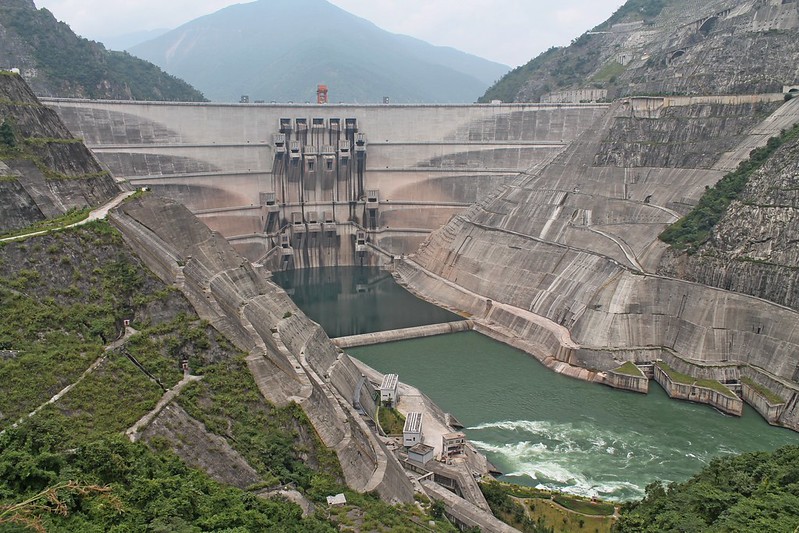
China’s Medog (墨脱) hydropower megaproject on the Yarlung Tsangpo (雅鲁藏布江) – located at one of the steepest gorges on Earth – has become one of the most geopolitically sensitive and ecologically alarming infrastructure projects in Asia. The dam, which Beijing promotes as a flagship contribution to its 2060 carbon-neutrality (碳中和) target, is expected to surpass even the Three Gorges Dam(三峡大坝)in power generation and strategic symbolism. Yet behind the carefully curated discourse about China’s climate leadership lies a multidimensional crisis in the making.
The Medog site sits in a region defined by volatile tectonics, rapid climate warming, glacial retreat, and fragile sediment structures. Recall the January 2025 earthquake on the Tibetan Plateau that caused massive damage to human life, ecology, and security. Combined with the political sensitivities surrounding Tibet and China’s upper-riparian status, the project raises a series of questions that cannot remain outside the purview of global climate governance, especially the United Nations Framework Convention on Climate Change (UNFCCC).
Two critical questions become unavoidable: can the UNFCCC maintain credibility if it overlooks the destabilizing ecological impacts unfolding on the Tibetan Plateau? And what happens when one country’s ‘green’ initiative directly compromises the climate resilience and water security of an entire region?
Interpreting China’s Internal Narrative
Understanding Medog requires examining how it is discussed within China’s domestic political and scientific spheres. State agencies, the National Development and Reform Commission (国家发展和改革委员会), the Ministry of Water Resources (水利部), and powerful state-owned energy corporations, present the dam as a logical extension of China’s historical expertise in water engineering. State media narratives emphasize national rejuvenation, infrastructural leadership, and the moral legitimacy of transitioning to renewable energy. Medog has been lauded as a key project, one that supports China’s ambitions for net-zero emissions and clean energy development.
However, beneath this confident exterior lie quieter debates within China’s scientific community. Hydrologists, environmental researchers, and geologists have expressed unease regarding the project’s feasibility and safety. Some studies published in domestic academic journals, though often constrained by political sensitivities, highlight the extreme seismic volatility of the Indo-Tsangpo Suture Zone (印‑藏缝合带). This region sits along the collision boundary of the Indian and Eurasian tectonic plates. Drilling vast tunnels through this terrain may disturb permafrost layers, trigger mass wasting events, or alter the course of subterranean water flows.
Adding further complexity is the tone of nationalistic rhetoric that often accompanies the Medog debate on platforms like Weibo and Bilibili. In these online spaces, the dam is framed less as an environmental project and more as a symbol of sovereignty. As noted in an earlier article, hydrological information related to the Yarlung Tsangpo has become a matter of national security, shrouded in secrecy. This securitization of hydropower, framing the Brahmaputra as a strategic asset rather than a shared natural resource, shifts Medog from a climate discussion to one that sits squarely in the realm of geopolitical leverage.
Fragile Himalayan Ecological Balance
Beijing characterizes Medog as a masterstroke of clean-energy expansion, a necessary investment to reduce coal dependency and to accelerate economic development in the Tibetan Autonomous Region. However, the ecological and geological reality contradicts this narrative. Tibet, often described as the “third pole” (第三极), is warming nearly twice as fast as the global average. Permafrost is collapsing, snowlines are retreating, and previously stable glacier systems are melting at unprecedented speeds.
In such a context, the construction of a mega-dam and extensive diversion tunnels through the Namcha Barwa massif (南迦巴瓦峰) is not simply an engineering undertaking. It is a high-risk intervention into a landscape already on the edge of climatic transformation. The Himalayan ecology itself may reach a breaking point. Dams alter water temperature, flow velocity, and riverine biodiversity. Sudden releases of water, especially in a geologically unstable region, can trigger glacial lake outburst floods (GLOFs). There are more than 150 potentially dangerous glacial lakes in the eastern Himalayas. A large dam in proximity to such a volatile system could act as a risk amplifier, setting off cascading environmental disasters across borders.
Threat of Regional Destabilization
A project of Medog’s scale has the potential to alter the hydrology of the Brahmaputra basin downstream, which is home to tens of millions in India and Bangladesh. As the Brahmaputra enters India through Arunachal Pradesh and flows into India’s Assam, it becomes the lifeblood of the region’s agriculture, fisheries, and daily water needs. Large dams trap sediments, reducing fertility downstream, accelerating erosion, and weakening embankments. If Medog were to trap even a fraction of the sediment that currently flows naturally, the agricultural systems of both India and Bangladesh could face long-term degradation. Bangladesh, already one of the most climate-vulnerable countries globally, faces a compounded risk. The Jamuna (雅穆纳河), as the Brahmaputra is known in Bangladesh, supports a major part of the national irrigation system. For a country grappling with rising sea levels, increased cyclone intensity, and population density, a destabilized Brahmaputra adds another layer of existential threat.
Political dynamics further complicate the picture. China provides limited hydrological data to India and Bangladesh, often only during monsoon months and occasionally with delays. In a region where climate variability is intensifying, such opacity makes planning nearly impossible. As argued earlier, water security is increasingly intertwined with broader geopolitical rivalries, raising fears of strategic weaponization of water during conflicts. The Medog Dam underscores China’s evolving “hydro-hegemony,” where control over shared water resources becomes a strategic tool for regional influence.
Why UNFCCC Must Confront the Medog Question
The UNFCCC’s longstanding silence on Tibet’s ecological crisis, and on projects like Medog, exposes a structural blind spot in global climate governance. The Tibetan Plateau is Asia’s hydrological engine. Its glaciers feed ten major rivers, influencing the lives of nearly two billion people across China, India, Nepal, Bhutan, Bangladesh, Myanmar, Thailand, Laos, Cambodia, and Vietnam. Yet it is rarely discussed in climate negotiations as a transboundary ecosystem requiring global oversight.
In addition to global warming, China’s ‘unprecedented development’ policies have hastened Tibet’s climate crisis. The situation on the Tibetan Plateau is akin to a global climate emergency, much like that being witnessed in the Arctic or by low-lying island states. A mega dam that destabilizes cryosphere systems, disrupts downstream hydrology, and threatens multi-country climate resilience cannot be categorized as a simple “renewable energy project.”
Looking Ahead
The principle of climate justice must extend to Himalayan and South Asian communities that bear the consequences of decisions made far upstream. Adaptation and loss-and-damage frameworks cannot ignore water-related vulnerabilities in the Brahmaputra basin. Indeed, the Medog project strengthens the argument for the UNFCCC to formally recognize Tibet as a critical climate zone whose stability is essential to continental resilience.
The UNFCCC must insist that China conduct transparent, independent environmental impact assessments; share real-time hydrological data; and participate in regional water-governance frameworks that include India and Bangladesh.
In the end, the Medog dam is not merely a Chinese domestic project but a bellwether for the integrity of the global climate system. If Tibet continues to be treated as an internal developmental frontier rather than a global ecological asset, the world risks overlooking one of the most important climate flashpoints of the 21st century.
Written by

Jagannath Panda
jppjagannath1Dr. Jagannath Panda is the Head of the Stockholm Center for South Asian and Indo-Pacific Affairs (SCSA-IPA) at the Institute for Security and Development Policy, Sweden, and a Senior Fellow at The Hague Center for Strategic Studies (HCSS) in The Netherlands. He recently attended the COP30 in Belem, Brazil, as an invited observer by the Global Institute for Water, Environment and Health (GIWEH), Geneva.