As the war in Ukraine continues, both Europe and China face growing incentives to diversify their trans-Eurasian connectivity. The Middle Corridor has therefore emerged as an increasingly attractive alternative to traditional routes. While some observers view this overlapping interest as grounds for cooperation, particularly at a time of mounting EU–China trade tension, such optimism risks overlooking significant strategic divergences. Shared operational interests do not equate to shared strategic visions. Indeed, China’s expanding footprint along the Middle Corridor places Europe in a complex dilemma over how deeply it should engage.
Shared Operational Interests
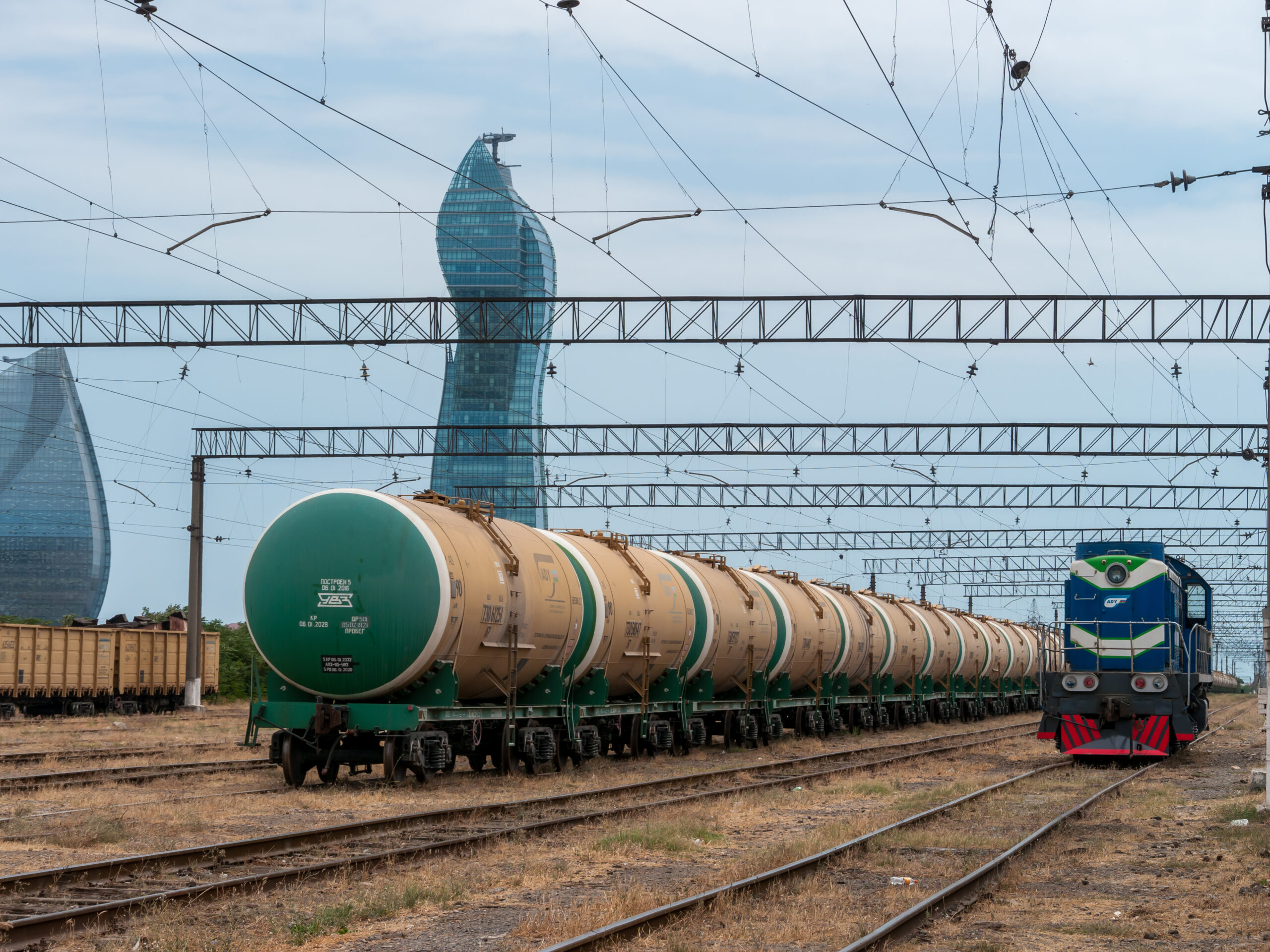
The Middle Corridor, also known as the Trans-Caspian International Transport Route (TITR), connects China to Europe through Kazakhstan, the Caspian Sea, Azerbaijan and Georgia, before reaching Turkey and onwards to European markets. Despite its formal launch in 2013 with significant political backing from Turkey, and several major infrastructure developments since then, the route received limited international attention for most of the time during its first decade.
Eurasian connectivity was traditionally conducted through Russia (the Northern Corridor), due to the lack of multiple border checks and crossings, as well as the comparatively volatile political situation in Central Asia. In addition, the EU has traditionally preferred to engage Russia, with over 85 percent of China-Europe trade passing through Russia before 2022. By contrast, the Middle Corridor suffers persistent operational obstacles. In 2022 the corridor handled only around 33,000 twenty-foot equivalent (TEU) containers and approximately 1.5 million tons of cargo, despite having a theoretical annual throughput capacity of about 5.8 million tons. Multimodal complexity remains a key issue as the route requires multiple border crossings, variable rail gauges, divergent customs and technical standards across Kazakhstan, Azerbaijan, Georgia and Turkey. Furthermore, maritime transits via the Caspian and Black Seas put additional financial and time costs: the cost to move a forty-foot equivalent unit (FEU) from China to Europe via the corridor is estimated at $2,500-3,250, while transit time can still reach up to 50 days.
On top of operational hurdles, political considerations added another layer of hesitation for China. With the increasing strategic and political alignment with Russia after 2014, China also favored the Northern Corridor and wanted to avoid a potential clash of influence with Russia over Central Asia and the Caucasus. One should also note that the Middle Corridor was once seen as a competing initiative by Turkey to Beijing’s Belt and Road Initiative. While Turkey sought to connect its Middle Corridor initiative with the BRI throughout the 2010s, China displayed limited engagement and strategic hesitation, when Beijing was even reportedly prepared to bypass the Middle Corridor in 2018.
A series of disruptions in the early 2020s dramatically altered this calculus. Following Russia’s full-scale invasion of Ukraine in 2022, the EU enacted multiple rounds of sanctions on Russia, with container traffic slashed by more than half on the Northern Corridor in 2023, rendering the route no longer a viable option for Europe. For China, the risk of being entangled in sanctions targeting Russia made the once-preferred route far less viable. Simultaneously, maritime trade faced its own shocks. The Suez Canal blockage in 2021 by the Ever Given and the Red Sea crisis from 2023 onwards have together exposed the vulnerability of global shipping.
These developments created converging incentives for Europe and China to explore alternatives, with both ending up looking to the Middle Corridor. The EU increased its presence in the region through its Global Gateway initiative, while China formally incorporated the TITR into the BRI in 2023. As a result, they have become the two most influential investors in the corridor’s infrastructure.
Diverging Strategic Visions
Although European and Chinese infrastructure projects can, in some cases, complement one another, this should not be mistaken for strategic alignment.
For Europe, the corridor is seen as a means to reinforce strategic autonomy in an increasingly volatile geopolitical environment. Key objectives include diversifying critical supply chains, reducing exposure to external economic or political coercion, and securing more reliable access to resource-rich regions across Central Asia and the South Caucasus, which are home to significant reserves of oil, natural gas and critical raw materials (CRMs). Given China’s dominant position across global CRM supply chains, the EU is actively seeking to broaden its sourcing and enhance resilience. Brussels has therefore prioritized CRM-related partnerships with Kazakhstan, Uzbekistan and other states in the region.
Meanwhile, China is not merely a passive observer in Central Asia’s CRM sector but an increasingly active partner. For example, in Uzbekistan a Chinese state‐owned miner secured agreements with the Ministry of Geology and Mining to undertake geological exploration, joint mining ventures and subsequent value-added production of critical minerals and high-value products. China has been estimated to have imported around 70% of all CRMs extracted in Central Asia in 2024, and Chinese firms currently manage 25 identified projects in the region, five times as that of the European firms. These partnerships reflect Beijing’s strategy to secure upstream extraction and integrate it into its downstream processing base, thereby consolidating its supply‐chain position in Central Asia even as European actors seek to diversify.
Beyond competition over resources and supply chain, tension also lies in the contrasting frameworks and visions through which the EU and China engage the region. The EU’s Global Gateway was conceived in part as a strategic counterweight to China’s BRI, offering an alternative model of connectivity that promotes democratic values and high standards, for instance good governance, transparency, and sustainability. These political and normative components are integral to the EU’s external action, yet they are fundamentally at odds with China’s position. Beijing consistently rejects the promotion of democratic standards as interference in the domestic affairs of developing countries and argues that such conditionality undermines the autonomy of partner states.
China instead frames its engagement along the Middle Corridor as part of its wider “South–South cooperation” narrative. This approach emphasizes solidarity among developing countries, state-led development, and the avoidance of political stipulations associated with what Beijing labels the “Global North”. Within this framework, China presents itself as a development partner offering infrastructure, finance, and connectivity without governance demands. These contrasting models of engagement create structural tensions and significantly constrain the potential for meaningful EU–China cooperation along the Middle Corridor.
Europe’s Dilemma
While China’s step up in the Middle Corridor has pushed Europe to catch up in order not to compromise its de-risking and strategic autonomy agenda, European engagement does not come without risks.
First, the EU may inadvertently enhance Turkey’s leverage over European connectivity. Relations between Brussels and Ankara remain strained because of concerns about democratic backsliding and human rights violation, which have also stalled Turkey’s EU accession for years. Moreover, Turkey has repeatedly used its control of strategic access points, including the Black Sea straits and key border crossings of migrants, to extract concessions from the EU. A Middle Corridor that relies heavily on Turkish transit could therefore expose Europe to new forms of geopolitical vulnerability.
A second concern is the geopolitical volatility of the regions through which the corridor passes. Unresolved issues between Armenia and Azerbaijan continue to be a potential source of instability in the South Caucasus despite their peace agreement. Russia retains significant influence despite its weakened geopolitical position, and its actions remain unpredictable. Relations between Turkey and Russia combine competition with selective cooperation, often in ways that destabilize surrounding regions. Georgia’s domestic political oscillations complicate its reliability as a partner. In Central Asia, Kazakhstan’s attempt to balance China, Russia, and Western partners illustrates the fragility of the strategic environment. Deepening involvement in these unstable environments could overstretch Europe’s constrained resources and, at worst, entangle the EU in regional conflicts it is currently unable to absorb.
Europe must therefore balance its strategic objectives, such as diversification of supply chains and internal market resilience, against the risks of political entanglement. Limited engagement would leave the corridor’s development largely in the hands of China and Turkey, while deeper involvement may expose Europe to regional rivalries and dependencies that undermine its broader foreign-policy goals.
The Bottom Line
Europe and China increasingly share an operational need for alternative Eurasian connectivity, and the Middle Corridor offers a viable, although imperfect, solution. Yet this convergence masks profound strategic differences. For Europe, the corridor serves as a tool for de-risking and reinforcing strategic autonomy. For China, it is an extension of its westward influence and part of a global narrative that challenges Western political norms. As China deepens its involvement, Europe faces a difficult balancing act. It must strengthen its presence in the region without allowing new dependencies or regional entanglements to develop. Achieving this balance will require sustained diplomatic engagement, careful risk mitigation and a clear articulation of Europe’s long-term strategic priorities across Eurasia.
Written by

Owen Au
Owen Au is an independent analyst specializing in China’s sea-power development and foreign policy.

Tin-Ching Leung
Tin-Ching Leung is a policy researcher specializing in EU-China relations, Chinese foreign policy, and economic statecraft. He has previously worked in the German Bundestag and the European Parliament.